

AI Safety Testing: Test Cases for High-Risk Applications
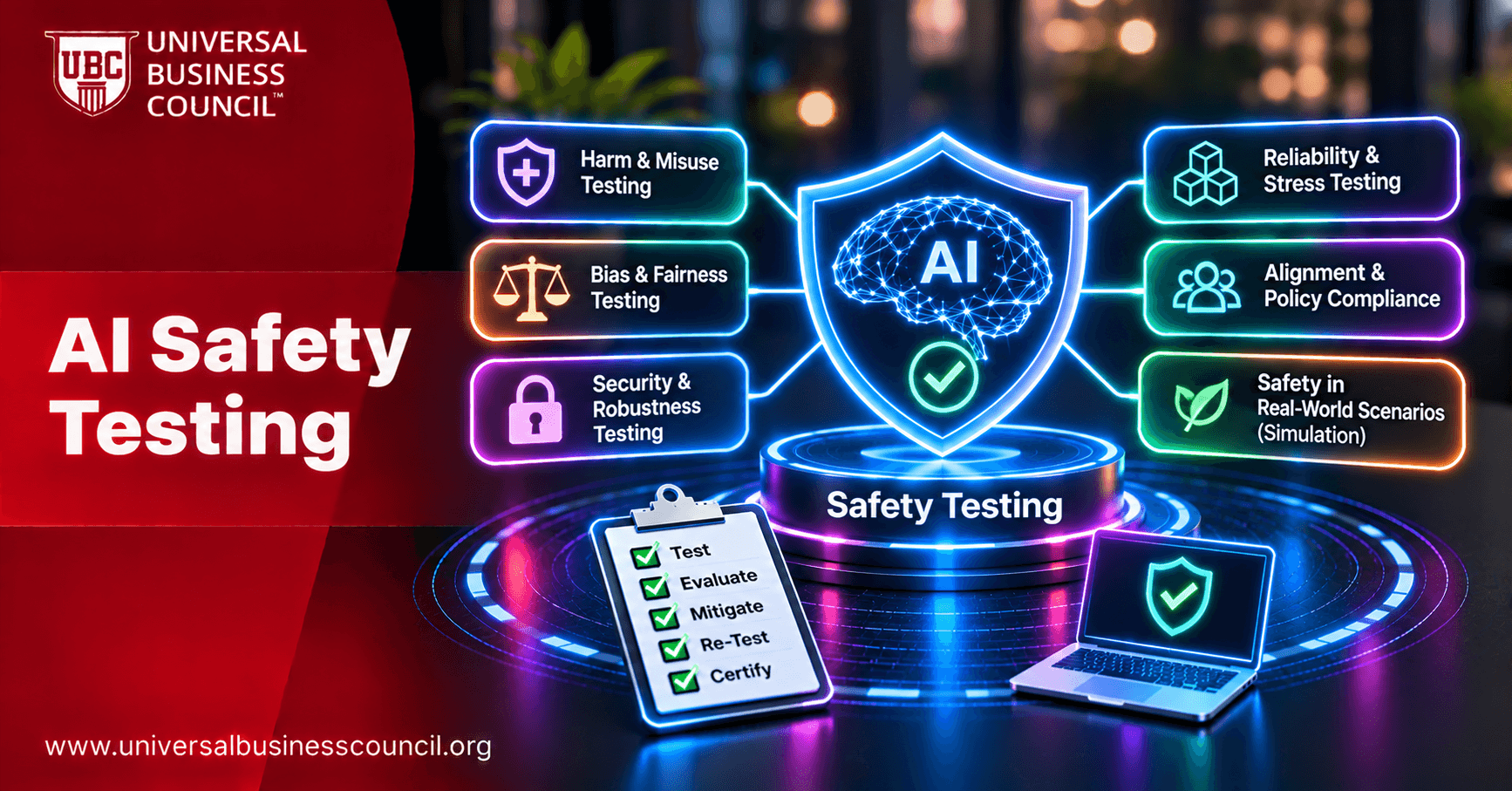
Passing a benchmark is not the same as being safe to deploy. High-risk AI applications, such as those used in healthcare, lending, hiring, transport and public services, need testing that goes beyond average accuracy and asks what could go wrong, for whom and how badly. A well-designed set of safety test cases is how teams find out before users do.
This guide explains what AI safety testing is, how to plan it and which test cases matter most for high-risk applications. Professionals who want wider training in responsible AI may also look at the Certified Responsible AI Expert certification from Universal Business Council.

What Is AI Safety Testing?
AI safety testing is the structured evaluation of an AI system to confirm it behaves reliably, avoids harmful outcomes and stays within defined limits across normal use, edge cases, misuse and attack. It combines quantitative measurement, scenario-based testing, adversarial probing and expert review.
It differs from ordinary software testing because AI behavior is probabilistic and depends on data. The same input can yield different outputs, performance can vary across groups and conditions and failures often appear only in unusual situations. For that reason, testing must be designed around risks, not only functions.
Regulation reinforces the need. The EU AI Act expects high-risk systems to meet requirements for accuracy, robustness and cybersecurity and to maintain risk management throughout the lifecycle, and frameworks such as the NIST AI Risk Management Framework and ISO/IEC 42001 call for measurement and ongoing evaluation.
How to Plan Safety Testing
Start with the system's intended use, users and potential harms. Classify its risk level, then build a test plan that traces each identified risk to specific test cases, pass criteria and owners. Decide what must be tested before launch, what is monitored afterward and what triggers retesting, such as a new model version or data change.
Plan Elements
Scope and context: intended use, out-of-scope use and operating environment
Risk register link: each test tied to a named risk
Acceptance thresholds: minimum performance, maximum error rates and zero-tolerance conditions
Test data: representative, independent of training data and including rare cases
Roles: independent testers where possible, with domain experts involved
Evidence: logs, reports and sign-off kept for audit
Core Test Case Categories for High-Risk Applications
1. Accuracy and Reliability Tests
Measure performance on realistic data and on the cases where errors cost the most. Check false positives and false negatives separately, since their consequences differ. For a medical triage tool, missing a serious condition may be far worse than a false alarm, so thresholds should reflect that. Include confidence calibration tests to see whether stated confidence matches reality.
2. Robustness and Edge-Case Tests
Noisy, incomplete or out-of-range inputs
Rare conditions and long-tail scenarios
Distribution shift, such as new populations, devices or seasons
Formatting changes, typos and unusual phrasing for language systems
Degraded sensors, poor lighting or connectivity loss for physical systems
3. Fairness and Bias Tests
Compare performance and outcomes across relevant groups and intersections, such as age, gender, language, region and disability, where lawful and appropriate. Look at error rates, approval rates and calibration, and test for proxy variables that stand in for protected characteristics. Report results by subgroup, not only overall.
4. Security and Adversarial Tests
Test for adversarial inputs, data poisoning exposure, prompt injection, jailbreaks, model extraction attempts and data leakage. Include red-team exercises that simulate a motivated attacker with realistic access.
5. Harmful Output and Misuse Tests
For generative systems, probe for hallucinated facts, unsafe advice, toxic or discriminatory content, privacy leaks and policy violations. Use scenario libraries that reflect your domain, such as dangerous medication guidance or misleading financial recommendations.
6. Human Oversight and Fallback Tests
Check that people can understand, question and override the system. Test escalation paths, alerts, kill switches and fallback procedures when the AI is unavailable or uncertain. Verify that reviewers have the information and time to make meaningful decisions, not rubber-stamp ones.
7. Explainability and Transparency Tests
Confirm that explanations are accurate, understandable to the intended audience and consistent with how the model really works. Test that required notices and disclosures appear correctly.
8. Privacy Tests
Test for memorization, membership inference exposure, personal data in outputs and compliance with retention and deletion rules.
Example Test Cases by Domain
Concrete cases make the categories real. A few illustrations:
Healthcare triage: patients with atypical symptom presentations; missing lab values; non-native language descriptions of symptoms
Credit scoring: applicants with thin credit files; similar profiles differing only by a proxy such as postal area; sudden income changes
Hiring tools: resumes with career gaps, non-traditional education or different name formats; identical qualifications in different phrasing
Autonomous or assisted driving: unusual weather, faded road markings, unexpected pedestrians, sensor failure
Customer-facing chatbots: attempts to extract confidential data, requests for harmful advice, emotionally distressed users, injected instructions in uploaded documents
Running and Documenting the Tests
Automate repeatable tests and run them in the delivery pipeline, so each new model version is checked before release. Keep manual and expert-led tests for complex or contextual risks. Record results, failures, fixes and residual risk, and link them to the model card and risk register. Require sign-off from the system owner and, for high-risk systems, an independent reviewer or governance committee before launch.
After deployment, keep testing. Monitor live performance, fairness metrics, incidents and user feedback, and rerun relevant tests after any significant change. Testing staff need technical skill and domain knowledge, and short tech certifications can help build the coding and data foundations. When hiring independent testers or auditors, organizations often verify credentials, and HireValid can support that process.
Common Mistakes
Testing only on data similar to training data
Reporting a single overall accuracy figure
Letting the building team be the only tester
Skipping retesting after model or data changes
Having no defined pass or fail thresholds
When test outcomes are shared with customers or regulators, accuracy matters. A Digital Marketing Course can help communications teams describe safety practices truthfully. Teams should also follow wider technology trends, and Deep Tech Certifications offer useful background on emerging fields.
Conclusion
Effective AI safety testing is risk-driven, covers accuracy, robustness, fairness, security, harmful output, oversight, explainability and privacy and continues after launch. Define thresholds, use realistic and independent test data, document everything and retest on change. The FAQs below answer common questions.
Frequently Asked Questions
What is AI safety testing?
Structured evaluation to confirm an AI system behaves reliably and avoids harm.
What counts as a high-risk AI application?
Systems affecting health, safety, rights or access to essential services, such as medical, lending or hiring tools.
How is it different from normal software testing?
AI is probabilistic and data-dependent, so risks vary by input and population.
What should a test plan include?
Scope, risk links, thresholds, test data, roles and evidence requirements.
Why test false positives and negatives separately?
Their consequences can differ greatly in high-risk settings.
What is a robustness test?
A test of performance under noisy, unusual or shifted conditions.
How do you test for bias?
Compare error rates and outcomes across groups and check for proxy variables.
What is red teaming?
Adversarial testing that simulates attackers or misuse to find weaknesses.
What are harmful output tests?
Probes for hallucinations, unsafe advice, toxic content and policy violations.
What is a fallback test?
A test of what happens when the AI fails, is unavailable or is uncertain.
Should testers be independent?
Where possible, yes, to reduce blind spots.
What is confidence calibration?
Whether a model's stated confidence matches its real accuracy.
Why use data separate from training data?
It reveals how the model performs on new cases.
How often should testing happen?
Before launch, after any major change and continuously through monitoring.
What is a pass threshold?
A predefined result a system must meet to be approved.
What does the EU AI Act expect?
Accuracy, robustness, cybersecurity and risk management for high-risk systems.
What documents should record test results?
Test reports, model cards and the risk register.
Can testing be automated?
Many tests can run in pipelines, while complex risks need expert-led testing.
What triggers retesting?
A new model version, data change, new use case or incident.
What are common testing mistakes?
Overall-only metrics, no thresholds, builder-only testing and no retesting.
Related Articles
View All
Artificial Intelligence
Responsible AI in Autonomous Vehicles: Safety, Testing and Accountability
Explore how responsible AI supports the safe development and deployment of autonomous vehicles. Learn about AI testing, risk assessment, decision-making, human oversight, and accountability measures that help reduce safety risks and build public trust in self-driving technology.
Artificial Intelligence
AI Evaluation Frameworks: How to Test Reliability and Safety
Explore AI evaluation frameworks and how organizations can test the reliability, safety, and performance of AI systems. Learn about key evaluation methods, testing criteria, risk assessments, and best practices for identifying weaknesses, measuring model behaviour, and supporting responsible AI deployment.

Artificial Intelligence
AI Model Validation Audit: Testing Performance and Reliability
Understand how an AI model validation audit evaluates whether machine learning models perform as expected and meet defined requirements before and after deployment. Explore key validation methods, performance metrics, testing procedures, documentation, and ways to identify weaknesses that could affect model accuracy, reliability, and fairness.
Trending Articles
The Role of Blockchain in Ethical AI Development
How blockchain technology is being used to promote transparency and accountability in artificial intelligence systems.
AWS Career Roadmap
A step-by-step guide to building a successful career in Amazon Web Services cloud computing.
Top 5 DeFi Platforms
Explore the leading decentralized finance platforms and what makes each one unique in the evolving DeFi landscape.