

AI Security vs AI Safety: Key Differences and Best Practices
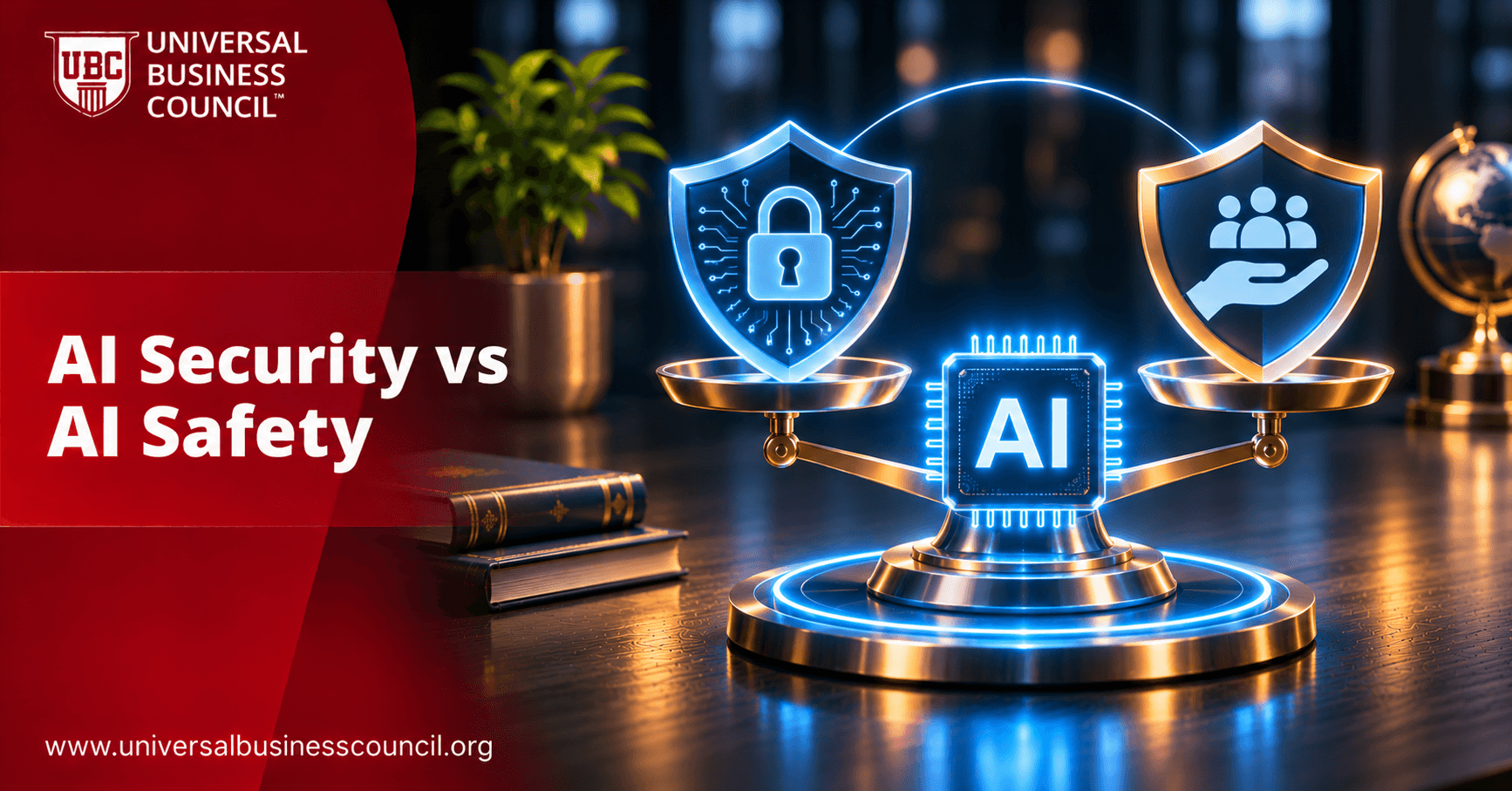
The words security and safety are often used interchangeably in AI conversations, but they describe two different problems. One asks how to stop people from attacking an AI system. The other asks how to stop an AI system from causing harm, even when nobody is attacking it. Mixing them up leads to gaps in protection.
This guide explains the differences between AI security and AI safety, where they overlap, the main risks in each and the practices organizations should follow. For readers who want structured training in responsible AI, the Certified Responsible AI Expert certification from Universal Business Council covers related topics.

What Is AI Security?
AI security is the protection of AI systems, models, data and infrastructure from malicious actors and misuse. It treats AI as an asset to defend, and its core goals mirror classic information security: confidentiality, integrity and availability. In AI, that includes stopping theft of models, tampering with training data, manipulation of inputs and unauthorized access to sensitive information.
Typical AI security threats include adversarial examples that fool models, data poisoning, model extraction and theft, prompt injection against language models, privacy attacks such as membership inference and compromised supply chain components. The question security teams ask is: who could attack this system, and how do we stop them?
What Is AI Safety?
AI safety focuses on ensuring AI systems behave as intended and do not cause unintended harm to people, organizations or society. The harm may come from design flaws, poor data, misaligned objectives, unexpected behavior or misuse. Nobody needs to be attacking the system for a safety failure to happen.
Safety topics include reliability and robustness, bias and discrimination, hallucination and misinformation, harmful content, unsafe recommendations in high-stakes settings, loss of human control in autonomous systems and alignment of model behavior with human values and goals. The question safety teams ask is: what could this system do wrong, even when used as designed, and how do we prevent harm?
Key Differences at a Glance
Source of harm: security deals with deliberate adversaries, while safety deals with unintended failures, though misuse can fall in between
Object of protection: security protects the system and its assets, while safety protects people and the environment from the system
Typical methods: security uses threat modeling, access control, encryption and penetration testing, while safety uses evaluation, alignment, human oversight and guardrails
Typical owners: security often sits with CISO teams, while safety is shared among AI, product, risk and ethics teams
Success measure: security looks at resistance to attack, while safety looks at harm avoided and behavior within bounds
Where They Overlap
The two disciplines are intertwined. A prompt injection attack is a security issue, but its result may be a safety problem if the model then produces harmful instructions or takes dangerous actions. A poisoned dataset is a security breach that creates unsafe, biased outputs. Jailbreaks, which bypass safety training, sit squarely in both camps. Robustness to unusual inputs supports both goals at once.
Because of these links, siloed teams create blind spots. A security team may harden infrastructure without checking harmful outputs, while a safety team may test behavior but never simulate an attacker. Joint ownership, shared threat models and combined testing close the gap.
Frameworks That Address Both
Several references help structure the work. The NIST AI Risk Management Framework describes trustworthy AI as safe, secure and resilient, among other traits. The OWASP Top 10 for LLM Applications lists common security risks such as prompt injection and insecure output handling. MITRE ATLAS catalogs adversarial tactics against AI systems. ISO/IEC 42001 provides a management system covering both, and the EU AI Act requires accuracy, robustness and cybersecurity for high-risk systems.
Best Practices for AI Security
Threat-model AI systems: map assets, entry points, attackers and abuse cases, including training data and prompts
Secure the data and model supply chain: verify sources, scan dependencies and control who can change datasets and models
Control access: apply least privilege to models, APIs, vector databases and tools that agents can use
Defend against known attacks: use input validation, rate limiting, adversarial testing and output filtering
Monitor and log: detect unusual queries, extraction attempts and data exfiltration
Test continuously: run red-team exercises and security reviews before and after release
Prepare incident response: include AI-specific scenarios in playbooks
Security work depends on technical depth, and teams that build AI defenses need strong coding and systems knowledge. Short tech certifications can help staff build that foundation.
Best Practices for AI Safety
Design and Evaluation
Define intended use and out-of-scope use, then evaluate for accuracy, bias, hallucination, harmful content and edge cases before launch. Include subgroup testing and domain expert review for high-stakes uses such as healthcare, lending or hiring.
Controls in Operation
Add guardrails that filter or block harmful inputs and outputs
Keep humans in the loop for consequential decisions
Limit autonomy of AI agents and require approval for risky actions
Monitor performance, drift and user complaints after launch
Provide clear user disclosures and ways to report problems
Governance
Assign accountable owners, set risk tiers, require sign-off before deployment and document decisions in model cards. Both security and safety roles need credible, qualified people, and many organizations verify credentials and experience during hiring. HireValid can help with that screening.
Building One Combined Program
Start with a single inventory of AI systems and one risk register that lists both security and safety risks. Run joint threat modeling sessions with security, data science, product, legal and risk teams. Share findings from red-teaming, since an attack path discovered by security may reveal a safety flaw and vice versa. Report combined metrics to leadership, such as incidents, test coverage, open high-severity issues and time to remediate.
Customer-facing teams also need accurate language about protections. A Digital Marketing Course can help communications staff describe AI safeguards without overpromising. Because threats evolve alongside new technologies, it also helps to follow related fields, and Deep Tech Certifications provide useful background on security-adjacent technologies.
Conclusion
AI security defends systems against attackers, while AI safety protects people from harmful system behavior. They overlap in areas such as prompt injection, poisoning and jailbreaks, so treat them as two lenses on one program. Threat-model, test, monitor and govern both together. The FAQs below answer common questions.
Frequently Asked Questions
What is AI security?
Protecting AI systems, models and data from malicious attacks and misuse.
What is AI safety?
Ensuring AI behaves as intended and does not cause unintended harm.
How are they different?
Security addresses adversaries, while safety addresses harmful behavior, including accidental failures.
Do they overlap?
Yes, issues such as prompt injection, data poisoning and jailbreaks affect both.
What is an example of an AI security threat?
Data poisoning, model theft or prompt injection.
What is an example of an AI safety risk?
Biased decisions, hallucinations or harmful content.
Who owns AI security?
Typically security teams, working with data science and engineering.
Who owns AI safety?
Shared among AI, product, risk, legal and ethics teams.
What is a jailbreak?
An attempt to bypass a model's safety controls.
What is prompt injection?
Malicious input that manipulates a language model's instructions.
What is adversarial machine learning?
Techniques that manipulate or attack machine learning systems.
What is red teaming?
Structured adversarial testing to find weaknesses in a system.
What is OWASP Top 10 for LLMs?
A list of common security risks in large language model applications.
What is MITRE ATLAS?
A knowledge base of adversary tactics against AI systems.
What are AI guardrails?
Controls that filter or constrain model inputs and outputs.
Does the EU AI Act address security?
Yes, high-risk systems need accuracy, robustness and cybersecurity.
Why combine security and safety efforts?
Siloed teams miss risks that cross both areas.
How do you test for safety?
With evaluations for accuracy, bias, hallucination and harmful outputs, plus expert review.
How do you test for security?
With threat modeling, penetration testing and adversarial attacks.
Is human oversight a security or safety control?
Mainly a safety control, though it also helps catch misuse.
What should be in an AI incident plan?
Both attack scenarios and harmful-behavior scenarios, with clear owners and timelines.
Related Articles
View All
Artificial Intelligence
Responsible AI Audit: Principles, Controls and Best Practices
Discover what a responsible AI audit involves and how organizations evaluate AI systems against principles of fairness, transparency, accountability, safety, and privacy. Learn about the audit process, key assessment areas, and how regular reviews help identify risks and strengthen responsible AI practices.

Artificial Intelligence
AI Audit vs AI Assessment vs AI Risk Assessment: Key Differences
Understand the differences between an AI audit, AI assessment, and AI risk assessment. Explore their purposes, processes, scope, and outcomes to learn when organizations should use each approach to evaluate AI systems, identify risks, and strengthen governance.

Artificial Intelligence
Data Privacy in Artificial Intelligence: Risks, Controls and Best Practices
Explore the key data privacy risks associated with artificial intelligence and how organizations can address them. Learn about sensitive data exposure, unauthorized access, consent, data protection controls, and best practices for safeguarding personal information throughout the AI lifecycle.
Trending Articles
The Role of Blockchain in Ethical AI Development
How blockchain technology is being used to promote transparency and accountability in artificial intelligence systems.
AWS Career Roadmap
A step-by-step guide to building a successful career in Amazon Web Services cloud computing.
Top 5 DeFi Platforms
Explore the leading decentralized finance platforms and what makes each one unique in the evolving DeFi landscape.