

Red-Teaming AI Agents: Methods, Scenarios and Safety Checks
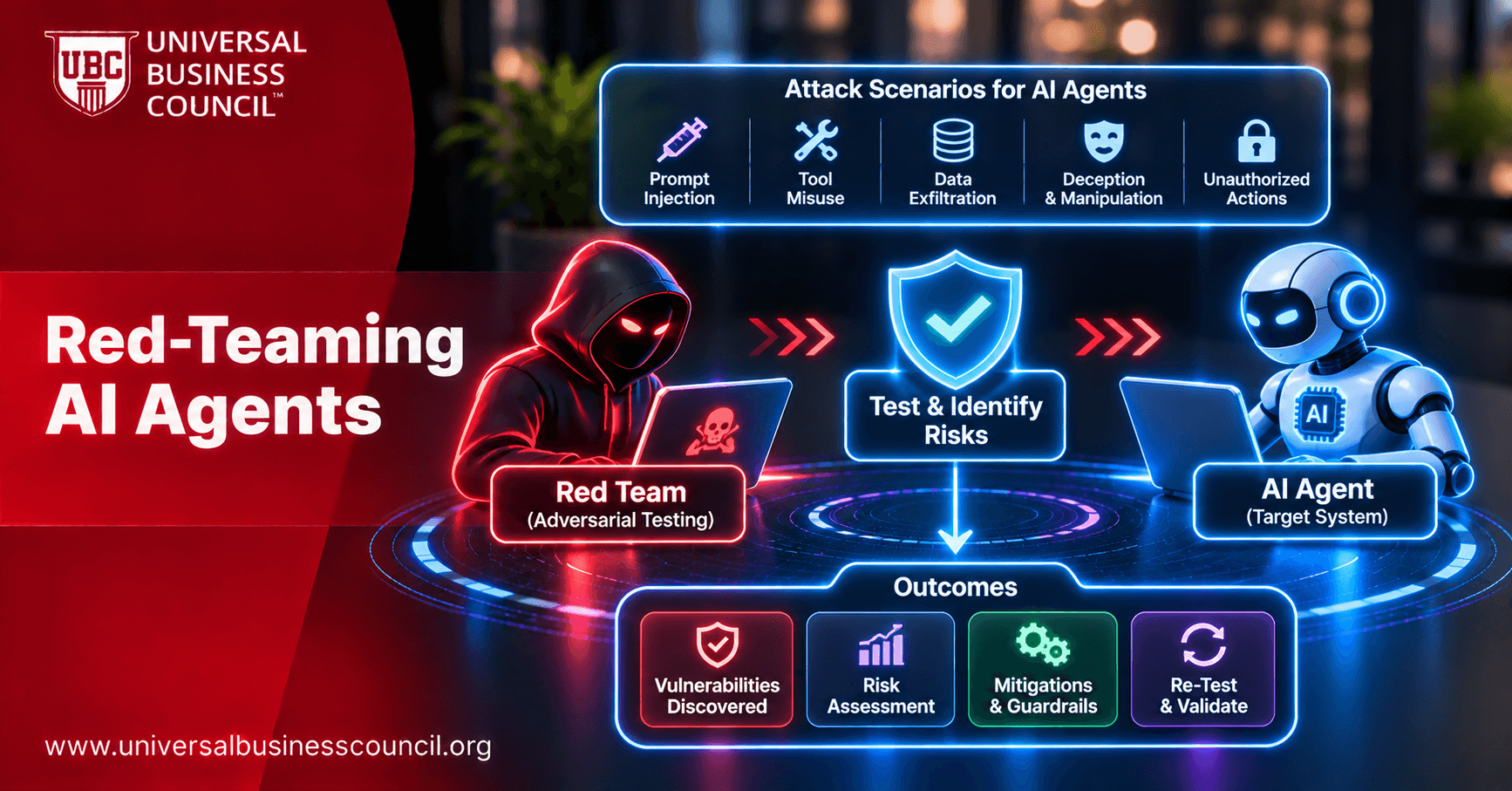
Red teaming a chatbot tests what it says. Red teaming an AI agent tests what it does. That shift matters, because agents plan, call tools, read untrusted content and take actions in real systems, so a single weakness can turn a bad answer into a bad transaction. This guide explains how red teaming works for AI agents, which methods and scenarios to use and which safety checks to build into the exercise and the product. For professional training in the field, see the certified responsible AI expert certification. This is general information, not legal advice.
What is red-teaming for AI agents?
Red teaming AI agents is a structured exercise in which testers deliberately try to make an agent misbehave: exceed its permissions, follow hostile instructions, leak data, take harmful actions or fail in unsafe ways. The aim is to find weaknesses in the model, the instructions, the tools, the permissions and the human oversight before real users or attackers do.

It differs from testing a standalone model because the attack surface is larger. The agent's tools, memory, data sources and the other agents it talks to all become targets.
Why agents need special attention
Several features raise the stakes.
Agents act, so errors can have real-world effects
They read emails, web pages and documents that may contain hidden instructions
They chain steps, so small mistakes compound
They hold credentials and access to internal systems
They may coordinate with other agents, which complicates accountability
Planning the exercise
Good red teams start with scope and rules.
Define scope and goals
State which agents, tools, data and environments are in scope, what harms matter most and which actions are off limits during testing. Use a sandbox with test data wherever possible, and get approval from security, privacy and legal teams before beginning.
Build a mixed team
Combine security testers, engineers who understand the agent's architecture and domain experts who know what harm looks like in your business. Engineers who build such tests benefit from sound technical grounding, which many develop through tech certifications.
Methods
Use several methods, because each finds different problems.
Manual adversarial testing
Skilled testers craft inputs, documents and conversations designed to manipulate the agent. Human creativity finds subtle exploits that automated tools miss.
Automated and scaled testing
Scripts and test generators run large numbers of variations, catch regressions after changes and test consistency. Some teams use other models to generate attacks, which should be validated by human review.
Scenario-based walkthroughs
Testers play out realistic workflows from start to finish, looking for places where a plausible request leads to an unsafe action. This often reveals problems in handoffs between steps or systems.
Test the whole system
Include the tools, permissions, logging, approvals and fallback processes, not just the model. Many serious failures come from over-broad access or missing approval steps rather than from the model alone.
Scenarios to test
Build a library of scenarios and expand it over time.
Indirect prompt injection
Hide instructions in content the agent will read, such as a web page, email, calendar invite or shared document, and see whether it follows them. Check whether it treats external content as data or as commands.
Permission and privilege abuse
Try to get the agent to use tools or data beyond the user's rights, to act on behalf of the wrong person or to escalate its own access. Test whether limits are enforced by the system and not merely by instructions.
Data leakage
Attempt to extract confidential data, system instructions, credentials or other users' information through conversation, tool output or memory.
Harmful or irreversible actions
Test requests that could lead to deleting records, sending messages, moving money or changing settings, and see whether approval steps trigger. Check how the agent handles ambiguous or conflicting instructions.
Goal drift and runaway behavior
Look for loops, excessive tool use, cost spikes and pursuit of a goal in ways the designer never intended. Test whether the agent stops when it should.
Multi-agent and memory risks
Test whether one agent can mislead another, whether poisoned memory persists across sessions and whether responsibility can be traced across the chain.
Safety checks to build in
Red teaming is most valuable when findings become controls.
Technical safeguards
Apply least privilege, short-lived credentials, input and output filtering, rate and spending limits, sandboxed execution and hard limits enforced outside the model. Require human approval for sensitive or irreversible actions.
Monitoring and kill switches
Log goals, plans, tool calls and approvals, alert on unusual behavior and make it easy to pause an agent. Secure, tamper-evident logs support investigations, and related ideas appear in deep tech certifications.
Rate findings and retest
Rate each finding by severity and likelihood, assign owners and deadlines, fix, then retest. Where a risk cannot be removed, record a decision to restrict, add controls or accept it knowingly.
Governance, people and communication
Red teaming results should feed accountability.
Roles and evidence
Name an owner for each agent and for the red team program, and keep scope documents, test logs, findings and fixes on file. Verify that testers and approvers hold the credentials they claim, using services such as HireValid for hiring and contractor checks, especially for external testers who access your systems.
Honest claims
Say what testing you have done, and do not claim an agent is "safe" or "unhackable." A digital marketing course can help teams describe safeguards accurately.
Conclusion
Red teaming AI agents tests actions as well as outputs. Plan scope and rules carefully, combine manual, automated and scenario-based methods and test the whole system, including tools, permissions and approvals. Cover prompt injection, privilege abuse, data leakage, harmful actions, runaway behavior and multi-agent risks. Turn findings into safeguards, retest and keep clear records so that you can show how risks were found and handled.
Frequently asked questions
These are the questions teams ask most about red teaming agents.
1. What is an AI agent?
A system that plans steps and uses tools to act toward a goal.
2. How is agent red teaming different from chatbot testing?
It tests actions, tools and permissions, not just text output.
3. Why are agents riskier?
They can act on mistakes and be redirected by hostile content.
4. What is indirect prompt injection?
Hidden instructions in content the agent reads that try to redirect it.
5. Where should testing happen?
In a sandbox with test data wherever possible.
6. Who should be on the team?
Security testers, engineers and domain experts.
7. Can automation replace manual testing?
No. Use both for coverage and creativity.
8. What is least privilege?
Giving an agent only the access its task requires.
9. How do we test permission abuse?
Try to make the agent act beyond the user's rights.
10. What is goal drift?
The agent pursuing its goal in unintended ways.
11. What are runaway loops?
Repeated actions that waste resources or cause harm.
12. Should human approval be required?
For sensitive or irreversible actions, yes.
13. How do we test multi-agent systems?
Check whether agents can mislead each other and whether actions can be traced.
14. What is a kill switch?
A way to pause or stop an agent quickly.
15. What should be logged?
Goals, plans, tool calls, approvals and errors.
16. How do we rate findings?
By severity and likelihood, with owners and deadlines.
17. What if a risk cannot be fixed?
Restrict the use, add controls or knowingly accept it with documentation.
18. Should external testers be used?
For higher-risk agents, yes, under clear rules and access limits.
19. How often should we red team?
Before launch, after major changes and on a schedule.
20. What evidence should we keep?
Scope, test logs, findings, fixes and retest results.
Related Articles
View All
Artificial Intelligence
AI Performance Audit: Accuracy, Robustness and Reliability Checks
Explore how an AI performance audit evaluates the accuracy, robustness, and reliability of AI systems under different conditions. Learn which performance metrics, testing methods, and validation techniques auditors use to identify weaknesses, assess model behavior, and determine whether AI systems meet their intended performance requirements.

Artificial Intelligence
AI Bias Audit: Methods for Detecting Unfair Outcomes
Learn how an AI bias audit identifies unfair outcomes in AI systems and evaluates whether models treat different groups equitably. Explore common bias detection methods, fairness metrics, testing approaches, and ways to address discriminatory patterns in AI-driven decisions.

Artificial Intelligence
How Do AI Agents Work?
Discover how AI agents work, from understanding goals and processing information to planning actions and using tools. Explore the key components of AI agents, their decision-making process, and how they complete tasks with varying levels of autonomy.
Trending Articles
The Role of Blockchain in Ethical AI Development
How blockchain technology is being used to promote transparency and accountability in artificial intelligence systems.
AWS Career Roadmap
A step-by-step guide to building a successful career in Amazon Web Services cloud computing.
Top 5 DeFi Platforms
Explore the leading decentralized finance platforms and what makes each one unique in the evolving DeFi landscape.