

Responsible AI Design Patterns for Product Teams
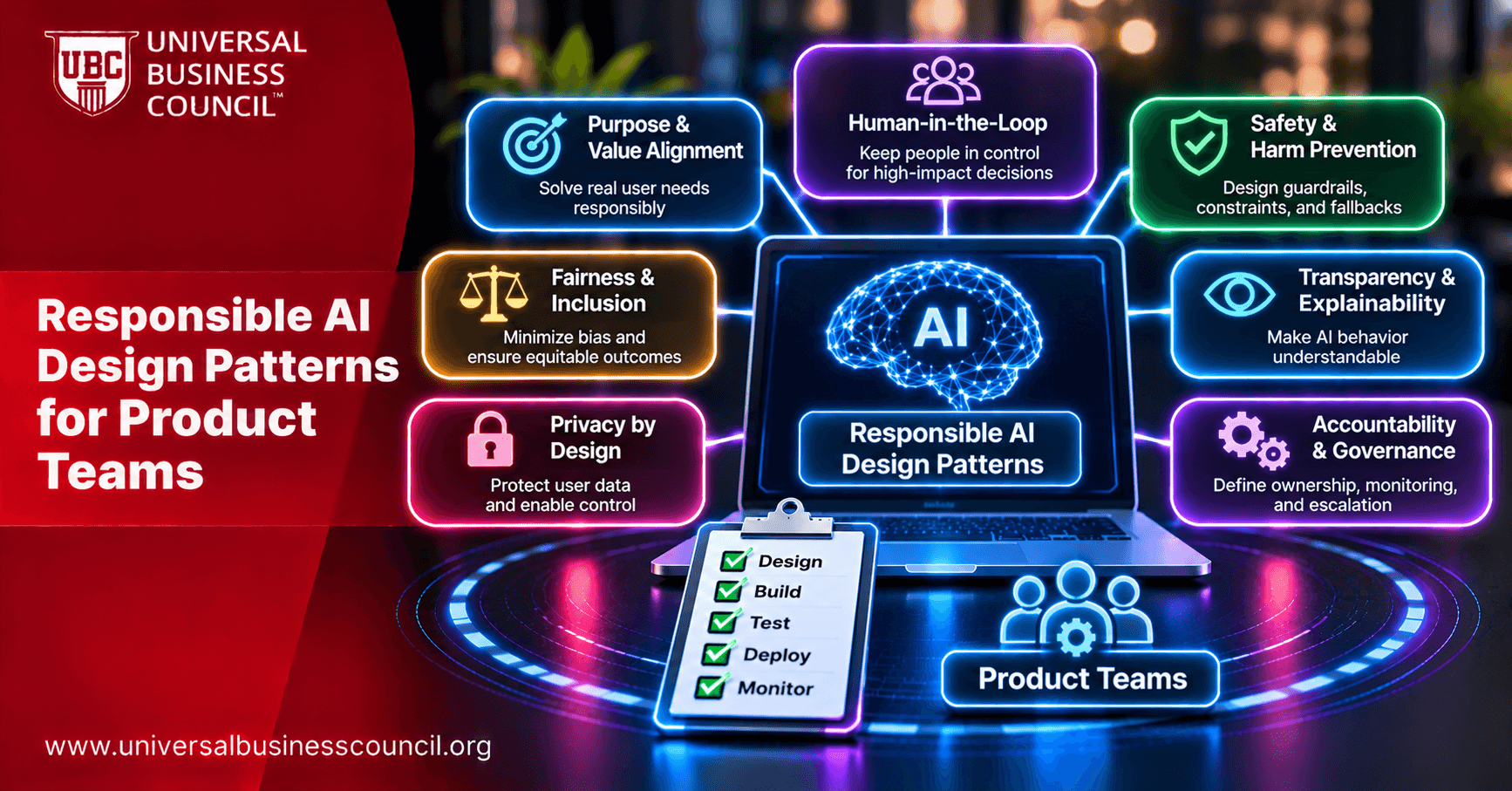
Product teams make dozens of small decisions that decide whether an AI feature earns trust or loses it: what the interface says, when a human steps in, what happens when the model is unsure. Responsible AI design patterns are reusable answers to those recurring decisions, so that good practice becomes the default and not an afterthought.
This guide introduces the most useful responsible AI design patterns for product teams, explains when to apply each and shows how to build them into product workflows. For readers seeking structured learning on the subject, the Certified Responsible AI Expert certification from Universal Business Council is a helpful companion.

What Are Responsible AI Design Patterns?
A design pattern is a proven, reusable solution to a common problem in a given context. In responsible AI, patterns address recurring challenges such as communicating uncertainty, keeping humans in control, protecting privacy, preventing harmful output and handling errors gracefully. They combine interface design, system architecture and process.
Patterns matter because principles like fairness and transparency are too abstract to guide a sprint. A pattern turns a principle into something a designer, engineer or product manager can implement, test and review. Teams can also share patterns in a library, which speeds up delivery and keeps products consistent.
Patterns for Transparency and Trust
Clear AI Disclosure
Tell users when they are interacting with AI or when content is AI-generated, in plain language and at the right moment. Avoid dark patterns that make AI feel like a human agent. Transparency obligations in laws such as the EU AI Act make this pattern more than a courtesy for many products.
Explain the Why
Give meaningful explanations for important outputs: key factors, sources or reasoning at a level users can understand. Use progressive disclosure, a short explanation by default and more detail on request. Explanations must reflect how the system works, since misleading ones damage trust.
Show Uncertainty and Limits
Display confidence or caution cues where they help decisions
State what the system cannot do or is not designed for
Cite sources for generated answers when possible so users can verify
Flag when information may be out of date
Patterns for Human Control
Human-in-the-Loop Review
For consequential decisions, route AI recommendations to a trained person who can accept, edit or reject them. Design the review screen to give reviewers the evidence, time and authority needed, and avoid layouts that nudge them toward automatic approval.
Confirm Before Acting
When an AI agent can take actions such as sending messages, spending money or deleting data, show a clear preview and require approval for sensitive steps. This reduces the harm from errors and from malicious manipulation such as prompt injection.
Easy Override, Undo and Appeal
Let users correct the AI, reverse actions and contest decisions. Provide a visible path to a human, and make sure the appeal actually reaches someone able to change the outcome.
Patterns for Safety and Reliability
Graceful Degradation and Fallbacks
Decide what the product does when the model is unsure, unavailable or out of its depth. Options include asking a clarifying question, offering a simpler non-AI path, handing off to a human or declining to answer. A confident wrong answer is usually worse than a transparent refusal.
Guardrails
Apply input and output filters, topic limits and policy checks to reduce harmful, off-topic or unsafe responses. Combine them with testing, since guardrails alone are not complete protection.
Staged Rollout
Internal testing and red teaming
Limited beta with monitoring
Gradual expansion with thresholds and rollback options
Continuous monitoring after general release
Patterns for Privacy, Fairness and Inclusion
Privacy by Design
Collect only what is needed, give users clear choices about data use and training, and keep sensitive data out of prompts and logs unless essential. Offer simple controls to view, export or delete data, and consider techniques such as on-device processing or anonymization.
Fairness Checks Built In
Include subgroup testing in release criteria, monitor outcomes after launch and give users ways to report unfair behavior. Design for diverse users from the start, including different languages, abilities, devices and contexts.
Accessible and Inclusive Interaction
Support screen readers, plain language, multiple input modes and adjustable settings. Test with real users from varied backgrounds, not only the people who built the product.
Patterns for Feedback and Learning
Make it easy to flag bad output, with a one-click report and optional comment. Route feedback to owners, review it regularly and use it to improve prompts, data and rules. Log key events within privacy limits so incidents can be investigated, and publish release notes when behavior changes in ways users may notice.
Building Patterns into the Product Process
Patterns only help when teams use them. Create a shared library with descriptions, examples, test criteria and ownership, and reference it in product requirement templates and design reviews. Add a short responsible AI checklist to the definition of ready and the definition of done, and tie high-risk features to a governance review.
Capability matters as well. Designers, product managers and engineers all need basic AI literacy, and short tech certifications can help build technical understanding. When hiring for responsible AI product or design roles, many companies verify qualifications and experience, and HireValid can support that process.
Common Pitfalls
Treating disclosure as a footnote nobody reads
Using AI confidence displays that are not calibrated
Designing review steps that encourage rubber-stamping
Skipping fallbacks for low-confidence cases
Applying patterns once and never updating them
Honest product messaging is part of the pattern set. A Digital Marketing Course can help teams describe AI features without overpromising. Product teams should also keep an eye on adjacent technologies, and Deep Tech Certifications provide helpful background on emerging fields.
Conclusion
Responsible AI design patterns turn principles into practical, repeatable product decisions. Use patterns for transparency, human control, safety, privacy, fairness and feedback, keep them in a shared library and embed them in product workflows. The FAQs below answer common questions.
Frequently Asked Questions
What is a responsible AI design pattern?
A reusable solution to a recurring responsible AI challenge in product design.
Why do product teams need them?
They turn abstract principles into concrete, testable decisions.
What is AI disclosure?
Telling users when they interact with AI or see AI-generated content.
What does explain the why mean?
Giving understandable reasons for important AI outputs.
How should uncertainty be shown?
With calibrated confidence cues, source links and clear limits.
What is human-in-the-loop?
A design where people review and can override AI decisions.
What is confirm before acting?
Requiring user approval before an AI agent takes sensitive actions.
Why provide an appeal path?
So people can contest decisions that affect them.
What is graceful degradation?
Handling low confidence or failure with safe fallback behavior.
What are guardrails?
Controls that filter or limit harmful or off-topic inputs and outputs.
What is a staged rollout?
Releasing gradually with monitoring and rollback options.
What is privacy by design?
Building data protection into the product from the start.
How can fairness be built into design?
Through subgroup testing, monitoring and user reporting channels.
How does design support accessibility?
With screen reader support, plain language and flexible input options.
Why collect user feedback?
It reveals failures and guides improvements.
Where should patterns be stored?
In a shared library linked to design and product templates.
Who owns the patterns?
A responsible AI or design systems team with product input.
How do patterns relate to the EU AI Act?
Many, such as disclosure and human oversight, support legal requirements.
Should every feature use all patterns?
No, apply them according to the risk level and context of the feature.
What is a common pattern mistake?
Building rubber-stamp review steps or ignoring fallbacks.
Related Articles
View All
Artificial Intelligence
AI and Children's Privacy: Responsible Design for Young Users
Learn how developers and organizations can design AI systems that protect children's privacy and safety. Explore age-appropriate design, data minimization, parental consent, online risks, and responsible AI practices that help safeguard young users.

Artificial Intelligence
Responsible AI Documentation: What Teams Should Record
Learn what teams should document to support responsible AI development, deployment, and ongoing management. Explore the essential records organizations should maintain, including data sources, model details, risk assessments, testing results, human oversight procedures, and monitoring activities to improve transparency and accountability.

Artificial Intelligence
Responsible AI Training for Businesses: How to Upskill Teams in AI Ethics and Governance
Learn how businesses can train and upskill their teams in responsible AI practices. Explore how structured training helps employees understand AI ethics, governance, risk management, data privacy, bias prevention, and accountability while supporting the safe and effective use of AI across the organization.
Trending Articles
The Role of Blockchain in Ethical AI Development
How blockchain technology is being used to promote transparency and accountability in artificial intelligence systems.
AWS Career Roadmap
A step-by-step guide to building a successful career in Amazon Web Services cloud computing.
Top 5 DeFi Platforms
Explore the leading decentralized finance platforms and what makes each one unique in the evolving DeFi landscape.