AI Coding for Non-Developers: How AI Is Empowering Non-Developers to Build Real Software
April 06, 2026 By Smita
The rules of software creation are changing. For decades, building a functional app, automating a business process, or extracting insights from data required a developer — someone with programming knowledge, time, and a backlog of competing priorities. Today, AI-assisted development tools are dismantling that gatekeeping. Professionals without a single line of code in their resume are now building dashboards, prototypes, and automation systems — often in a single afternoon.This transformation matters because the people closest to business problems are rarely engineers. Operations lead to spot inefficiencies. Marketers see data gaps. Founders see product opportunities. For years, turning those insights into working tools meant submitting a ticket and waiting. AI is collapsing that gap — and fundamentally changing who gets to build.
What Does AI-Assisted Development Actually Mean?
AI-assisted development is exactly what it sounds like: using generative AI tools to write, debug, explain, and improve code — without requiring deep programming expertise from the human in the loop. Instead of typing syntax, you describe what you want. Instead of debugging line by line, you ask AI to explain the error and propose a fix.This has made software creation meaningfully accessible to a new class of builders: marketers who want custom reporting tools, analysts who need data pipelines, educators building quiz platforms, and founders validating ideas with real prototypes. The goal is not to eliminate developers — it is to shrink the distance between a person who has an idea and a person who can execute it.
Why the Adoption Curve Is Accelerating
Several forces are converging to drive adoption of AI coding tools among non-technical professionals.Better language understanding: Modern AI models have dramatically improved their ability to interpret natural language instructions and convert them into working code. A description like “build a form that captures leads and emails them to my inbox” is now enough to get a functional starting point.More intuitive interfaces: Today’s tools accept file uploads, screenshots, spreadsheets, and wireframes — not just typed prompts. For people who think in outcomes rather than syntax, this makes all the difference.Faster business experimentation: Organizations increasingly need to test ideas quickly without spinning up a full engineering sprint. AI tools let non-technical teams validate workflows, automate small processes, and ship internal tools in days instead of months.The rise of no-code + AI hybrids: The boundary between no-code platforms and AI-generated code is blurring. Users can now combine visual builders with AI-generated logic, giving them more power with less friction.
What Modern AI Tools Can Build for Non-Developers
Today’s AI development tools are far more capable than simple autocomplete systems. From a plain-language prompt, they can produce:
Full-page web applications with working forms and logic
Data dashboards that pull and visualize metrics
Automation scripts that clean, sort, and reformat spreadsheets
Customer intake systems with email or Slack notifications
Lightweight SaaS prototypes ready for user testing
Internal reporting tools tailored to team workflows
For non-developers who want to move faster and communicate more effectively with technical teammates, structured learning through an AI Powered Marketing certification can build the strategic and technical vocabulary needed to bridge that gap.
The Rise of Agentic AI: From Assistant to Collaborator
One of the most important developments in AI-assisted development is the shift from reactive tools to agentic systems. Traditional AI tools wait for you to ask a question and respond to it. Agentic AI systems plan, act, revise, and iterate — often completing multi-step tasks with minimal supervision.Imagine asking an AI to “build a user feedback form, store the responses in a database, and send a weekly digest to the team.” A traditional tool might give you a form. An agentic system can handle the entire pipeline: generating the form, setting up storage, writing notification logic, and providing deployment instructions — all as a coherent workflow.This is a significant shift for non-developers. It means AI can function as something closer to a technical collaborator than a search engine. Professionals who want to understand and harness these systems effectively are increasingly pursuing an Agentic AI certification to build foundational fluency in AI agents, workflow orchestration, and autonomous task management.
Real-World Use Cases Across Industries
Marketing Teams
Marketing professionals can use AI tools to build campaign performance dashboards, automate SEO audits, consolidate data from multiple ad platforms, and generate custom reports — without waiting on the data team. The combination of AI fluency and marketing strategy is increasingly valued, which is why formal training in AI Powered Marketing is gaining traction among growth-focused professionals.
Operations and Process Teams
Operations managers deal with repetitive, time-consuming data work — reformatting exports, cleaning CRM entries, standardizing record formats, or moving data between systems. AI tools can automate much of this, and for those looking to go deeper, a Python certification provides the scripting foundation to build more robust automations that don’t require constant babysitting.
Founders and Product Teams
Founders can use AI coding tools to build MVPs, test user demand, and show a working product before hiring developers. This lowers the cost of experimentation significantly. For product teams building web-facing tools, understanding server-side logic is increasingly important — and a Node.js certification can help non-technical founders speak the same language as their engineering hires and make smarter architecture decisions.
Educators and Trainers
Educators are creating quiz generators, progress trackers, automated grading systems, and scheduling tools without tapping IT departments. These tools are often deployed within days and tailored exactly to their instructional needs.
The Limits of AI-Generated Code: What Non-Developers Must Know
AI-generated code is impressive, but it is not infallible. Understanding where it falls short is just as important as knowing what it can do.Logic errors with confident presentation: AI can produce code that looks polished while containing flawed logic, broken edge cases, or incorrect assumptions. The output may run without crashing and still produce wrong results.Security blind spots: Non-developers often cannot identify exposed credentials, poor authentication flows, insecure data handling, or unsafe third-party dependencies. These become serious problems when real users, payments, or regulated data are involved.Maintenance complexity: Getting a prototype working is only the first step. As requirements grow, maintaining AI-generated code becomes harder without understanding its structure. Poor organization accumulates technical debt quickly.Missing business context: AI can generate workflows but cannot understand your organization’s exceptions, compliance requirements, approval logic, or edge-case policies. A human still needs to define what the software is actually supposed to do and why.
How to Get Better Results from AI Coding Tools
The professionals who get the most out of AI coding tools tend to follow a consistent set of practices:Start with a narrow problem. A single-purpose tool — an invoice formatter, a lead capture form, a report aggregator — is a better first project than a multi-feature platform. Success with small projects builds the judgment needed for bigger ones.Write clear, outcome-focused prompts. Describe the user, the data, the purpose, and the expected behavior. Vague inputs produce vague outputs. The more specific you are, the better.Ask AI to explain its output. Request plain-language explanations of each function, file, and dependency. This helps you catch errors and builds real understanding over time.Test with realistic and adversarial data. Use real data formats, try edge cases, enter incorrect inputs, and look for what breaks. Never deploy untested code where it affects customers or real systems.Involve a developer before going live. Once a project touches customer data, payments, authentication, or critical workflows, have a developer review it. An experienced eye can catch problems that no amount of testing will surface.
Where Technical Skills Still Matter — And How to Build Them
Using AI tools effectively does not require becoming a software engineer. But a working knowledge of how code is structured gives non-developers a significant edge in quality, communication, and problem-solving.For professionals who want to understand the logic behind the scripts AI generates, a Python certification offers a practical starting point. Python’s readable syntax and widespread use in data, automation, and AI tooling make it the most transferable skill a non-developer can build.For those whose work touches web applications, APIs, or server-side logic, a Node.js certification provides the foundation to understand backend systems, evaluate AI-generated server logic, and communicate more effectively with engineering teams.Neither requires becoming a professional programmer. They build enough fluency to evaluate code critically, prompt AI more effectively, and make better decisions about what should be built and how.
How AI Coding Tools Are Changing the Developer Role
Giving non-developers the ability to build prototypes and internal tools does not make developers obsolete. It makes their expertise more focused and more valuable. Rather than writing every routine component from scratch, developers increasingly spend their time on architecture, security, integration design, scalability, and code governance.Non-technical teams can now arrive at conversations with working prototypes instead of abstract feature requests. Developers can focus on the parts that genuinely require deep technical skill. The result is better collaboration and faster product cycles — not a replacement of either side.
The Skills That Will Define the Next Wave of Non-Developer Builders
The future of software creation is not syntax memorization. It is the combination of clear thinking, domain expertise, and technical literacy. The professionals who will benefit most from AI coding tools are those who can:
Define problems precisely before reaching for tools
Evaluate AI outputs critically rather than deploying blindly
Understand enough code structure to ask better questions
Connect what is technically possible to what is operationally needed
Know when to build independently and when to bring in a developer
This is not a purely technical skill set — it is a blend of business judgment and growing technical fluency. And it is increasingly rewarded across industries, from marketing and operations to product management and consulting.
What the Future of AI-Assisted Development Looks Like
AI coding tools will continue to become more visual, more conversational, and more autonomous. Interfaces will increasingly combine natural language with drag-and-drop components. Agentic systems will handle more of the build-test-deploy cycle. The barrier between “having an idea” and “having a working tool” will keep shrinking.At the same time, expectations will rise. Organizations will want speed without sacrificing security, reliability, or regulatory compliance. The professionals who benefit most from these tools will not just be those who generate the most code — they will be those who guide AI intelligently, verify its outputs rigorously, and connect digital tools to real business outcomes.AI coding is not about turning every employee into a software engineer. It is about making software creation a practical, accessible skill for a much wider group of professionals — and giving those professionals the technical awareness to use it responsibly.
Conclusion
AI-assisted development is creating a genuine shift in who can build software and how quickly they can do it. Marketers, founders, analysts, operations leaders, and educators can now create tools that solve real problems — without sitting on a developer waitlist for months. The opportunity is real, and so are the responsibilities that come with it.Effective use of AI coding tools requires more than prompting skills. It requires clear problem definition, critical evaluation of outputs, and enough technical literacy to know when something is working and when it is not. For professionals who want to grow in this space, structured credentials offer a clear path forward:
Technical fluency is no longer a niche skill locked inside engineering teams. It is becoming a broad competitive advantage and AI is making it more accessible every day.
Frequently Asked Questions
What is AI-assisted software development for non-developers?It means using AI tools to create apps, automate tasks, generate scripts, and build workflows without requiring advanced programming expertise. Users describe what they want in plain language and AI handles the technical translation.Can professionals without coding experience really build useful tools?Yes. Non-developers can build dashboards, forms, prototypes, automation scripts, and internal tools by clearly describing desired outcomes. The tools handle the code; the human provides the direction.What types of projects are most suitable for AI-assisted development?Internal reporting tools, customer intake forms, data cleaning scripts, workflow automations, lightweight product prototypes, and custom calculators are all well-suited to this approach.What is an Agentic AI certification and who needs one?An Agentic AI certification covers how AI systems plan, execute, and revise multi-step workflows autonomously. It is useful for professionals who want to design, deploy, or manage AI-powered business systems.Why should a non-developer learn Python or Node.js?Python and Node.js give non-developers the ability to understand and modify AI-generated code, automate processes independently, and communicate more effectively with technical colleagues — without requiring a full engineering background.What are the biggest risks of using AI-generated code?The main risks include hidden logic errors, security vulnerabilities non-developers may not recognize, poor documentation that complicates maintenance, and AI outputs that miss critical business context or edge cases.Does AI-assisted development replace software developers?No. It shifts where developer expertise is most valuable toward architecture, security, scalability, and complex integrations while allowing non-technical teams to build smaller tools and prototypes independently.How can marketers use AI coding tools effectively?Marketers can build campaign dashboards, automate performance reporting, audit landing pages, analyze conversion data, and create internal productivity tools — often without waiting for engineering support.What certifications support growth in this space?An AI Powered Marketing certification, Agentic AI certification, Python certification, and Node.js certification each provide structured frameworks for building the technical fluency and strategic skills most in demand.How do I start using AI coding tools as a non-developer?Start with a narrow, well-defined problem. Use clear, outcome-focused prompts. Ask AI to explain every output in plain language. Test thoroughly before deploying. Involve a developer before going live with anything customer-facing or security-sensitive.


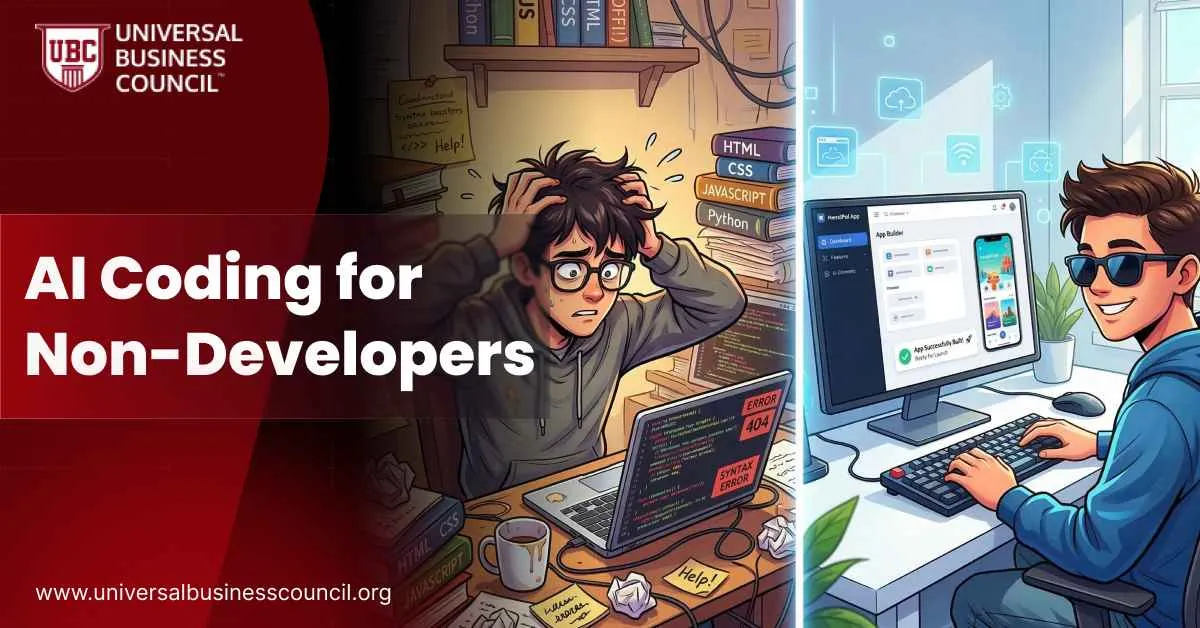 The rules of software creation are changing. For decades, building a functional app, automating a business process, or extracting insights from data required a developer — someone with programming knowledge, time, and a backlog of competing priorities. Today, AI-assisted development tools are dismantling that gatekeeping. Professionals without a single line of code in their resume are now building dashboards, prototypes, and automation systems — often in a single afternoon.
This transformation matters because the people closest to business problems are rarely engineers. Operations lead to spot inefficiencies. Marketers see data gaps. Founders see product opportunities. For years, turning those insights into working tools meant submitting a ticket and waiting. AI is collapsing that gap — and fundamentally changing who gets to build.
The rules of software creation are changing. For decades, building a functional app, automating a business process, or extracting insights from data required a developer — someone with programming knowledge, time, and a backlog of competing priorities. Today, AI-assisted development tools are dismantling that gatekeeping. Professionals without a single line of code in their resume are now building dashboards, prototypes, and automation systems — often in a single afternoon.
This transformation matters because the people closest to business problems are rarely engineers. Operations lead to spot inefficiencies. Marketers see data gaps. Founders see product opportunities. For years, turning those insights into working tools meant submitting a ticket and waiting. AI is collapsing that gap — and fundamentally changing who gets to build.


Leave a Reply