

 Search Engine Optimization (SEO) is essentialfor online visibility, but not all SEO strategies are the same. Businesses must choose between Local SEO and International SEO depending on their target audience and growth goals.
Understanding the difference between these two approaches helps businesses build effective, scalable, and results-driven digital strategies.
For professionals looking to master real-world SEO applications, structured learning programs from Universal Business Council provide practical insights into both local and global optimization techniques.
Master the differences between local and international SEO by focusing on geo-targeting, multilingual keyword strategies, and regional search intent through a Digital marketing course, while strengthening technical implementation using a Python Course and understanding AI-driven search algorithms with an AI Course.
What Is Local SEO?
Local SEO focuses on optimizing your online presence to attract customers from specific geographic locations.
Key Characteristics
- Targets local customers in a defined area
- Uses location-based keywords like “near me”
- Focuses on Google Business profiles and maps
- Relies on local backlinks and citations
Example
A coffee shop targeting “coffee shop near me” searches in a specific city.
Key Insight
Local SEO is ideal for businesses that depend on foot traffic or regional customers.
What Is International SEO?
International SEO targets a global audience across multiple countries or regions.
Key Characteristics
- Targets multiple countries or languages
- Uses broader, global keywords
- Requires multilingual or region-specific content
- Implements hreflang tags and regional targeting
Example
An e-commerce brand selling products worldwide with localized versions for different countries.
Key Insight
International SEO focuses on scaling visibility across global markets.
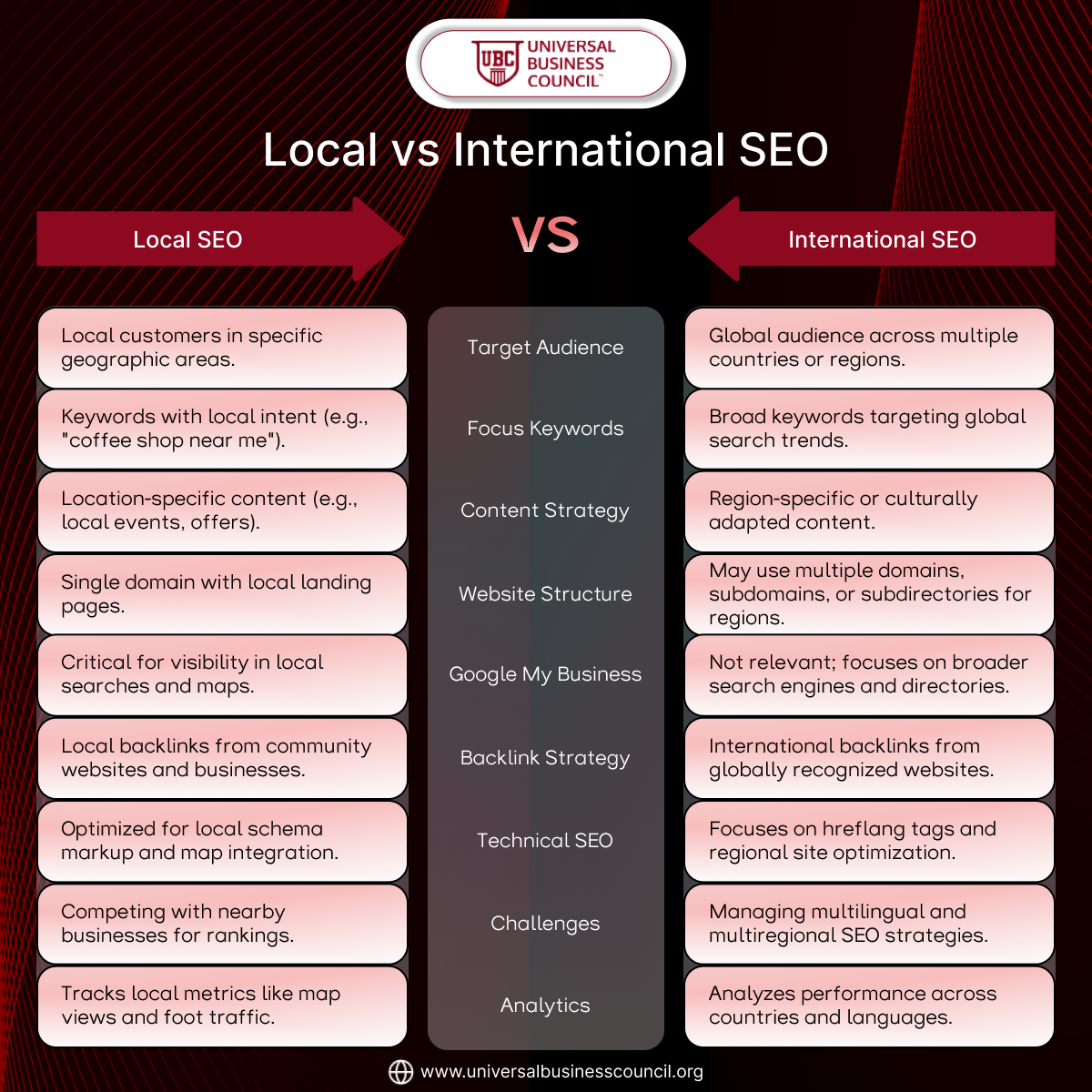
Key Differences Between Local and International SEO
1. Target Audience
- Local SEO: Specific geographic region
- International SEO: Global audience
2. Keyword Strategy
- Local SEO: Location-based keywords
- International SEO: Broad and region-specific keywords
3. Content Strategy
- Local SEO: Location-specific content (events, offers)
- International SEO: Multilingual and culturally adapted content
4. Website Structure
- Local SEO: Single domain with local landing pages
- International SEO: Multiple domains, subdomains, or directories
5. Backlink Strategy
- Local SEO: Community-based backlinks
- International SEO: Global authority backlinks
6. Technical SEO
- Local SEO: Schema markup and map integration
- International SEO: Hreflang tags and geo-targeting
Key Insight
The biggest difference lies in scope—local precision vs global scalability.
Challenges in Both SEO Strategies
Local SEO Challenges
- High competition in specific areas
- Dependence on local reviews and ratings
- Limited audience reach
International SEO Challenges
- Managing multiple languages
- Cultural adaptation
- Complex technical implementation
Analytics and Performance Tracking
Local SEO Metrics
- Map views
- Local search rankings
- Foot traffic
International SEO Metrics
- Country-wise traffic
- Language performance
- Global keyword rankings
Key Insight
Tracking the right metrics is essential for measuring SEO success effectively.
Which SEO Strategy Should You Choose?
The choice depends on your business goals:
- Choose Local SEO if you target a specific region
- Choose International SEO if you want global expansion
- Use a hybrid approach if you operate in multiple markets
Developing the right strategy requires both conceptual clarity and practical execution. Programs offered by Universal Business Council are designed to help professionals understand how to implement both local and international SEO strategies effectively in real-world scenarios.
Build scalable SEO strategies for both local visibility and global reach by learning audience segmentation, hreflang optimization, and content localization through an AI powered marketing course, enhancing data-driven decisions via a machine learning course, and leveraging intelligent systems with an Agentic AI Course.
Learning Perspective
SEO today is not just about keywords—it involves data analysis, user behavior, and technical optimization.
Professionals who want to build expertise in modern SEO and digital marketing can benefit from structured certifications by Universal Business Council , where real-world case studies and practical frameworks are covered in depth.
Final Thoughts
Both Local SEO and International SEO play a crucial role in digital growth.
- Local SEO drives targeted, high-intent traffic
- International SEO enables global scalability
- The right approach depends on your business model
Understanding these strategies gives you a competitive edge in today’s digital landscape. To gain hands-on expertise and stay ahead in SEO and digital marketing, exploring certification programs from Universal Business Council can help you build industry-relevant skills and practical knowledge.
FAQs: Local vs International SEO
1. What is Local SEO?
Local SEO focuses on optimizing a website to attract customers from a specific geographic area.
2. What is International SEO?
International SEO targets audiences across multiple countries and languages.
3. Which is better: Local or International SEO?
It depends on your business goals and target audience.
4. Can a business use both SEO strategies?
Yes, many businesses use a hybrid approach.
5. What are local keywords?
Keywords with geographic intent like “near me” or city names.
6. What are global keywords?
Broad keywords targeting international audiences.
7. What is hreflang?
A tag used to indicate language and regional targeting.
8. Is Google Business important for Local SEO?
Yes, it is crucial for local visibility and map rankings.
9. What is multilingual SEO?
Optimizing content in multiple languages for global audiences.
10. How do backlinks differ?
Local SEO uses local links, while international SEO uses global authority links.
11. What tools are used for SEO?
Tools like Google Analytics, Search Console, and keyword planners.
12. Is Local SEO easier than International SEO?
Generally, yes, because it targets a smaller audience.
13. What are the challenges of International SEO?
Language, culture, and technical complexity.
14. How long does SEO take?
It typically takes 3–6 months to see results.
15. Can small businesses use SEO?
Yes, especially Local SEO.
16. What is geo-targeting?
Targeting users based on their location.
17. What is SEO content strategy?
Planning content to rank for relevant keywords.
18. How do I measure SEO success?
Through traffic, rankings, and conversions.
19. Why is SEO important?
It improves visibility and drives organic traffic.
20. How can I learn SEO professionally?
Through structured certifications and practical training programs offered by Universal Business Council .




Leave a Reply