A high-converting landing page is one of the most valuable digital assets any business can own. Whether the objective is capturing leads, launching a product, driving event registrations, or generating direct revenue, the landing page is where visitor intent either turns into action or evaporates entirely. Getting that moment right has always mattered. What has changed dramatically is how attainable it is.For most of digital marketing’s history, producing a strong landing page required coordinating a copywriter, a designer, a front-end developer, and a conversion rate specialist. That workflow was slow, expensive, and inaccessible to anyone without a dedicated team or budget. AI has fundamentally disrupted that model. Today, professionals at every level marketers, founders, developers, and consultants can build polished, conversion-optimized landing pages faster and more affordably than ever before.This guide walks through the complete process: the core advantages AI brings to landing page creation, the tools shaping the field, a step-by-step build workflow, real-world industry applications, common pitfalls to avoid, and the professional skills that determine who gets the best results from these tools.
What Makes AI-Assisted Landing Page Creation a Game Changer
Speed Without Sacrificing Strategic Quality
A landing page that once required two to three weeks of coordinated effort across multiple roles can now be produced in hours. That speed gain is not the result of cutting corners it is the result of eliminating bottlenecks. AI handles the blank-page problem for writers, the empty canvas problem for designers, and the repetitive markup problem for developers. Human experts are freed to focus on refinement, strategic judgment, and the brand-specific nuance that AI cannot supply on its own.
Conversion Intelligence Embedded from the Start
Traditional landing pages begin as blank slates and improve only through accumulated testing and iteration. AI-assisted pages start from a much stronger position. AI tools trained on data from thousands of high-performing pages already understand which headline structures, call-to-action placements, and content hierarchies tend to perform well across different industries and audience types. The starting point is informed by patterns that would take years of manual testing to discover independently.
Accessible to Professionals Without Technical Backgrounds
Perhaps the most transformative shift is accessibility. Business owners, marketers, and content creators who have never written a line of code can now build professional, conversion-ready landing pages through natural language interfaces. The ability to launch a high-quality campaign page is no longer gated behind a development team or a significant production budget and that change is reshaping the competitive dynamics of digital marketing at every level.
The Best AI Tools for Landing Page Creation in 2025
AI-Powered Page Builder Platforms
Dedicated AI landing page builders including Framer AI, Wix ADI, Durable, and Unbounce’s Smart Builder allow users to describe their business, audience, and campaign goal in plain language and receive a fully designed, content-populated page within minutes. These platforms combine generative design with conversion optimization logic, producing pages that are visually structured and strategically grounded from the first draft. Framer AI, for example, generates a complete multi-section page from a short text description including imagery, placeholder copy, and a logical visual hierarchy allowing users to refine rather than build from zero.
AI Copywriting and Messaging Tools
Copy drives conversion, and AI copywriting tools have matured considerably. Tools such as Claude, ChatGPT, Jasper, and Copy.ai generate headlines, subheadings, feature descriptions, objection-handling text, and calls to action aligned with proven conversion principles. The quality of AI-generated copy scales directly with the quality of the brief. A vague prompt produces generic output. A precise prompt that specifies the target audience, primary value proposition, key objections, and desired tone produces copy that competes seriously with experienced human writers.
AI Design and Visual Generation Tools
Visual design is no longer a bottleneck for non-designers. Tools such as Midjourney, Adobe Firefly, and DALL-E 3 generate custom, brand-aligned imagery for specific audience profiles and aesthetic directions. Canva’s AI features produce full layout concepts from a text description, while Figma’s AI plugins accelerate wireframing and component design for more technically oriented users. The combination of these tools removes the visual production barrier that once made landing page creation dependent on professional designers.
AI SEO and Analytics Platforms
Building the page is only part of the challenge. Attracting qualified traffic and optimizing for organic discovery requires AI SEO tools such as Surfer SEO, Clearscope, and Semrush’s AI features. These platforms analyze landing page content against top-ranking competitors for target keywords, recommend structural and copy adjustments, and identify technical performance issues that could undermine search visibility. What once required hours of manual keyword research and content analysis can now be completed in minutes.
Step-by-Step: How to Build a Landing Page with AI
Step One: Define Your Goal, Audience, and Value Proposition
No AI tool can compensate for strategic ambiguity. Before opening any platform, define three things precisely: the specific conversion goal of the page, the primary target audience and what motivates them, and the core value proposition the reason a visitor should take action now rather than later. This strategic foundation becomes the brief you provide to every AI tool in the process. The more clearly these three elements are defined, the more relevant and effective every AI output will be.
Step Two: Generate and Validate the Page Structure
With your brief established, use an AI page builder or a large language model to generate the recommended structure for your landing page. Ask the AI to outline the key sections hero, problem statement, solution overview, features and benefits, social proof, FAQs, and call to action and explain the conversion purpose of each. A well-structured landing page follows a clear narrative arc: it captures attention, builds desire, establishes credibility, addresses objections, and closes with a compelling action prompt. Understanding why each section exists allows you to evaluate and refine the AI-generated structure intelligently.
Step Three: Generate, Review, and Refine the Copy
With the structure confirmed, use an AI copywriting tool to generate content for each section. For every prompt, provide the section type, audience profile, value proposition, and specific messaging requirements. Review each output critically:
Does the headline communicate the core benefit immediately?
Is the body copy benefit-focused rather than feature-focused?
Does the call to action convey sufficient clarity and urgency?
Refinement is essential. AI copy is rarely optimal on the first pass. Use follow-up prompts to tighten language, add specificity, adjust tone, or shift emphasis. Professionals who hold an AI Powered Marketing certification bring the conversion strategy knowledge needed to evaluate AI-generated copy critically and direct the refinement process toward genuine performance rather than surface-level polish.
Step Four: Design the Visual Layout and Brand Experience
With the copy finalized, move to the visual layer. If using a dedicated AI page builder, input your copy and brief and allow the platform to generate the initial layout. Evaluate the design for visual hierarchy: Does the eye move naturally toward the call to action? as well as mobile responsiveness, load speed, and brand alignment. If building a more custom page, use AI design tools to generate imagery, icons, and visual elements that match the brand aesthetic.A common mistake at this stage is prioritizing visual complexity over conversion clarity. The most effective landing pages are often the simplest: every element serves a specific conversion purpose and nothing distracts from the primary action the visitor is meant to take.
Step Five: Implement the Technical Build
Once the design is approved, the page must be technically implemented. For those using no-code AI page builders, this step is handled automatically by the platform. For teams building on a custom stack, development skills become relevant. For server-side functionality — API integrations, dynamic content rendering, webhook handling, or form processing Python and Node.js are two of the most widely used choices.Python’s versatility makes it a strong option for back-end logic, data processing, and integration with AI APIs. Developers who hold a Python certification have the scripting fluency needed to build reliable back-end integrations, process form submissions, and connect landing pages to CRM or analytics platforms with clean, maintainable code.Node.js is particularly well suited to landing pages that must handle high-concurrency traffic from paid campaigns or viral sharing. Its non-blocking architecture makes it ideal for real-time API calls, webhook processing, and serverless deployment. Developers who hold a Node.js certification bring the backend expertise needed to implement, debug, and scale the server-side components of AI-generated landing page systems confidently.
Step Six: Optimize for Search Visibility and Page Performance
A landing page that search engines cannot properly index represents a significant missed opportunity. Use AI SEO tools to ensure the page is optimized for the primary target keyword, includes semantically related terms, features appropriate meta tags and structured data, and loads quickly on both desktop and mobile. Page speed directly affects both paid campaign quality scores and organic search rankings and AI tools can now complete this analysis and provide specific recommendations in a fraction of the time manual audits require.
Step Seven: Test Thoroughly, Launch, and Optimize Continuously
Before any public launch, conduct thorough pre-launch testing. Verify every form submission, payment flow, and tracking integration. Confirm that the page renders correctly across major browsers and device types. Check that all analytics events are firing correctly and that data is flowing into reporting dashboards as expected.After launch, implement A/B testing to systematically improve conversion rates. Modern AI platforms can run multivariate tests autonomously simultaneously testing headlines, images, button placements, and layout variations, then automatically directing traffic toward the highest-performing version. This continuous optimization loop is where the compounding value of AI becomes most visible over time.
Agentic AI and the Future of Autonomous Landing Page Creation
The workflow described above still involves meaningful human direction at each stage. The next generation of landing page creation is moving toward fully agentic workflows, in which AI systems execute the entire process from interpreting a brief to publishing and optimizing a live page with minimal human involvement at each step.Agentic AI systems are already capable of browsing competitor landing pages, analyzing their messaging strategies, generating differentiated copy, designing layouts, implementing the technical build, and configuring tracking — all within a single orchestrated workflow triggered by a high-level brief. For marketing teams, this represents a fundamental shift in resource allocation: human strategists focus on brand, positioning, and objectives while agentic systems manage execution.For professionals who want to design, deploy, and manage these agentic workflows at a production level, a structured understanding of AI system architecture is increasingly essential. Pursuing an Agentic AI certification provides a rigorous foundation in agent design, tool orchestration, memory management, and multi-step workflow construction precisely the knowledge required to build and supervise agentic landing page systems with confidence and precision.Understanding the boundaries of what agentic systems can handle autonomously and where human judgment remains indispensable is equally important. Brand voice, strategic positioning, ethical content decisions, and creative direction are areas where human oversight adds irreplaceable value, even as AI handles the mechanical execution within those parameters.
Who Is Using AI to Build Landing Pages: Real-World Applications
E-Commerce and Direct-to-Consumer Brands
E-commerce brands use AI landing page tools to create product-specific campaign pages at volumes that were previously impossible to sustain. A brand running seasonal promotions, influencer partnerships, or paid social campaigns may need dozens of unique landing pages per quarter — each tailored to a specific audience segment, traffic source, or product variant. AI makes that volume feasible without proportional increases in team size or production costs.
SaaS Companies and Technology Startups
Software-as-a-service companies use AI to build and test landing pages for individual features, pricing tiers, use-case personas, and competitive comparison keywords. The ability to rapidly generate and test multiple page variants allows growth teams to identify the highest-converting messaging with significantly less time and fewer resources than traditional testing cycles require.
Agencies, Consultants, and Freelancers
Digital marketing agencies and independent consultants use AI tools to dramatically increase their output capacity. An agency that previously required a full design and development team to produce a landing page can now deliver a polished first draft within hours, reserving human expertise for strategic refinement and client-specific customization. This shift is redefining the value proposition of professional services from execution to strategy, curation, and critical oversight.
Founders and Early-Stage Ventures
Early-stage founders with limited budgets are among the most direct beneficiaries of AI landing page tools. The ability to launch a professional, conversion-optimized page without hiring a designer or developer removes a significant barrier to market entry and makes rapid value proposition testing accessible to any team regardless of size or funding stage.
Common Mistakes That Undermine AI-Built Landing Pages
Accepting generic output without meaningful customization
AI tools generate content based on patterns from large datasets. The initial output is often competent but generic lacking the specific voice, differentiation, and audience nuance that separates a good page from a genuinely effective one. Treating AI output as a starting point, not a finished product, is essential for pages that perform in competitive markets.
Neglecting mobile optimization
A large proportion of landing page traffic arrives via mobile, particularly from paid social campaigns. AI-generated layouts that look polished on desktop may not render well on smaller screens. The mobile version of every page must be reviewed and tested as a distinct priority not as an afterthought to the desktop experience.
Overlooking page load speed
AI image generation tools can produce high-resolution visuals that are visually impressive but slow to load. Unoptimized images, heavy scripts, and excessive animations significantly undermine conversion rates. Every AI-generated page should be run through a speed analysis tool such as Google PageSpeed Insights and optimized before launch.
Skipping pre-launch testing
The efficiency of AI-assisted production can tempt teams to abbreviate or skip testing. A landing page with a broken form submission, a misfiring analytics pixel, or a payment integration error does not just fail to convert it actively damages brand credibility and wastes every dollar of paid media spend directed toward it.
The Professional Skills That Make AI Landing Pages Perform
As AI tools become standard in the landing page creation workflow, the skills that add the most value are shifting. Raw execution skills hand-coding HTML, writing every word of copy manually are becoming less differentiating. Strategic, critical, and supervisory skills are becoming more valuable and more sought after at every level of the profession.The most effective AI landing page practitioners combine several capabilities. They understand conversion optimization principles well enough to evaluate whether an AI-generated structure is strategically sound. They can direct AI copywriting tools with briefs precise enough to produce genuinely compelling output. They have sufficient technical knowledge to implement, debug, and customize AI-generated code and integrate the page with the broader marketing technology ecosystem.For professionals looking to build these capabilities systematically, structured learning pathways are available across the key disciplines that intersect with AI landing page development. An AI Powered Marketing certification provides the strategic marketing foundation audience analysis, conversion funnel design, paid traffic management, and analytics interpretation that transforms AI-generated components into coherent, high-performing campaign assets.An Agentic AI certification offers the deep technical understanding of autonomous AI systems and multi-step workflow design that is becoming essential for professionals working at the frontier of marketing automation. A Python certification establishes the scripting fluency needed to build, customize, and integrate the back-end components of AI-generated landing page systems. And a Node.js certification provides the server-side and API expertise needed to deploy scalable, high-performance landing page infrastructure with confidence.
Conclusion
The ability to build a high-converting landing page with AI is no longer a capability reserved for well-resourced teams with large budgets and specialized talent. It is an accessible, practical skill that is transforming how businesses of every size approach digital marketing, campaign execution, and online growth.AI tools are amplifiers, not replacements. The quality of what they produce is bounded by the quality of the strategic thinking, creative direction, and technical judgment that guides them. The process outlined in this guide from a precise brief through structured generation, critical refinement, technical implementation, SEO optimization, and systematic testing represents a discipline that combines the best of human expertise with the best of AI capability.Whether you are a marketer building campaign pages at scale, a developer implementing custom landing page systems, a founder testing a value proposition, or a consultant delivering client work with greater efficiency, the combination of AI tools and well-developed professional credentials is your most powerful competitive advantage.
FAQs
What does it mean to build a landing page with AI? It means using AI tools to create landing page copy, layout, and structure faster.
Can non-technical professionals build landing pages with AI? Yes. AI page builders let marketers, founders, and business owners create pages without coding.
Which AI tools are best for landing pages in 2025? Popular tools include Framer AI, Unbounce Smart Builder, Durable, Claude, ChatGPT, Jasper, Midjourney, and Surfer SEO.
How do I write a good AI prompt for landing page copy? Include the audience, value proposition, tone, objections, and the section you want written.
What is agentic AI in landing page creation? It is AI that can handle more of the page-building process with less human input.
Why is Python useful for AI landing page development?Python helps with integrations, forms, data handling, and CRM or analytics connections.
When should I use Node.js for a landing page project? Use Node.js for APIs, server-side features, webhooks, and high-traffic landing pages.
What are the biggest risks of using AI for landing pages? Main risks include generic content, weak optimization, poor testing, and too much reliance on AI.
How does an AI Powered Marketing certification help? It builds the strategy and marketing skills needed to use AI landing page tools effectively.
Is AI landing page creation useful for both small businesses and enterprises? Yes. It helps small teams move faster and large teams scale landing page production.


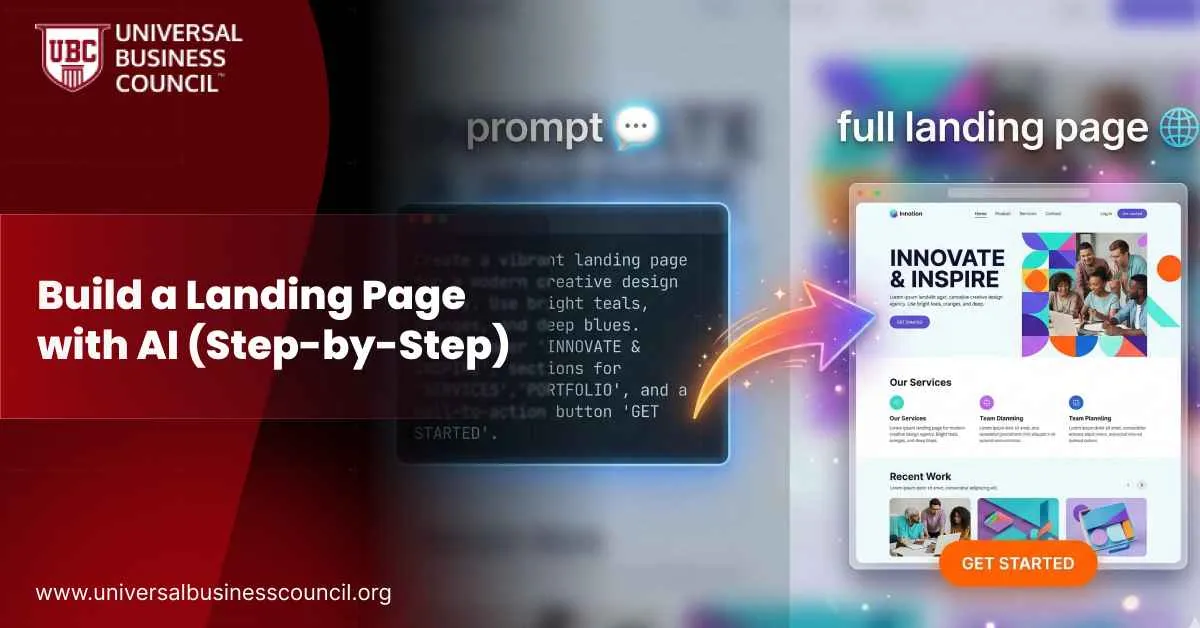 A high-converting landing page is one of the most valuable digital assets any business can own. Whether the objective is capturing leads, launching a product, driving event registrations, or generating direct revenue, the landing page is where visitor intent either turns into action or evaporates entirely. Getting that moment right has always mattered. What has changed dramatically is how attainable it is.
For most of digital marketing’s history, producing a strong landing page required coordinating a copywriter, a designer, a front-end developer, and a conversion rate specialist. That workflow was slow, expensive, and inaccessible to anyone without a dedicated team or budget. AI has fundamentally disrupted that model. Today, professionals at every level marketers, founders, developers, and consultants can build polished, conversion-optimized landing pages faster and more affordably than ever before.
This guide walks through the complete process: the core advantages AI brings to landing page creation, the tools shaping the field, a step-by-step build workflow, real-world industry applications, common pitfalls to avoid, and the professional skills that determine who gets the best results from these tools.
A high-converting landing page is one of the most valuable digital assets any business can own. Whether the objective is capturing leads, launching a product, driving event registrations, or generating direct revenue, the landing page is where visitor intent either turns into action or evaporates entirely. Getting that moment right has always mattered. What has changed dramatically is how attainable it is.
For most of digital marketing’s history, producing a strong landing page required coordinating a copywriter, a designer, a front-end developer, and a conversion rate specialist. That workflow was slow, expensive, and inaccessible to anyone without a dedicated team or budget. AI has fundamentally disrupted that model. Today, professionals at every level marketers, founders, developers, and consultants can build polished, conversion-optimized landing pages faster and more affordably than ever before.
This guide walks through the complete process: the core advantages AI brings to landing page creation, the tools shaping the field, a step-by-step build workflow, real-world industry applications, common pitfalls to avoid, and the professional skills that determine who gets the best results from these tools.



Leave a Reply