Marketing has always been about connecting with customers at the right time with the right message. In recent years, technology has transformed how marketers reach audiences, manage campaigns, and personalize experiences. Today, a new wave of innovation, generative AI, is accelerating marketing automation, enabling teams to deliver highly tailored content at scale, streamline workflows, and gain deeper insights into customer behavior.This article explains what generative AI means for marketing automation, recent developments, practical applications, challenges, and why professionals should consider structured learning paths such asmarketing certification,tech certification, anddeep tech certification to stay competitive in a fast-moving field.
Marketing Automation Basics
Marketing automation refers to technologies and processes that automate repetitive tasks involved in managing marketing campaigns and customer interactions. Traditionally, tools helped automate email sends, scheduling social media posts, and tracking leads across channels. These systems reduce manual effort and help ensure consistent engagement.Recent advances in generative AI, machine learning models that can create human-like text, images, and even audio, are taking marketing automation to a new level. Generative AI can craft personalized content, create on-brand assets, summarize insights, and drive dynamic customer interaction without constant manual input.
Why Generative AI Matters
Generative AI matters because it extends automation beyond rule-based tasks into creative and analytical domains. Instead of automating only pre-defined triggers, marketers can now automate creative thinking, segment-specific messages, and adaptive campaign strategies.Major benefits include:
Faster content creation
Dynamic personalization
More efficient A/B testing
Enhanced customer insights
Real-time campaign optimization
Rather than replacing human creativity, generative AI augments it, freeing marketers to focus on strategy and relationship building.
Core Capabilities
Personalized Content
Generative AI can create tailored content variations for different audience segments. For example, an email campaign can automatically produce multiple versions of copy depending on interests, location, or past behavior. This level of personalization was once too time-consuming to produce manually.
AI Chat and Support
AI-driven chatbots can manage high volumes of customer interactions without relying on scripted replies. They can understand context, provide helpful answers, and hand off to human agents when needed. This improves both efficiency and customer satisfaction.
Creative Asset Support
Generative models can produce graphics, video snippets, and branded templates. Marketing teams can quickly generate variations for campaign collateral while preserving brand guidelines.
Insights and Predictions
Generative AI can also analyze customer data to identify trends, recommend audience segments, and forecast responses. For example, models can suggest the best time to deliver offers or predict which message variants are likely to perform better.
Recent Developments
AI Inside Marketing Platforms
Marketing platforms are embedding generative AI into workflows for content drafting, segmentation support, and campaign orchestration. This shift is moving generative AI from experimental add-ons to built-in capabilities.
Real-Time Personalization
Generative AI enables dynamic generation of website content, offers, and recommendations based on live user behavior. Two visitors can see different messages on the same page, tailored to their profiles, without complex manual rules.
Multimodal Content Creation
Newer systems support multimodal content creation, combining text and visuals for faster production of social posts, ad variations, product descriptions, and campaign assets aligned with brand tone.
Real-World Examples
Ecommerce Campaign Optimization
An online retailer improved abandoned cart recovery by using generative AI to create personalized emails referencing recently viewed products, complementary items, and time-limited offers. The result was higher engagement and conversions, with reduced manual creative effort.
Customer Support Efficiency
A subscription service deployed generative-AI chatbots to handle billing and product questions. The system resolved common issues quickly and escalated only complex cases to human agents, lowering support costs and improving response times.
Dynamic Social Advertising
A travel brand generated location-specific ad variations tied to seasonality and user preferences. Instead of manually designing dozens of creatives, the team set guidelines and used AI to produce many on-brand versions, improving speed and testing breadth.
Challenges and Ethics
Brand Consistency
Generative AI can produce fluent content that still misses the brand voice. Human review and clear style constraints remain important.
Privacy and Compliance
Personalization depends on customer data. Teams must maintain consent controls, data minimization practices, and compliance with privacy regulations.
Bias and Risk
Models can replicate biases in training data. Marketers should evaluate outputs for fairness, especially in targeting and personalization.
Over-Automation
Too much automation can dilute authenticity. The best results come from combining AI efficiency with human strategy and oversight.
Skills and Certification
Generative AIis reshaping marketing roles, and interdisciplinary skills are now a practical advantage. Professionals who combine marketing expertise with technology literacy can manage automation, evaluate outputs, and collaborate effectively with analytics and engineering teams.Structured pathways such asmarketing certification can strengthen campaign strategy, automation workflows, and measurement discipline. Technical pathways such astech certification anddeep tech certification support professionals who want a deeper understanding of how AI systems work, how they integrate into platforms, and how to govern them responsibly.
Best Practices
Start With Clear Use Cases
Begin with low-risk, high-value use cases such as first drafts of emails, ad variations, or product descriptions, rather than sensitive compliance messaging.
Set Quality Metrics
Track results using metrics that match business goals: conversion rate, engagement, customer satisfaction, and time saved.
Keep Humans in the Loop
Use AI for speed and scale, but keep human review where nuance, brand reputation, or legal risk matters.
Monitor and Improve
Models and campaigns change over time. Ongoing testing, feedback loops, and periodic updates keep automation aligned with customer expectations.
Conclusion
Marketing automation has evolved from rule-based triggers to intelligent, context-aware systems powered by generative AI. This shift enables more personalized experiences, faster creative production, and deeper insights. Success, however, depends on strategy, governance, and continuous learning.Organizations that adopt generative AI thoughtfully and train teams through pathways likemarketing certification,tech certification, anddeep tech certification are more likely to build automation that is effective, responsible, and sustainable.


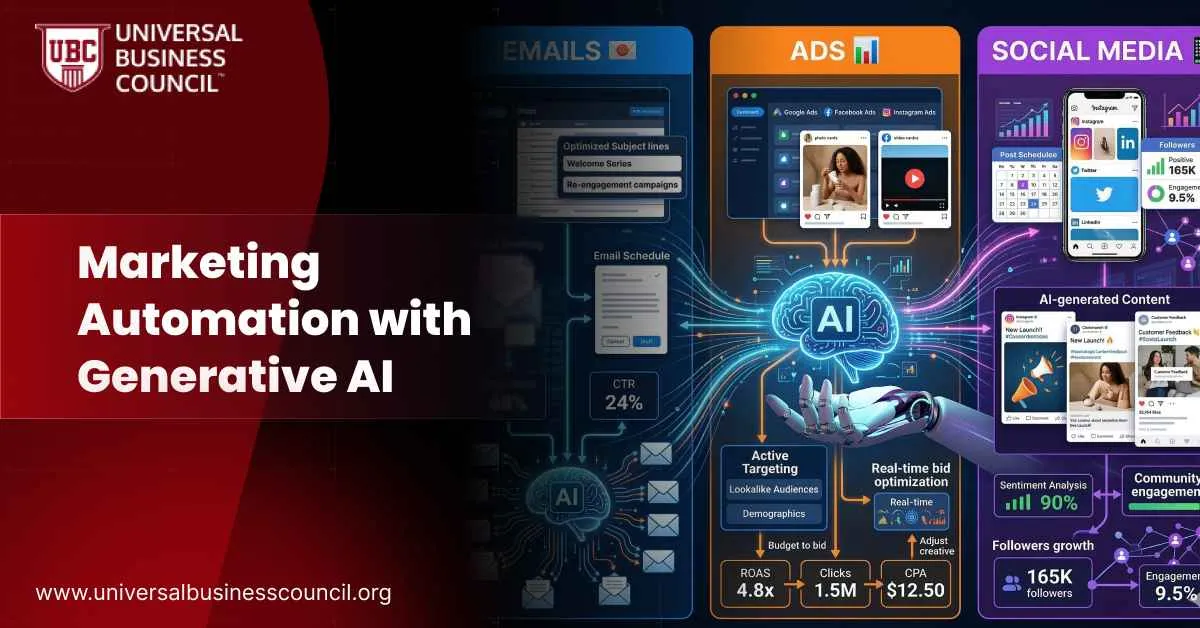 Marketing has always been about connecting with customers at the right time with the right message. In recent years, technology has transformed how marketers reach audiences, manage campaigns, and personalize experiences. Today, a new wave of innovation, generative AI, is accelerating marketing automation, enabling teams to deliver highly tailored content at scale, streamline workflows, and gain deeper insights into customer behavior.
This article explains what generative AI means for marketing automation, recent developments, practical applications, challenges, and why professionals should consider structured learning paths such as marketing certification, tech certification, and deep tech certification to stay competitive in a fast-moving field.
Marketing has always been about connecting with customers at the right time with the right message. In recent years, technology has transformed how marketers reach audiences, manage campaigns, and personalize experiences. Today, a new wave of innovation, generative AI, is accelerating marketing automation, enabling teams to deliver highly tailored content at scale, streamline workflows, and gain deeper insights into customer behavior.
This article explains what generative AI means for marketing automation, recent developments, practical applications, challenges, and why professionals should consider structured learning paths such as marketing certification, tech certification, and deep tech certification to stay competitive in a fast-moving field.