Every business, regardless of size or industry, operates on a foundation of repetitive processes. Invoices are generated and sent. Reports are compiled and distributed. Customer inquiries arrive and require routing. Leads are captured, qualified, and handed off to sales teams. Data is extracted, cleaned, and loaded into systems. These tasks are essential to operations, yet they consume a disproportionate share of the most valuable resource any organization possesses: human time and focused attention.Artificial intelligence has fundamentally changed the economics of business automation. The convergence of large language models capable of understanding natural language, AI-assisted code generation tools that translate business requirements into working automation scripts, and autonomous agent systems that execute multi-step workflows has made sophisticated automation genuinely accessible to organizations of every size, not just enterprises with large engineering budgets and dedicated development teams.This guide covers which tasks are best suited to AI automation, how to design and implement effective AI-powered automation workflows, which technologies underpin the most capable systems, concrete real-world examples across multiple industries, and the professional credentials that allow practitioners to lead and manage these initiatives with confidence and credibility.
Why AI-Powered Business Automation Is Different from Everything That Came Before
The Limits of Traditional Rule-Based Automation
Conventional business process automation robotic process automation tools, macro scripts, and scheduled batch jobs operates through rigid, predetermined logic. It works reliably for processes that are completely predictable, fully structured, and never deviate from an expected pattern. The moment a process encounters an exception, an unexpected input format, or a variation it was not programmed to handle, traditional automation breaks down entirely and requires human intervention to resolve.AI-powered automation handles variability with far greater resilience. Because it is built on models that understand context and can reason through unexpected inputs, it can process unstructured data, interpret ambiguous instructions, adapt to format changes, and make judgment-based decisions that rule-based systems cannot. This dramatically extends the boundary of what can be automated encompassing tasks that were previously considered too nuanced or too variable for conventional approaches.
The Compounding Return on Automation Investment
The return on investment in business automation is not linear; it compounds over time. Each hour of human time freed from a repetitive task becomes available for higher-value activities: strategic planning, client relationship development, product innovation, and organizational growth. A process that consumes two hours per day, five days per week, represents more than five hundred hours per year, the equivalent of over twelve full work weeks that can be redirected to activities that directly drive revenue and competitive advantage.
Scalability That Human Teams Simply Cannot Match
A human team can process only as much volume as its headcount permits. An AI automation system can handle significantly greater volume without any proportional increase in cost, operating with consistent quality around the clock, without the fatigue, error rates, or recruitment overhead associated with scaling a human workforce. For growing businesses, this scalability advantage alone makes early investment in AI-powered automation one of the most strategically sound decisions available.
How to Identify the Right Business Tasks to Automate First
The Characteristics That Make a Task a Strong Automation Candidate
Not every business task is equally suited to AI automation. The tasks that offer the greatest return from automation share several defining characteristics. They are performed frequently daily, hourly, or continuously. They involve a repeatable process with consistent inputs and defined outputs. They consume significant time relative to the strategic value they deliver. They are currently handled by team members who have more valuable work they could be doing instead. And they produce measurable outputs that make it straightforward to verify whether the automation is functioning correctly.Applying these criteria across a typical organization reveals a rich landscape of automation opportunities. In finance and operations: invoice processing, expense report handling, bank reconciliation, and financial report generation. In marketing: lead qualification, CRM data entry, email follow-up sequencing, social media scheduling, and campaign performance reporting. In customer service: inquiry triage, FAQ response generation, appointment scheduling, and feedback analysis. In human resources: onboarding documentation, timesheet processing, and benefits administration communications.
Sequencing Your Automation Program for Maximum Early Impact
Once automation candidates have been identified, prioritize them by the intersection of business impact and implementation complexity. Tasks that are high-impact and relatively straightforward to automate represent the most attractive starting points; they deliver significant value quickly and build organizational confidence in the automation program. More complex automations can be pursued once foundational systems are in place and the team has developed practical proficiency with the relevant tools and methodologies.
The Core Technologies Behind Effective AI Business Automation
Python: The Dominant Language for AI Automation Workflows
Python is the primary programming language for AI-powered business automation. Its readable syntax makes automation scripts easy to maintain and audit. Its library ecosystem is unmatched in breadth; libraries for HTTP communication, data processing, database interaction, spreadsheet manipulation, email handling, PDF generation, and AI API integration are all mature, well-documented, and widely adopted across industries.For businesses building AI automation systems, Python’s AI-specific libraries are especially valuable. The ability to call large language model APIs, implement retrieval-augmented generation for document processing, and orchestrate agentic workflows using frameworks such as LangChain, LangGraph, or AutoGen all within a single development environment makes Python the natural foundation for any serious AI automation initiative.Node.js: Real-Time and Event-Driven Automation at ScaleWhile Python dominates the data processing and AI integration layer, Node.js is the preferred technology for automation systems that require real-time event handling, high-throughput API interactions, and serverless function deployment. Webhook-based automation triggers — where an external event such as a completed payment, a new form submission, or an opened support ticket initiates a workflow immediately are commonly implemented in Node.js because of its non-blocking, event-driven architecture and native compatibility with JavaScript-based API ecosystems.For teams building automation beyond what no-code platforms offer, Node.js serverless functions deployed on AWS Lambda, Google Cloud Functions, or Cloudflare Workers provide a highly scalable and cost-effective foundation for event-triggered workflows. AI APIs and Large Language Model IntegrationThe ingredient that most distinguishes modern business automation from older approaches is access to large language model capabilities through API integrations. The OpenAI API, the Anthropic Claude API, and Google’s Gemini API all provide programmatic access to state-of-the-art language understanding and generation that can be embedded directly into automation workflows. Practical applications include extracting structured data from unstructured documents such as invoices, contracts, and support tickets; generating customized content at scale including personalized emails and report summaries; classifying and routing incoming communications based on content and intent; and making context-sensitive decisions that previously required human judgment.
Workflow Orchestration Platforms for Non-Code and Hybrid Implementations
For businesses that need automation without building everything from custom code, a new generation of AI-enhanced platforms has matured significantly. Make, n8n, Zapier, and Microsoft Power Automate all offer visual workflow builders with embedded AI capabilities. For more sophisticated use cases, orchestration frameworks such as Apache Airflow and Prefect provide production-grade pipeline management with monitoring, logging, error handling, and retry logic built in from the start.
Step-by-Step: How to Design and Implement AI Business Automation
Step One — Document the Existing Process in Full Detail
Before writing a single line of automation code, document the existing process precisely. Identify every input the process receives: where does the data originate, in what format, and how frequently? Identify every action taken: what decisions are made, what transformations are applied, and what outputs are produced? Identify every system involved: which applications, databases, APIs, and communication channels does the process currently touch? This documentation serves as the specification for the automation system and is the benchmark against which the completed automation will be validated.
Step Two — Design the Automation Architecture
With the process fully documented, design the automation architecture. Determine what triggers the automation of a schedule, an incoming event, or a manual initiation. Map how data flows through the system, which tools and APIs are called at each step, how exceptions and errors are handled, and how results are logged and made visible to the team responsible for oversight. At this stage, make informed technology decisions: Python scripts, Node.js serverless functions, an automation platform, or a combination based on the specific requirements of the process being automated.
Step Three — Build and Test Each Component in Isolation
Implement the automation incrementally, building and testing each component independently before integrating the whole. Use representative real-world data, including edge cases and exception scenarios. Validate that the automation produces the correct output for every input type it may encounter in production. Document the testing approach and results for internal reference and for the stakeholders who will need to approve the automation before deployment.
Step Four — Implement Monitoring, Logging, and Error Handling
A production automation system without monitoring is a liability rather than an asset. Implement comprehensive logging so that every execution is recorded, inputs received, actions taken, outputs produced, and errors encountered. Set up alerting so that failures are immediately visible to the team responsible for the system. Implement graceful error handling so that a failure at one step does not silently corrupt downstream data or leave processes in an incomplete and unresolvable state. The quality of your monitoring and error handling directly determines how confidently you can trust the automation to operate without constant human supervision.
Step Five — Deploy, Monitor Carefully, and Iterate
Deploy the automation to its production environment and monitor its performance closely during the first few weeks. Review logs regularly, gather feedback from the team members whose work it affects, and be prepared to iterate quickly when issues arise or when the underlying business process evolves. Automation systems are not set-and-forget tools, they are living systems that require ongoing maintenance as the business changes, APIs are updated, and data formats shift over time.
Real-World AI Business Automation Examples Across Industries
Marketing Campaign Reporting and Performance Automation
Marketing teams managing multiple campaigns across several platforms spend hours each week manually compiling performance data from Google Ads, Meta Ads, and analytics platforms into client-facing or leadership reports. An AI automation built with Python pulls data from each platform’s API, applies performance calculations and trend analysis, generates narrative summaries of key insights using a large language model, and delivers branded reports automatically on a weekly schedule.Professionals who combine technical implementation skills with formal marketing strategy knowledge are particularly effective at designing these automation outputs. An AI Powered Marketing certification equips marketing professionals with the strategic vocabulary and analytical framework needed to ensure that automated reports are not just technically accurate, but strategically meaningful and immediately actionable for the teams that receive them.
Automated Invoice Processing in Finance and Operations
A professional services firm receives dozens of vendor invoices weekly in various formats PDFs, email attachments, and scanned documents. Using AI code automation, the firm built a system that monitors the accounts payable inbox, extracts invoice data using a large language model parsing script, validates the data against purchase order records, generates accounting entries, and routes exceptions for human review achieving a significant reduction in manual processing time while improving accuracy and audit traceability.
AI-Powered Customer Support Inquiry Triage
An e-commerce business receiving thousands of support inquiries weekly implemented a Python-based automation that reads incoming emails, uses a large language model to classify inquiry type and urgency, extracts relevant order and account data from the CRM, generates draft responses for routine inquiries, and routes complex cases to the appropriate specialist with a pre-populated case summary. Agent response times decreased significantly and customer satisfaction scores improved measurably within the first month of deployment.
HR Onboarding Workflow Automation
A growing technology company automated its new employee onboarding process. When a new hire record is created in the HR system, the automation generates personalized welcome documentation using a large language model, submits system access requests via API integrations, creates and sends calendar invitations for orientation sessions, schedules benefit enrollment reminders, and tracks completion of required training modules all without any manual HR intervention for standard onboarding flows.
Agentic AI: The Next Generation of Fully Autonomous Business Automation
What Agentic Business Automation Looks Like in Practice
The automation examples described above represent powerful but relatively structured implementations workflows with defined inputs, predictable steps, and clear outputs. The next generation of business automation goes considerably further, enabling agentic AI systems that handle complex, multi-step processes with genuine autonomy and adaptability in response to what they discover as they work.An agentic business automation system is not a scripted workflow, it is an AI agent with access to tools, memory, and planning capabilities that adapts its approach based on real-time results. Consider a sales development agent given a list of target accounts and the goal of booking qualified discovery calls. The agent researches each account using web search, identifies relevant contacts, drafts personalized outreach emails based on its research, sends the emails via the CRM, monitors responses, follows up intelligently based on recipient behavior, and updates CRM records with outcomes all without human direction at each individual step.Designing, implementing, and managing these agentic systems requires a deep understanding of agent architectures, planning systems, and tool use frameworks. Pursuing a formal Agentic AI certification provides the comprehensive technical foundation needed to build and supervise autonomous systems that operate reliably in real production business environments covering agent design principles, orchestration patterns, memory management, and responsible deployment practices.
Building Responsible Human-in-the-Loop Controls
Responsible agentic business automation always includes carefully designed human-in-the-loop controls defined points in the workflow where the system presents its reasoning and proposed action to a human reviewer and proceeds only with explicit approval. For business-critical processes involving financial transactions, contractual commitments, or public communications, human oversight at key decision points ensures that the speed advantages of automation are realized without sacrificing the accountability that high-stakes decisions require. This is not a limitation of AI capability, it is a deliberate design principle that reflects sound engineering and responsible risk management.
The Professional Credentials That Position You to Lead AI Automation Initiatives
As AI-powered business automation becomes a strategic priority across industries, the professionals who can design, implement, and manage these systems are in growing demand. Building the right skill set and credentialing it through recognized programs positions practitioners as indispensable contributors to their organizations’ automation programs and opens doors to higher-value, higher-paid roles.An AI Powered Marketing certification is the most valuable credential for professionals building automation in marketing operations, campaign management, or growth functions. It provides the strategic marketing foundation audience analysis, conversion funnel design, campaign analytics, and digital strategy that ensures automated systems are built around genuine business goals rather than purely technical efficiency metrics.An Agentic AI certification is the defining credential for professionals who want to lead AI automation at the frontier of current capability. It provides comprehensive, structured knowledge of autonomous AI system design, multi-step workflow orchestration, and responsible deployment practices, the expertise that most directly enables practitioners to design and manage the most sophisticated automation systems in production.A Python certification establishes the foundational technical competence needed across virtually every AI automation use case: data processing, AI API integration, document parsing, automation scripting, and agentic workflow orchestration. A Node.js certification adds the backend and event-driven architecture expertise needed for real-time automation triggers, webhook processors, and serverless function deployment. Together, these four credentials define a comprehensive and market-ready professional profile for AI automation leadership.
Conclusion
The ability to automate business tasks using AI code is one of the most powerful levers available to any organization seeking to scale operations, reduce costs, and redirect human talent toward genuinely strategic work. The technologies are mature, the implementation frameworks are well-established, and the business case is compelling across virtually every industry and business function.The organizations that will realize the greatest value from AI automation are not necessarily the largest or most technically advanced they are those that combine a clear understanding of which processes are worth automating, the technical expertise to implement those automations reliably, and the business judgment to ensure that automated systems serve genuine strategic goals. For professionals building careers in this space, investing in rigorous technical foundations in Python, in Node.js, in AI system design, and in the business domains where automation creates the most strategic value pays compounding returns that increase with every passing year.The AI automation era is not approaching it is already here. The professionals who master it now, supported by recognized credentials such as an Agentic AI certification, a Python certification, a Node.js certification, and an AI Powered Marketing certification, will define how organizations operate for the decade ahead.
Frequently Asked Questions
How does an AI Powered Marketing certification help with business automation?
It helps professionals design automation that supports real marketing goals, not just technical tasks.
What does it mean to automate business tasks with AI code?
It means using AI-powered code to handle repetitive or complex business processes automatically.
Which business tasks work best for AI automation?
Tasks like invoicing, reporting, lead qualification, scheduling, data entry, and customer triage.
Why is Python useful for AI business automation?
Python is widely used for APIs, data handling, and AI workflow development.
What role does Node.js play in AI automation?
Node.js is useful for webhooks, serverless functions, APIs, and real-time automation.
What is agentic AI in business automation?
It is AI that can plan and manage multi-step workflows with less human input.
How is AI automation different from traditional automation?
Traditional automation follows fixed rules. AI automation can handle variable inputs and context.
How long does it take to build AI automation?
Simple systems may take days, while complex workflows can take weeks or longer.
Why is human oversight important in AI automation?
It helps prevent mistakes in sensitive tasks like payments, contracts, and customer communication.
Which certifications are most useful for AI automation professionals?


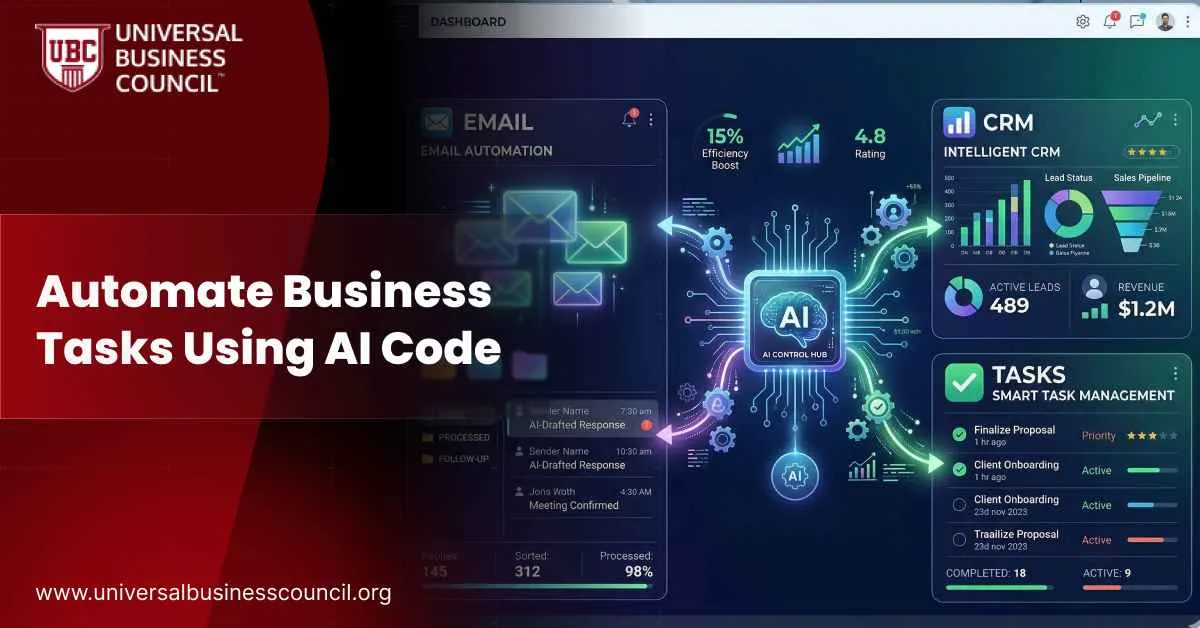 Every business, regardless of size or industry, operates on a foundation of repetitive processes. Invoices are generated and sent. Reports are compiled and distributed. Customer inquiries arrive and require routing. Leads are captured, qualified, and handed off to sales teams. Data is extracted, cleaned, and loaded into systems. These tasks are essential to operations, yet they consume a disproportionate share of the most valuable resource any organization possesses: human time and focused attention.
Artificial intelligence has fundamentally changed the economics of business automation. The convergence of large language models capable of understanding natural language, AI-assisted code generation tools that translate business requirements into working automation scripts, and autonomous agent systems that execute multi-step workflows has made sophisticated automation genuinely accessible to organizations of every size, not just enterprises with large engineering budgets and dedicated development teams.
This guide covers which tasks are best suited to AI automation, how to design and implement effective AI-powered automation workflows, which technologies underpin the most capable systems, concrete real-world examples across multiple industries, and the professional credentials that allow practitioners to lead and manage these initiatives with confidence and credibility.
Every business, regardless of size or industry, operates on a foundation of repetitive processes. Invoices are generated and sent. Reports are compiled and distributed. Customer inquiries arrive and require routing. Leads are captured, qualified, and handed off to sales teams. Data is extracted, cleaned, and loaded into systems. These tasks are essential to operations, yet they consume a disproportionate share of the most valuable resource any organization possesses: human time and focused attention.
Artificial intelligence has fundamentally changed the economics of business automation. The convergence of large language models capable of understanding natural language, AI-assisted code generation tools that translate business requirements into working automation scripts, and autonomous agent systems that execute multi-step workflows has made sophisticated automation genuinely accessible to organizations of every size, not just enterprises with large engineering budgets and dedicated development teams.
This guide covers which tasks are best suited to AI automation, how to design and implement effective AI-powered automation workflows, which technologies underpin the most capable systems, concrete real-world examples across multiple industries, and the professional credentials that allow practitioners to lead and manage these initiatives with confidence and credibility.



Leave a Reply