Old photographs carry emotional value that often grows stronger with time. Family portraits, wedding memories, childhood snapshots, and historical pictures preserve moments people never want to lose. Unfortunately, many old photos become damaged due to scratches, fading, blur, stains, and poor storage conditions. In the past, restoring these images required professional editing expertise and hours of manual work. Today, artificial intelligence can restore old photos in seconds using advanced prompts and image enhancement tools.Modern AI systems can sharpen blurry faces, remove scratches, repair damaged areas, improve lighting, and even colorize black-and-white images automatically. Humanity spent decades carefully protecting family albums in plastic covers only to discover the future solution involved uploading an image and typing a sentence. Progress continues to be both impressive and slightly ridiculous.As AI-powered creative tools become more common in marketing and digital media, professionals are increasingly improving their automation skills through theAI powered digital marketing course, which focuses on AI-driven campaign optimization and content strategies.Professionals seeking broader AI implementation knowledge are also pursuing theAI Expert certification to understand modern AI systems and enterprise workflows.At the same time, creators and developers are improving AI instruction-writing expertise through thePrompt engineering certification to master advanced prompting and AI-assisted creative workflows.
What Is AI Photo Restoration?
AI photo restoration uses artificial intelligence models to repair and enhance damaged photographs automatically. These systems rely on machine learning and computer vision technology trained on millions of images.AI restoration tools can:
Remove scratches and stains
Repair faded areas
Sharpen blurry faces
Improve image quality
Colorize black-and-white photos
Enhance resolution
Reduce grain and noise
Restore lighting and contrast
Unlike traditional editing, AI systems analyze patterns and intelligently recreate missing visual details.
Why AI Prompts Matter
The quality of the prompt often determines how accurate the restoration result will be. AI prompts act as instructions that guide the enhancement process.For example, instead of using a simple prompt such as:“Fix this old photo”A more effective prompt would be:“Restore this faded family portrait by removing scratches, sharpening faces, improving lighting, and preserving natural textures.”Detailed prompts help AI systems produce more realistic and natural restorations.Apparently the future of advanced image restoration still depends heavily on humans learning how to communicate clearly. Civilization really does enjoy repeating lessons.
Popular AI Prompts for Restoring Old Photos
Different types of photographs require different restoration approaches.
Basic Restoration Prompt
“Restore this damaged old photo by removing scratches, repairing faded areas, sharpening details, and improving clarity naturally.”
Black-and-White Colorization Prompt
“Colorize this black-and-white family portrait with realistic skin tones, natural clothing colors, and balanced lighting while preserving historical authenticity.”
Historical Photo Prompt
“Repair this historical image by reducing blur, restoring damaged sections, improving readability, and preserving original textures.”
Portrait Enhancement Prompt
“Enhance this vintage portrait with sharper facial details, natural skin texture, improved contrast, and high-resolution quality.”
Best AI Tools for Photo Restoration
Several AI-powered tools are now widely used for restoring old photographs.
Adobe Photoshop AI
Adobe offers AI-powered neural filters and generative editing tools for professional restoration projects.
Remini
Remini specializes in improving blurry facial photos and low-resolution images.
MyHeritage AI
MyHeritage provides AI restoration and colorization features designed for family photographs and historical archives.
Topaz Labs
Topaz Labs offers advanced AI sharpening, denoising, and image upscaling tools.
Stable Diffusion Workflows
Advanced users often combine prompts with Stable Diffusion models for customized restoration workflows.Technical professionals building AI-assisted editing systems often improve automation expertise through theAI Powered coding expert Course to strengthen development and AI workflow skills.
AI Restoration and Social Media Content
Restored old photos have become highly popular on social media platforms. Creators use restored images for storytelling, nostalgia campaigns, documentaries, educational content, and family history projects.Businesses and marketers also use vintage-style visuals to create emotional audience connections and improve engagement.Professionals strengthening AI-driven branding strategies are increasingly pursuing theAI Powered marketing certification to understand AI-assisted marketing and visual storytelling workflows.
Agentic AI and Automated Restoration
One of the newest developments in AI technology is agentic AI, where autonomous systems can complete multi-step workflows independently.
How Agentic AI Supports Restoration
AI agents can:
Detect photo damage
Apply restoration prompts
Enhance image quality
Organize restored files
Generate archive descriptions
Optimize image formats
This reduces manual editing work and improves efficiency for photographers, archivists, and creators.Professionals interested in intelligent automation systems are increasingly pursuing theAgentic AI expert certification to understand autonomous AI workflows and automation technologies.
Benefits of AI Photo Restoration
AI-powered restoration provides several major advantages.
Faster Results
Photos can be repaired within seconds instead of hours.
Lower Costs
Users no longer need expensive editing services for basic restoration tasks.
Beginner Accessibility
Even users with no editing experience can restore old photos using simple prompts.
Preservation of Family Memories
AI helps preserve historical and emotional memories digitally for future generations.
Improved Creative Workflows
Photographers and content creators can integrate AI restoration into larger editing pipelines.Humanity once gathered around physical photo albums during holidays. Future generations may restore entire family histories from a smartphone while waiting for coffee.
Challenges of AI Restoration
Despite its advantages, AI restoration also presents challenges.
Over-Editing Risks
Too much sharpening or colorization may create unrealistic images.
Historical Accuracy
AI-generated colors may not always match real historical details.
Privacy Concerns
Users should be cautious when uploading personal family images to online platforms.
Dependence on AI Tools
Excessive reliance on AI may reduce traditional editing skills over time.The internet already struggles with reality on a daily basis. Giving algorithms complete creative freedom over century-old photographs may require at least mild supervision.
Future of AI Photo Restoration
AI restoration technology continues evolving rapidly.
More Accurate Colorization
Future systems may improve historical color prediction and realism.
Better Facial Reconstruction
AI models are becoming increasingly effective at restoring damaged facial features.
Real-Time Restoration
Future tools may provide instant restoration previews and live adjustments.
Automated Restoration Pipelines
AI workflows may eventually combine scanning, enhancement, restoration, organization, and archiving automatically.As AI systems continue improving, restoring old photographs will become faster, more realistic, and more accessible for everyday users.
Conclusion
AI-powered photo restoration is transforming how people preserve memories and historical images. With the help of detailed prompts and advanced AI tools, users can repair damaged photos, sharpen blurry faces, restore faded colors, and revive old family memories within seconds.From photographers and historians to casual users restoring family albums, AI restoration tools are making image enhancement easier and more affordable than ever before. At the same time, understanding prompt engineering and AI workflows is becoming increasingly valuable across creative industries.
FAQs
1. What are AI prompts for old photo restoration?
AI prompts are written instructions that tell an AI tool how to improve an old photograph. They can request actions such as removing scratches, sharpening faces, restoring faded colors, or improving lighting. Clear prompts help the AI create more natural and accurate results, because apparently even machines prefer humans to be specific.
2. Can AI restore old photos in seconds?
Yes, many AI restoration tools can improve old photos within seconds or minutes. They use machine learning to detect damage, blur, fading, and missing details automatically. The final speed depends on the tool, image quality, and complexity of the restoration.
3. What is the best prompt for restoring a damaged photo?
A strong prompt should describe the damage and desired result clearly. For example: “Restore this damaged family photo by removing scratches, sharpening faces, improving lighting, and preserving natural textures.” This gives the AI enough direction to avoid random creative crimes.
4. Can AI colorize black-and-white photos?
Yes, AI can colorize black-and-white photos by predicting realistic colors for skin, clothing, and backgrounds. The results often look natural, but they may not always be historically accurate. Human review is useful when authenticity matters.
5. Does AI photo restoration work on blurry faces?
AI can improve blurry faces by sharpening facial structures and reconstructing missing details. It works best when the face is still partly visible in the original image. If the photo is extremely damaged, results may vary.
6. Which tools are used for AI photo restoration?
Popular AI restoration tools include Adobe Photoshop AI, Remini, MyHeritage AI, Topaz Labs, and Stable Diffusion workflows. These tools support features like scratch removal, upscaling, colorization, and face enhancement. Some are beginner-friendly, while others suit advanced editors.
7. Is AI photo restoration safe for family pictures?
It depends on the platform’s privacy policy. Users should avoid uploading sensitive family photos to unknown or untrusted websites. Reputable tools with clear data handling policies are safer choices.
8. Can AI remove scratches and stains from old photos?
Yes, AI can detect scratches, dust marks, stains, and small tears in old photographs. It fills damaged areas using surrounding visual patterns. Severe damage may still need manual editing.
9. Can restored AI photos be printed?
Many AI-restored photos can be printed if the final resolution is high enough. AI upscaling tools can improve image size and clarity for better print quality. Always review the image before printing, because paper is less forgiving than screens.
10. What makes a good AI restoration prompt?
A good prompt includes the photo type, visible damage, and desired style. It may mention “natural colors,” “sharp faces,” “reduced grain,” or “preserve vintage look.” The more precise the prompt, the better the result.
11. Can AI restore historical photographs?
Yes, AI can restore historical photos by improving clarity, repairing damage, and enhancing contrast. However, historical images should not be over-edited because authenticity matters. Original versions should always be preserved.
12. What is the difference between AI restoration and manual editing?
AI restoration is faster and uses automated models to repair images. Manual editing gives professionals more control over fine details and historical accuracy. The best results often combine both methods, naturally, because one tool never gets to make life simple.
13. Can AI improve faded colors in old photos?
Yes, AI can restore faded colors and improve contrast in aging photographs. It analyzes the image and adjusts tones to make the photo clearer. The result should still be reviewed to avoid over-saturation.
14. Is prompt engineering useful for photo restoration?
Prompt engineering is very useful because it helps users write better AI instructions. Better prompts can improve restoration quality, reduce unwanted edits, and preserve the original look. It is a practical skill for creators, marketers, and editors.
15. Can AI restore torn photographs?
AI can repair small tears and missing sections by reconstructing damaged areas. It works best when enough surrounding detail remains. Large missing sections may require expert manual restoration.
16. How do marketers use restored old photos?
Marketers use restored old photos for nostalgia campaigns, brand heritage stories, documentaries, and social media content. These visuals can create emotional connections with audiences. Apparently even childhood memories have been promoted to marketing assets.
17. What is agentic AI in photo restoration?
Agentic AI refers to autonomous systems that can complete multi-step workflows with limited human input. In restoration, it can detect damage, apply prompts, enhance images, organize files, and create archive descriptions. This is useful for large photo collections.
18. Can beginners restore photos with AI tools?
Yes, beginners can restore photos using simple AI tools and clear prompts. Many platforms only require uploading an image and choosing enhancement options. No advanced editing skills are needed for basic restoration.
19. What mistakes should users avoid?
Users should avoid vague prompts, excessive sharpening, unrealistic colorization, and uploading private images to unsafe tools. They should also keep the original file before editing. AI is helpful, but it is not a substitute for judgment, sadly.
20. What is the future of AI photo restoration?
AI photo restoration will become faster, more realistic, and more automated. Future tools may offer better color accuracy, improved facial reconstruction, and real-time restoration previews. These advances will make preserving family and historical photos easier for everyday users.


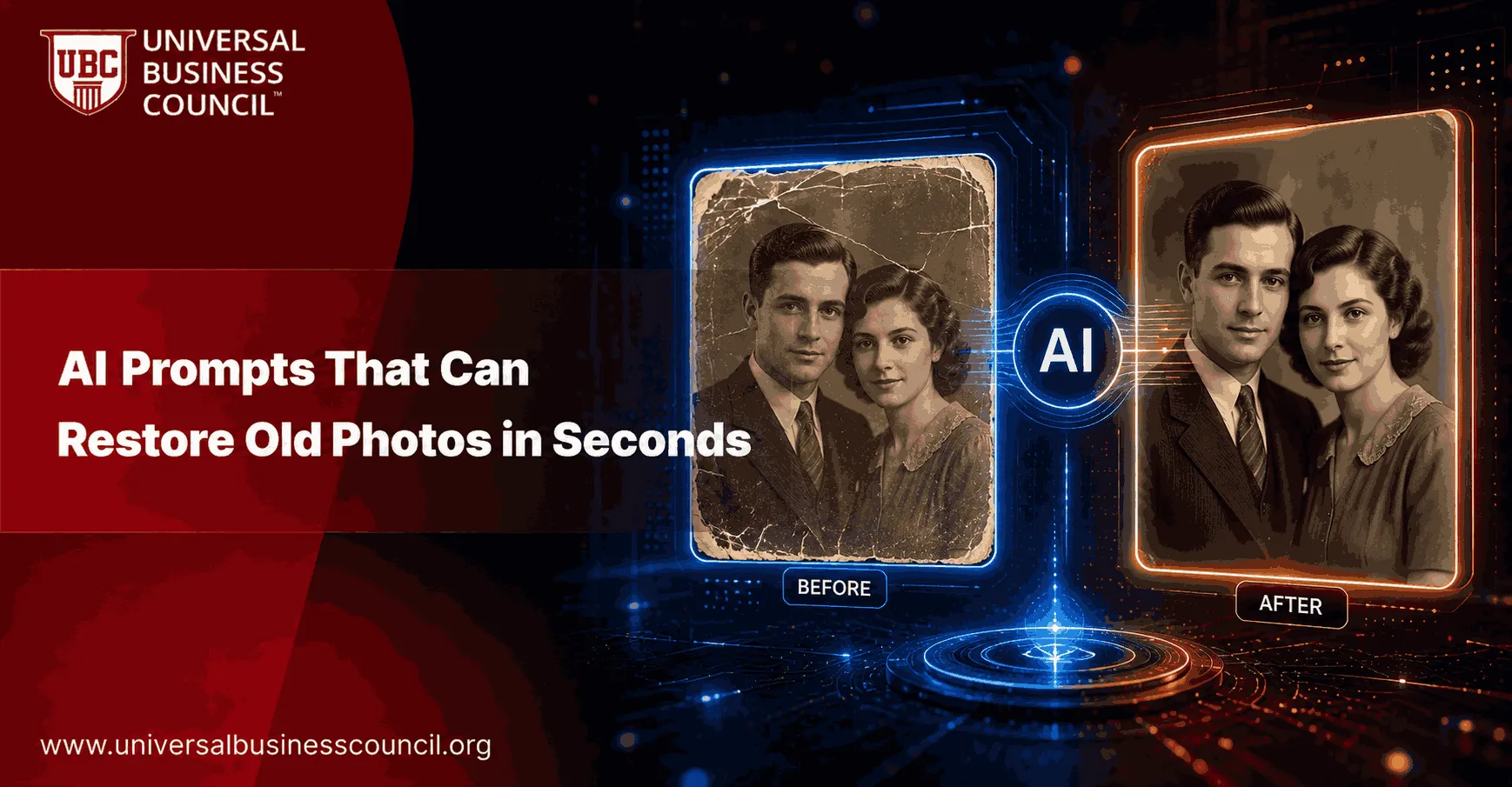 Old photographs carry emotional value that often grows stronger with time. Family portraits, wedding memories, childhood snapshots, and historical pictures preserve moments people never want to lose. Unfortunately, many old photos become damaged due to scratches, fading, blur, stains, and poor storage conditions. In the past, restoring these images required professional editing expertise and hours of manual work. Today, artificial intelligence can restore old photos in seconds using advanced prompts and image enhancement tools.
Modern AI systems can sharpen blurry faces, remove scratches, repair damaged areas, improve lighting, and even colorize black-and-white images automatically. Humanity spent decades carefully protecting family albums in plastic covers only to discover the future solution involved uploading an image and typing a sentence. Progress continues to be both impressive and slightly ridiculous.
As AI-powered creative tools become more common in marketing and digital media, professionals are increasingly improving their automation skills through the AI powered digital marketing course, which focuses on AI-driven campaign optimization and content strategies.
Professionals seeking broader AI implementation knowledge are also pursuing the AI Expert certification to understand modern AI systems and enterprise workflows.
At the same time, creators and developers are improving AI instruction-writing expertise through the Prompt engineering certification to master advanced prompting and AI-assisted creative workflows.
Old photographs carry emotional value that often grows stronger with time. Family portraits, wedding memories, childhood snapshots, and historical pictures preserve moments people never want to lose. Unfortunately, many old photos become damaged due to scratches, fading, blur, stains, and poor storage conditions. In the past, restoring these images required professional editing expertise and hours of manual work. Today, artificial intelligence can restore old photos in seconds using advanced prompts and image enhancement tools.
Modern AI systems can sharpen blurry faces, remove scratches, repair damaged areas, improve lighting, and even colorize black-and-white images automatically. Humanity spent decades carefully protecting family albums in plastic covers only to discover the future solution involved uploading an image and typing a sentence. Progress continues to be both impressive and slightly ridiculous.
As AI-powered creative tools become more common in marketing and digital media, professionals are increasingly improving their automation skills through the AI powered digital marketing course, which focuses on AI-driven campaign optimization and content strategies.
Professionals seeking broader AI implementation knowledge are also pursuing the AI Expert certification to understand modern AI systems and enterprise workflows.
At the same time, creators and developers are improving AI instruction-writing expertise through the Prompt engineering certification to master advanced prompting and AI-assisted creative workflows.


Leave a Reply