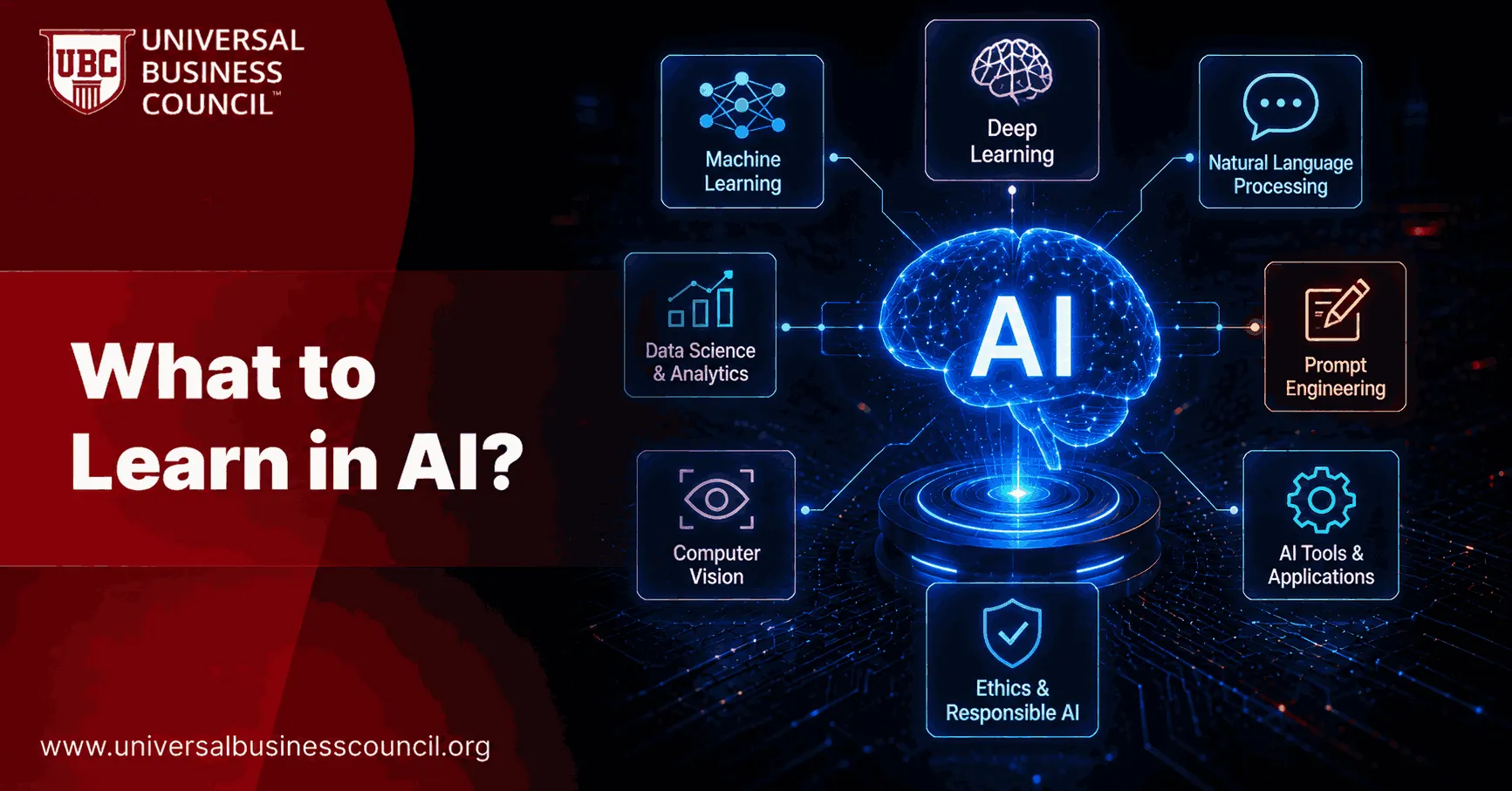
Artificial intelligence is changing the modern world faster than almost any other technology. From personalized recommendations on streaming platforms to advanced cybersecurity systems and autonomous AI agents, artificial intelligence is now deeply integrated into business operations and daily life. Companies across healthcare, finance, education, retail, marketing, and software development are investing heavily in AI-driven systems to improve productivity, automate workflows, and gain competitive advantages.As AI adoption grows, one important question continues to appear among students, professionals, creators, and business owners: what should you actually learn in AI? The field is massive, and new technologies emerge constantly. Between machine learning, prompt engineering, coding, automation, cybersecurity, and generative AI, many beginners feel overwhelmed before they even begin. Humanity created intelligent systems capable of writing essays, generating images, and analyzing massive datasets, then somehow turned learning AI into a maze of tutorials with titles like “Ultimate AI Roadmap FINAL_v27.” Deeply efficient species.The good news is that AI becomes far easier to understand when broken into practical categories and real-world skill sets. Professionals looking to improve AI-driven marketing and automation expertise are increasingly pursuing theAI powered digital marketing course, which focuses on AI-assisted campaign optimization and modern digital strategies.At the same time, professionals seeking broader technical expertise are pursuing theAI Expert certification to understand enterprise AI systems, implementation strategies, and intelligent automation workflows.
Understanding the Basics of Artificial Intelligence
Before learning advanced AI systems, it is important to understand what artificial intelligence actually means.
What Is Artificial Intelligence?
Artificial intelligence refers to computer systems capable of performing tasks that normally require human intelligence. These systems can analyze data, recognize patterns, generate content, solve problems, and make decisions.Examples of AI applications include:
AI chatbots
Recommendation systems
Fraud detection tools
Virtual assistants
AI-generated content
Smart automation systems
Image recognition software
Understanding these applications helps learners see how AI impacts industries and business operations.
Different Types of AI
AI includes several major categories.
Machine Learning
Machine learning allows systems to learn from data and improve performance over time.
Deep Learning
Deep learning uses neural networks to process complex information and patterns.
Generative AI
Generative AI creates new content such as text, images, audio, and code.
Agentic AI
Agentic AI systems can independently complete multi-step tasks and workflows.Learning these categories helps beginners identify which AI specialization aligns with their goals.
Learn Programming for AI
Programming is one of the most important technical skills in AI development.
Best Programming Languages for AI
The most commonly used AI programming languages include:
Python
R
Java
JavaScript
C++
Python remains the most popular option because of its simple syntax and extensive AI libraries.
Important AI Libraries
AI learners should become familiar with:
TensorFlow
PyTorch
Scikit-learn
Pandas
NumPy
These tools support machine learning, automation, and data analysis workflows.Professionals interested in automation and software development are increasingly strengthening technical expertise through theAI Powered coding expert Course, which focuses on AI coding systems and intelligent automation workflows.
Learn Machine Learning
Machine learning forms the foundation of many modern AI applications.
What Is Machine Learning?
Machine learning enables systems to identify patterns and make predictions using data rather than traditional programming rules.Common applications include:
Recommendation systems
Predictive analytics
Fraud detection
Medical diagnosis
Customer segmentation
Financial forecasting
Types of Machine Learning
AI learners should understand three core machine learning approaches.
Supervised Learning
The AI model learns using labeled training data.
Unsupervised Learning
The model identifies hidden patterns without predefined labels.
Reinforcement Learning
The AI system improves performance through rewards and penalties.Machine learning knowledge is valuable across technical and business-focused AI careers.
Learn Prompt Engineering
Prompt engineering has become one of the most important AI skills in recent years.
What Is Prompt Engineering?
Prompt engineering involves writing structured instructions that guide AI systems effectively.Strong prompts improve:
AI-generated writing
Coding accuracy
Automation workflows
Research outputs
AI image generation
For example, detailed prompts usually produce far better AI outputs than vague instructions.Apparently the future of advanced artificial intelligence still depends heavily on humans learning how to communicate properly. Civilization continues reinventing communication classes with dramatically more electricity involved.
Why Prompt Engineering Matters
Prompt engineering is useful for:
Marketers
Developers
Researchers
Content creators
Analysts
Business professionals
The ability to communicate effectively with AI systems is becoming an essential workplace skill.
Learn Data Science and Analytics
AI systems rely heavily on data quality.
Why Data Skills Matter
AI models require large, clean, and structured datasets for accurate performance. Poor-quality data often creates unreliable outputs.Important data-related skills include:
Data cleaning
Statistical analysis
SQL databases
Data visualization
Spreadsheet analysis
Predictive analytics
Data literacy is increasingly important even for non-technical AI professionals.
Learn Generative AI
Generative AI is one of the fastest-growing areas of technology.
What Is Generative AI?
Generative AI systems create new digital content such as:
Articles
Images
Videos
Audio
Code
Voice simulations
Popular generative AI tools include ChatGPT, Claude, Gemini, Midjourney, and Stable Diffusion.
Applications of Generative AI
Generative AI is widely used in:
Marketing
Design
Software development
Education
Customer support
Entertainment
Businesses increasingly rely on generative AI to improve productivity and automate creative workflows.
Learn AI Security
As AI systems become more powerful, AI security is becoming critically important.
Why AI Security Matters
AI systems face risks such as:
Data leaks
Prompt injection attacks
Model manipulation
Unauthorized access
Deepfake misuse
Privacy violations
Organizations need professionals who understand how to protect AI systems and ensure responsible deployment.Professionals interested in secure AI deployment are increasingly pursuing theAI security certification to strengthen expertise in AI governance, cybersecurity, and risk management.
Responsible AI and Ethics
AI learners should also understand:
Ethical AI development
Bias mitigation
Privacy protection
Responsible AI deployment
Regulatory compliance
Responsible AI practices are becoming essential for businesses worldwide.
Learn Agentic AI
Agentic AI is one of the newest developments in artificial intelligence.
What Is Agentic AI?
Agentic AI refers to autonomous systems capable of completing tasks independently with minimal human supervision.These systems can:
Analyze information
Plan actions
Execute workflows
Monitor outcomes
Adapt strategies
Real-World Uses of Agentic AI
Agentic AI is increasingly used in:
Customer support
Workflow automation
AI research systems
Business analytics
Cybersecurity operations
Professionals interested in intelligent automation are increasingly pursuing theAgentic AI expert certification to understand autonomous AI systems and workflow optimization.
Learn AI for Marketing
Marketing is one of the industries most heavily transformed by AI.
How AI Is Used in Marketing
AI tools help marketers with:
SEO optimization
Email campaigns
Audience targeting
Social media automation
Content generation
Predictive analytics
Businesses use AI to improve customer engagement and campaign performance.
Important AI Marketing Skills
Marketing professionals should learn:
AI copywriting
Marketing automation
Audience analysis
AI-powered SEO
Campaign optimization
AI-driven marketing strategies are becoming essential across digital businesses.
Learn AI Automation
AI automation is transforming business operations globally.
What Is AI Automation?
AI automation combines intelligent systems with automated workflows to reduce repetitive manual tasks.Examples include:
AI chat support
Automated reporting systems
Smart scheduling tools
AI-driven analytics platforms
Workflow management systems
Automation helps businesses improve productivity and operational efficiency.Humanity spent decades building complicated administrative systems, then immediately created AI tools whose primary purpose is escaping those same systems. An inspiring cycle of self-inflicted efficiency problems.
Learn Cloud AI Platforms
Modern AI professionals should understand cloud-based AI systems.
Popular Cloud AI Platforms
Important platforms include:
Google Cloud AI
Microsoft Azure AI
AWS AI services
These systems support scalable AI deployment and machine learning infrastructure.
Why Cloud AI Matters
Cloud AI platforms help organizations:
Scale AI operations
Store large datasets
Deploy AI models efficiently
Improve team collaboration
Cloud computing knowledge is increasingly valuable in AI careers.
Learn Soft Skills for AI Careers
Technical expertise alone is not enough for long-term success in AI careers.
Important Soft Skills
AI professionals should also develop:
Communication
Problem-solving
Creativity
Critical thinking
Adaptability
Team collaboration
Businesses still need professionals capable of explaining AI concepts clearly and applying them strategically.Surprisingly, companies continue preferring employees who can communicate like humans instead of malfunctioning dashboards.
Build Real AI Projects
Practical projects remain one of the best ways to learn AI.
Beginner AI Project Ideas
Examples include:
AI chatbots
Recommendation systems
Sentiment analysis tools
AI writing assistants
Image recognition systems
Why Projects Matter
Projects help learners:
Apply technical concepts
Build portfolios
Gain practical experience
Prepare for interviews
Real-world practice is often more valuable than memorizing theory alone.
Future Trends in AI
The AI industry continues evolving rapidly.
Emerging AI Areas
Future AI trends may include:
Multimodal AI
AI robotics
Autonomous AI agents
AI governance systems
Personalized AI assistants
AI-powered cybersecurity
Professionals who continuously update their skills will remain competitive in future job markets.
Importance of AI Certifications
AI certifications help professionals validate skills and improve career opportunities.Certifications provide structured learning in areas such as:
Artificial intelligence is becoming one of the most important professional skills in the modern economy. However, learning AI successfully requires focusing on the right combination of technical knowledge, practical experience, and analytical thinking.Beginners should start with AI fundamentals, programming, machine learning, and data analysis before moving into advanced topics such as generative AI, prompt engineering, automation, AI security, and agentic AI systems.Most importantly, AI is no longer limited to researchers or software engineers. It is becoming a core workplace skill across marketing, business operations, cybersecurity, education, and digital content industries. Humanity finally created intelligent machines, and now everyone is racing to figure out how to collaborate with them before next year’s job descriptions become unreadable.The earlier source material and related draft used for this rewritten version can be referenced here:
FAQs
1. What should beginners learn first in AI?
Beginners should start with basic AI concepts, programming, and machine learning fundamentals. Python is usually the best language for beginners because it is simple and widely used in AI development. Learning through small projects also improves understanding quickly.
2. Is coding necessary for AI?
Coding is very useful for AI because it helps learners build models, automate workflows, and work with machine learning systems. Python is the most commonly used AI programming language. Some AI tools require less coding, but technical skills still provide major advantages.
3. What is machine learning?
Machine learning is a branch of AI where systems learn patterns from data instead of following fixed instructions. It powers recommendation engines, analytics systems, and predictive tools. Machine learning is one of the most important areas of AI.
4. Why is prompt engineering important?
Prompt engineering helps users communicate effectively with AI systems. Better prompts improve content generation, coding, automation, and research tasks. Clear instructions usually lead to more accurate and useful AI outputs.
5. What is generative AI?
Generative AI refers to systems that create content such as text, images, videos, and code. Popular tools include ChatGPT, Claude, and Midjourney. Businesses use generative AI for marketing, design, customer support, and automation.
6. What programming language is best for AI?
Python is considered the best programming language for AI because it supports powerful machine learning libraries and has simple syntax. Other useful languages include R, Java, and JavaScript. Most beginners start with Python.
7. What are the most important AI skills?
Important AI skills include programming, machine learning, prompt engineering, data analysis, automation, and communication. Problem-solving and adaptability are also valuable. AI professionals often combine technical and business knowledge.
8. What is AI security?
AI security focuses on protecting AI systems from risks such as data leaks, prompt attacks, and unauthorized access. It also includes privacy protection and ethical AI deployment. Businesses increasingly prioritize secure AI systems.
9. What is agentic AI?
Agentic AI refers to autonomous AI systems capable of completing multi-step tasks independently. These systems can analyze information, make decisions, and automate workflows. Agentic AI is becoming increasingly important in business automation.
10. How is AI used in marketing?
AI is used in marketing for SEO optimization, audience targeting, campaign automation, and content generation. Businesses use AI tools to improve customer engagement and personalization. AI-driven marketing continues growing rapidly.
11. How long does it take to learn AI?
Learning AI depends on prior experience and learning goals. Basic AI concepts can often be understood within a few months of consistent study. Advanced machine learning and AI development may require longer-term learning.
12. Is mathematics important in AI?
Mathematics is important for understanding machine learning and data science concepts. Topics such as statistics and probability are commonly used in AI. Beginners can still start practical AI learning before mastering advanced math.
13. What industries use AI the most?
AI is widely used in healthcare, finance, marketing, education, retail, cybersecurity, and software development. Businesses use AI for automation, analytics, and customer engagement. AI adoption continues expanding across industries worldwide.
14. What are the best AI tools to learn?
Popular AI tools include ChatGPT, Claude, Gemini, Midjourney, Stable Diffusion, and GitHub Copilot. These tools support writing, coding, image generation, and automation tasks. Learning modern AI platforms improves practical skills.
15. Can non-technical professionals learn AI?
Yes, non-technical professionals can learn AI concepts, prompting, automation, and workflow systems. Many AI tools are designed for beginners and business users. Technical knowledge becomes more important for development-focused roles.
16. Why are AI certifications useful?
AI certifications help professionals validate skills and improve career opportunities. They provide structured learning in areas such as security, automation, coding, and AI fundamentals. Many employers value certified AI expertise.
17. What is AI automation?
AI automation combines artificial intelligence with workflow systems to reduce repetitive manual tasks. Businesses use it for customer support, analytics, reporting, and scheduling. Automation improves efficiency and productivity.
18. Should beginners build AI projects?
Yes, practical projects help beginners apply concepts and gain real-world experience. Projects improve technical understanding and strengthen professional portfolios. Hands-on learning is extremely valuable in AI education.
19. What is the future of AI careers?
AI careers are expected to grow rapidly across technical and business sectors. Future roles may include AI development, automation, security, governance, and consulting. AI skills are becoming essential in many industries.
20. How can someone stay updated in AI?
People can stay updated by following AI news, practicing with tools, taking courses, and building projects regularly. The AI industry changes quickly, so continuous learning is important. Apparently humans now require regular software updates for their own careers too.


 Artificial intelligence is changing the modern world faster than almost any other technology. From personalized recommendations on streaming platforms to advanced cybersecurity systems and autonomous AI agents, artificial intelligence is now deeply integrated into business operations and daily life. Companies across healthcare, finance, education, retail, marketing, and software development are investing heavily in AI-driven systems to improve productivity, automate workflows, and gain competitive advantages.
As AI adoption grows, one important question continues to appear among students, professionals, creators, and business owners: what should you actually learn in AI? The field is massive, and new technologies emerge constantly. Between machine learning, prompt engineering, coding, automation, cybersecurity, and generative AI, many beginners feel overwhelmed before they even begin. Humanity created intelligent systems capable of writing essays, generating images, and analyzing massive datasets, then somehow turned learning AI into a maze of tutorials with titles like “Ultimate AI Roadmap FINAL_v27.” Deeply efficient species.
The good news is that AI becomes far easier to understand when broken into practical categories and real-world skill sets. Professionals looking to improve AI-driven marketing and automation expertise are increasingly pursuing the AI powered digital marketing course, which focuses on AI-assisted campaign optimization and modern digital strategies.
At the same time, professionals seeking broader technical expertise are pursuing the AI Expert certification to understand enterprise AI systems, implementation strategies, and intelligent automation workflows.
Artificial intelligence is changing the modern world faster than almost any other technology. From personalized recommendations on streaming platforms to advanced cybersecurity systems and autonomous AI agents, artificial intelligence is now deeply integrated into business operations and daily life. Companies across healthcare, finance, education, retail, marketing, and software development are investing heavily in AI-driven systems to improve productivity, automate workflows, and gain competitive advantages.
As AI adoption grows, one important question continues to appear among students, professionals, creators, and business owners: what should you actually learn in AI? The field is massive, and new technologies emerge constantly. Between machine learning, prompt engineering, coding, automation, cybersecurity, and generative AI, many beginners feel overwhelmed before they even begin. Humanity created intelligent systems capable of writing essays, generating images, and analyzing massive datasets, then somehow turned learning AI into a maze of tutorials with titles like “Ultimate AI Roadmap FINAL_v27.” Deeply efficient species.
The good news is that AI becomes far easier to understand when broken into practical categories and real-world skill sets. Professionals looking to improve AI-driven marketing and automation expertise are increasingly pursuing the AI powered digital marketing course, which focuses on AI-assisted campaign optimization and modern digital strategies.
At the same time, professionals seeking broader technical expertise are pursuing the AI Expert certification to understand enterprise AI systems, implementation strategies, and intelligent automation workflows.


Leave a Reply