AWS in Improving Digital Transformation for Modern Businesses in 2026
December 03, 2025 By Smita
Digital transformation has become the defining priority for modern enterprises, but the meaning of transformation has shifted. It is no longer just about moving servers to the cloud or digitizing a few processes. In 2026, digital transformation means building intelligent, connected, scalable systems that support automation, data driven decisions, and real business agility. Amazon Web Services is at the center of this shift, giving organizations the tools they need to modernize with speed and stability.Many business leaders preparing for cloud transformation begin by strengthening their strategic understanding of technology through programs like theDigital Marketing Course. A solid grounding in how data flows through marketing, customer analytics, and automation often makes it easier to understand how AWS fits into the broader business ecosystem. Once that foundation is set, AWS becomes a powerful engine for real operational and strategic change.AWS has become more than a cloud platform. It functions as a complete ecosystem that supports modernization across operations, analytics, infrastructure, cybersecurity, and product development. This article explores how AWS is improving digital transformation for modern businesses in 2026, backed by real case studies and current industry direction.
Understanding AWS as a Transformation Engine
AWS supports digital transformation through scalability, reliability, automation, and the ability to unify fragmented systems. Instead of modernizing one system at a time, businesses can create cloud powered workflows that connect departments, automate tasks, and accelerate decision making.AWS also supports cultural transformation by enabling rapid experimentation. Teams that once required weeks to deploy a new feature can now develop, test, and release updates in hours because AWS infrastructure removes many of the bottlenecks associated with traditional systems.Organizations often leverageAWS consulting services to map out which processes to modernize first. This ensures that investments in cloud, AI, and automation align with business goals rather than being technology upgrades for the sake of upgrading.
Modern Businesses Want Agility and AWS Delivers It
As market conditions change quickly, companies need systems that can scale, adapt, and evolve. AWS offers this through on demand compute, storage, AI tools, managed databases, and secure global infrastructure.The ability to scale up during peak traffic and scale down when demand is lower directly reduces operational costs. For example, e commerce businesses use AWS to handle traffic surges during seasonal sales while maintaining performance for global users.This flexibility makes AWS an attractive choice for startups and enterprises alike. AWS has become a standard backbone for digital products because it gives teams the ability to innovate without being slowed by infrastructure management.
How AWS Supports Intelligent Digital Operations
A modern business cannot run efficiently without data driven operations. AWS provides analytics, machine learning, and automation tools that help companies collect, process, and interpret data at scale.For instance, AWS Glue allows companies to prepare and transform data with minimal manual work. Amazon Redshift supports fast analytics queries. Amazon SageMaker makes it possible to build, train, and deploy machine learning models that improve forecasts, personalization, and productivity.Professionals who want to deepen their technical expertise and contribute to these initiatives often explore programs like theAI Course to understand how cloud, AI, and data systems can work together.
AWS and the Modernization of Legacy Infrastructure
One of the biggest hurdles in digital transformation is outdated infrastructure. Many organizations still rely on on-premise servers and legacy applications that were never designed for the demands of modern users. AWS provides a way to update these systems without disrupting operations.Companies use EC2 for scalable compute, Amazon RDS for managed databases, and Amazon S3 for reliable storage that replaces outdated file servers. This transition reduces maintenance costs and improves performance instantly.Many enterprises partner with experts offeringAWS migration services to ensure a smooth transition. Migrations that used to take months can now be executed in structured phases, reducing downtime and preserving data integrity.
Strengthening Security While Expanding Innovation
Security is a top concern for every modern business. AWS provides a robust security model with identity management, encryption, compliance frameworks, and network isolation. Companies can modernize confidently because AWS supports advanced security features by design.Amazon VPC allows businesses to define private networks. AWS IAM controls access at a granular level. AWS Shield and AWS WAF defend against cyber threats. This level of security allows companies to scale innovation without compromising sensitive data.Security and modernization also go hand in hand when organizations outsource operations to specialists who deliverAWS managed services. Outsourced monitoring, patching, and compliance management keep systems safe while freeing internal teams to focus on strategy.
How Case Studies Prove AWS Drives Transformation
Real transformation stories demonstrate AWS’s role in driving modernization. These highlights from recent years show how businesses across industries are gaining speed, intelligence, and operational efficiency.
Stellantis
AWS helped one of the world’s largest automotive manufacturers digitize its product workflows, enhance connected vehicle services, and accelerate the development of mobility solutions.
VPBank
By migrating ERP and risk management systems to AWS, VPBank achieved processing speeds that transformed customer experiences and internal operations.
Takenaka Corporation
Using AWS IoT and analytics, this construction giant unified data across project sites, reduced operational delays, and improved collaboration.
Moderna
AWS enabled automated scientific workflows, high speed COVID research, and scalable global operations.
Formula 1
AWS supported real time analytics for race telemetry, enhancing fan engagement and team strategy.These examples show AWS is already shaping high performance digital ecosystems. In 2026, adoption will only accelerate as companies seek more efficient, intelligent systems.
AWS and Future Ready Workplace Transformation
Beyond technology, AWS helps businesses reshape how teams work. Cloud infrastructure allows remote and distributed teams to collaborate smoothly. Automation tools reduce repetitive tasks and free employees to focus on innovation.AWS also supports rapid prototyping, enabling teams to test new ideas without heavy upfront investment. This reduces risk and encourages experimentation, which is a core principle of successful digital transformation.Skills in cloud, automation, and data workflows are becoming essential across roles. Developers, analysts, product managers, and even non-technical roles benefit from learning the fundamentals. Many professionals reinforce these skills through programs such as thePython Course, which builds confidence in automation and backend development.
The Role of AWS in Customer Experience Transformation
Customer expectations are changing quickly. Users want fast websites, personalized recommendations, seamless mobile experiences, and consistent service across channels. AWS supports this with global content delivery through CloudFront, scalable APIs on Lambda, personalized models on SageMaker, and real-time analytics through Kinesis.Because AWS supports modern digital experiences at scale, companies can innovate without worrying about performance limits. This is especially relevant for industries such as ecommerce, streaming, financial services, healthcare, and online education, where user experience has a direct impact on revenue.
Reinventing Business Models Through AWS
Digital transformation is not only about modernizing systems. AWS also helps companies reinvent their business models.Retailers are using AWS to implement predictive inventory systems. Manufacturers are moving toward smart factories powered by AWS IoT. Financial institutions are developing cloud-driven risk engines and fraud detection models. Media companies are building scalable streaming platforms.These innovations would not be possible without the scalability and intelligence AWS provides. Companies can experiment with new revenue models without massive upfront investment, reducing both risk and time-to-market.
Why AWS Will Remain Essential in 2026 and Beyond
AWS is expected to keep shaping digital transformation due to three core strengths. First, it remains the most mature, secure, and globally available cloud platform. Second, it integrates seamlessly with AI and automation technologies. Third, its ecosystem of partners, tools, and frameworks continues to expand.Organizations adopting AWS in 2026 will gain competitive advantages in innovation speed, operational efficiency, customer experience, and long-term scalability. This makes AWS one of the most valuable skills a tech professional can develop.
Conclusion
AWS is no longer a supporting technology. It is a strategic accelerator that improves digital transformation across operations, security, customer experience, analytics, and product innovation. As companies push toward intelligent automation and cloud-native ecosystems in 2026, AWS will play an even more central role.
Frequently Asked Questions
1. Why is AWS becoming essential for digital transformation in 2026?
AWS provides scalable infrastructure, secure networking, modern data tools, and AI ready services that help businesses transform quickly. Its ability to automate workflows, centralize data, and support global applications makes it a foundation for modern digital operations.
2. How does AWS help companies modernize legacy systems?
AWS offers managed databases, scalable compute, automated storage, and migration support. Companies can shift from outdated on premise systems to cloud based architectures without disruption. Services such as Amazon EC2, RDS, and S3 allow organizations to upgrade performance while reducing maintenance burdens.
3. Can small and mid sized businesses benefit from AWS transformation?
Yes. AWS allows smaller companies to adopt enterprise grade tools without large upfront costs. They can scale resources only when needed, automate key processes, and use AI powered insights to make better decisions. This helps them compete with larger companies.
4. How does AWS support AI driven business strategies?
AWS offers machine learning tools like Amazon SageMaker, analytics engines, and data integration services that allow companies to build intelligent applications. These tools support personalization, forecasting, automation, and real time decision making across various industries.
5. What skills should professionals develop to work on AWS transformation projects?
Professionals should learn cloud fundamentals, networking basics, data engineering concepts, and serverless architecture. They should also understand how AI and automation integrate with cloud infrastructure. Experience with Python, APIs, and AWS ecosystem tools makes the transition easier.


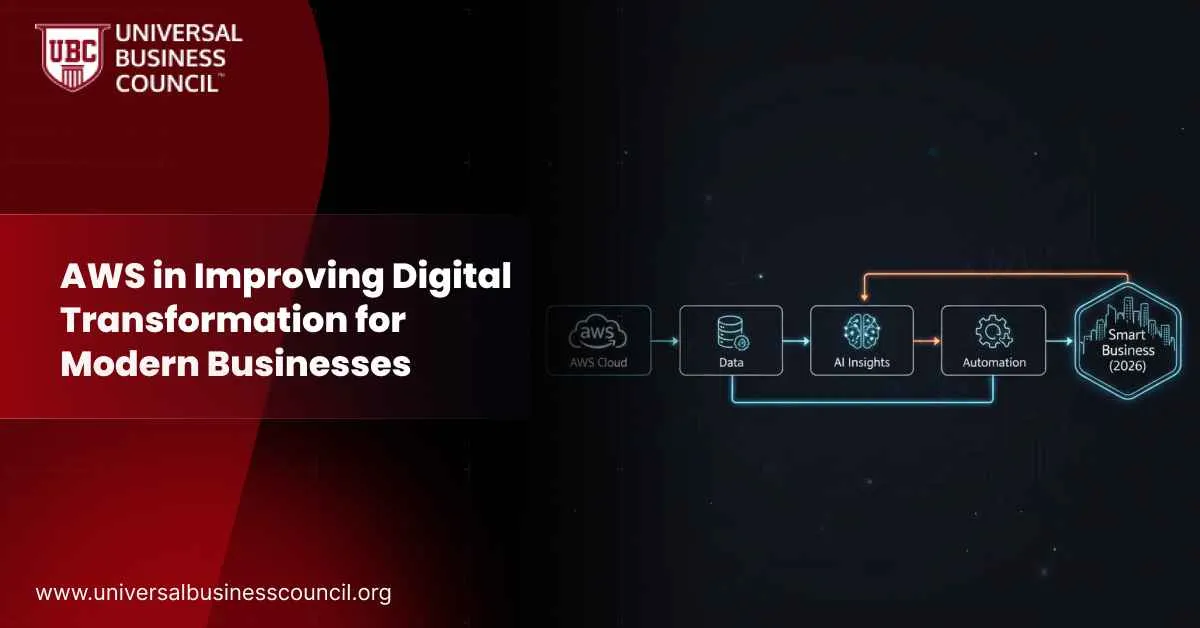 Digital transformation has become the defining priority for modern enterprises, but the meaning of transformation has shifted. It is no longer just about moving servers to the cloud or digitizing a few processes. In 2026, digital transformation means building intelligent, connected, scalable systems that support automation, data driven decisions, and real business agility. Amazon Web Services is at the center of this shift, giving organizations the tools they need to modernize with speed and stability.
Many business leaders preparing for cloud transformation begin by strengthening their strategic understanding of technology through programs like the Digital Marketing Course. A solid grounding in how data flows through marketing, customer analytics, and automation often makes it easier to understand how AWS fits into the broader business ecosystem. Once that foundation is set, AWS becomes a powerful engine for real operational and strategic change.
AWS has become more than a cloud platform. It functions as a complete ecosystem that supports modernization across operations, analytics, infrastructure, cybersecurity, and product development. This article explores how AWS is improving digital transformation for modern businesses in 2026, backed by real case studies and current industry direction.
Digital transformation has become the defining priority for modern enterprises, but the meaning of transformation has shifted. It is no longer just about moving servers to the cloud or digitizing a few processes. In 2026, digital transformation means building intelligent, connected, scalable systems that support automation, data driven decisions, and real business agility. Amazon Web Services is at the center of this shift, giving organizations the tools they need to modernize with speed and stability.
Many business leaders preparing for cloud transformation begin by strengthening their strategic understanding of technology through programs like the Digital Marketing Course. A solid grounding in how data flows through marketing, customer analytics, and automation often makes it easier to understand how AWS fits into the broader business ecosystem. Once that foundation is set, AWS becomes a powerful engine for real operational and strategic change.
AWS has become more than a cloud platform. It functions as a complete ecosystem that supports modernization across operations, analytics, infrastructure, cybersecurity, and product development. This article explores how AWS is improving digital transformation for modern businesses in 2026, backed by real case studies and current industry direction.






Leave a Reply