

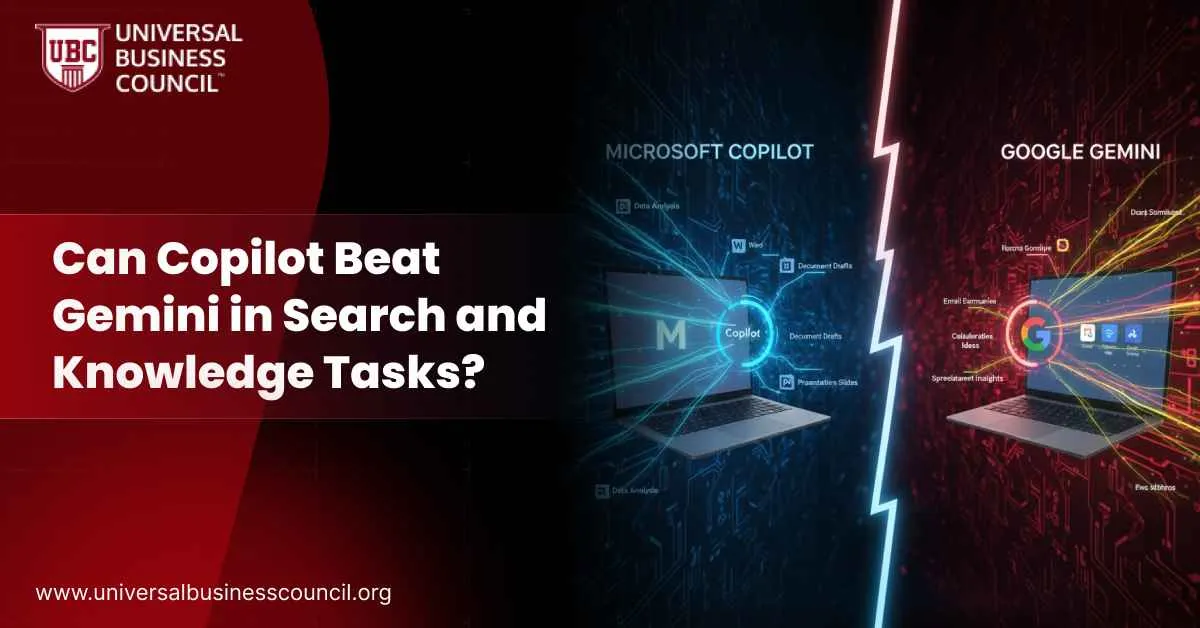
 Search and knowledge are the real tests of any AI assistant. People want fast, accurate answers, supported by clear sources, and ideally wrapped into their daily workflow. Microsoft’s Copilot and Google’s Gemini are now the leading rivals in this space. Both promise to combine generative models with live web results, but they approach the challenge differently. So, can Copilot actually beat Gemini when it comes to search and knowledge tasks?
If you’re thinking about how these AI assistants are transforming business strategies, the Marketing and Business Certification is a useful way to learn how to apply these tools at scale.
Search and knowledge are the real tests of any AI assistant. People want fast, accurate answers, supported by clear sources, and ideally wrapped into their daily workflow. Microsoft’s Copilot and Google’s Gemini are now the leading rivals in this space. Both promise to combine generative models with live web results, but they approach the challenge differently. So, can Copilot actually beat Gemini when it comes to search and knowledge tasks?
If you’re thinking about how these AI assistants are transforming business strategies, the Marketing and Business Certification is a useful way to learn how to apply these tools at scale.
What Copilot Brings to the Table
Microsoft Copilot has its strongest advantage inside the Microsoft ecosystem. In Word, Excel, Outlook, and Teams, it can summarize, suggest, and find information by understanding the context you are already working in. That means knowledge tasks become less about opening a new app and more about asking Copilot directly in the document or email you’re editing. In search, Copilot benefits from Microsoft’s work in Bing and Edge. Copilot Mode in Edge can analyze your open tabs, fetch data, compare content, and even assist with reservations. For users tied into Microsoft 365, this tight integration makes Copilot a reliable assistant that feels like part of the workflow rather than a separate tool. Copilot has also shown stronger performance in provenance, at least in some technical areas like code generation. Studies suggest it provides more relevant links to back up its outputs than Gemini does. This matters in knowledge work, where trust is just as important as speed.Where Gemini Stands Out
Google’s Gemini takes a broader view. It is integrated into Search, Android, Docs, Gmail, and even smart TVs and home devices. With Gemini 2.5, the assistant can handle multimodal prompts, reasoning across text, images, and diagrams in one go. That makes it powerful for research and exploration. For search specifically, Gemini’s edge is clear. It draws directly on Google’s infrastructure, giving it fresher results and deeper coverage of the web. Users benefit from multi-app tasks, where Gemini can look up information in Maps, send a message in Gmail, and add an event to Calendar without leaving the chat. Gemini is also more creative. Reviews highlight its strength in brainstorming, generating variations, and tackling open-ended research questions. While Copilot may be stronger in enterprise predictability, Gemini often feels more flexible and wide-ranging.Comparing Copilot and Gemini in Search and Knowledge
Here’s a simple look at how the two compare right now:| Category | Microsoft Copilot | Google Gemini |
| Ecosystem Strength | Deeply integrated in Microsoft 365 apps (Word, Excel, Outlook, Teams) | Works across Google apps (Docs, Gmail, Search, Maps) and Android |
| Search Integration | Powered by Bing and Edge with Copilot Mode | Powered by Google Search with real-time updates |
| Provenance & Citations | Better link relevance in studies, more reliable in code tasks | Broader reach but weaker link relevance |
| Multimodal Capabilities | Limited image or diagram understanding | Strong with Gemini 2.5, handles text, image, diagram |
| Knowledge Depth | Consistent in enterprise contexts | Wider and fresher results from the web |
| Accessibility | Built into Office apps and Edge browser | Available across Android, Chrome, web, and Google services |


Leave a Reply