

AGI Timeline Shifts Forward
 Smita
Smita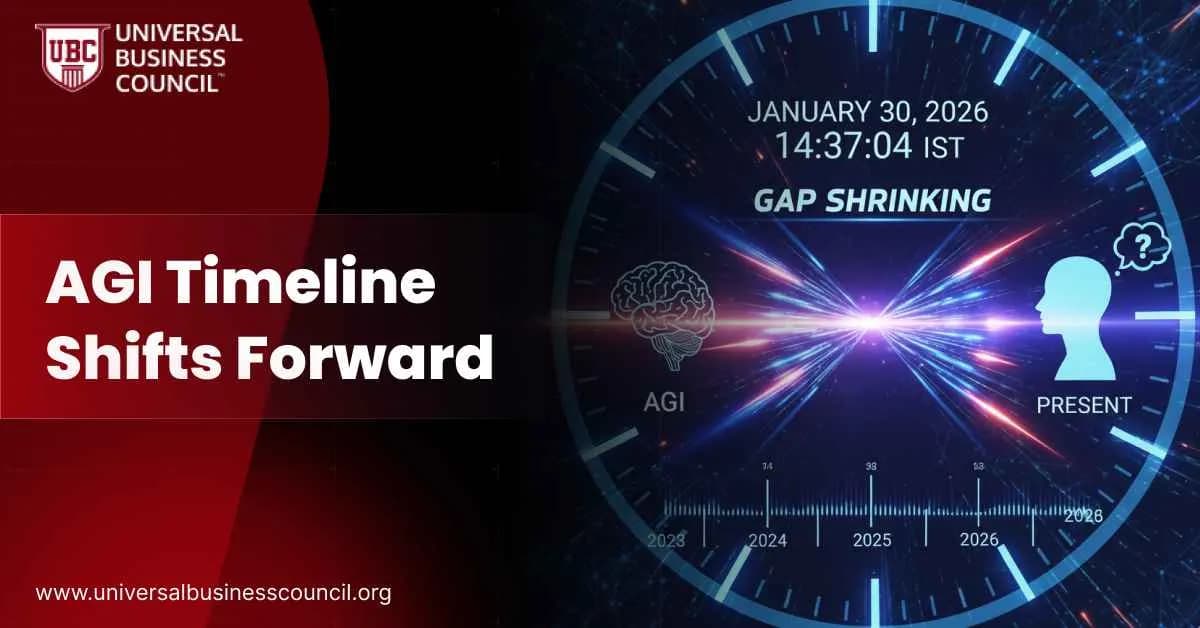
Davos 2026 context
At Davos in January 2026, the conversation around AGI became concrete. Instead of abstract futures, AI leaders tied timelines to chips, geopolitics, enterprise readiness, and labor impact. Two voices shaped the discussion:- Dario Amodei, CEO of Anthropic
- Demis Hassabis, CEO of Google DeepMind
Two timelines
The most important signal is not disagreement, but convergence toward shorter horizons.Five year estimate
Demis Hassabis described AGI as achievable in roughly five years. His view assumes continued progress, but not instant resolution of the hardest problems. The reasoning behind this estimate includes:- General intelligence requires reliability and planning, not just scale
- Compute accelerates progress but does not solve all edge cases
- The final phase involves hard-to-predict breakthroughs
Two year estimate
Dario Amodei offered a far shorter window, describing AGI as possible within two years or less. His framing was cautious in tone but aggressive in implication. His core argument centers on software automation:- If AI automates end-to-end software engineering, progress compounds
- Faster development cycles feed directly back into model improvement
- Feedback loops compress timelines dramatically
Compute and geopolitics
Once timelines shorten, access to compute becomes strategic. Advanced chips are the limiting resource for training and deploying large models. This is why export controls and hardware supply chains now sit at the center of AI policy discussions. Amodei emphasized that chip constraints are one of the few real brakes on rapid capability expansion. Remove those constraints, and competitive gaps narrow quickly. Hassabis was less confrontational in tone, but still acknowledged the importance of compute access in determining who leads. The takeaway is simple. If AGI is measured in years, chips stop being commercial infrastructure and start looking like national assets.Enterprise readiness gap
While leaders discuss near-term AGI, most organizations struggle with today’s AI. Across major surveys, patterns repeat:- A small minority of executives report clear financial gains from AI
- Many organizations see speed gains that are offset by rework
- Employees often report little or no time saved
- Fixing hallucinations
- Rewriting generic outputs
- Correcting logic or compliance issues
Leadership and workforce disconnect
Another consistent signal is perception mismatch. Executives often report saving multiple hours per week using AI. Employees frequently report minimal gains or none at all. This gap is not about motivation. It reflects shallow integration. Real gains correlate with:- Clear expectations from managers
- AI embedded into core workflows
- Shared standards for output quality
Labor impact shape
One concern raised explicitly is the shape of disruption. Rapid productivity gains combined with job displacement can produce unusual economic outcomes, including strong growth alongside rising unemployment. If automation hits high-leverage roles quickly, adjustment may feel abrupt rather than gradual. Even optimistic voices agree on one point. Adaptation must be intentional. No serious leader is suggesting that the workforce can ignore these changes.Public awareness lag
Outside AI circles, behavior still reflects old timelines. Inside AI labs, leaders are openly discussing year-scale change. That awareness gap is itself an accelerant. When planning assumptions differ this widely, systems tend to break before consensus catches up. This is why many organizations are now revisiting strategy, training, and positioning at the same time.Conclusion
AGI timeline shifts forward is not about predicting a date. It is about updating assumptions. Two influential lab leaders describe AGI in roughly five years and two years or less. Both agree acceleration is real. The consequences are already visible in policy debates, enterprise pressure, and workforce strain. The teams that adapt best will not be the ones chasing novelty. They will be the ones that reduce rework, embed AI into real workflows, and treat capability as a system, not a tool.Related Articles
View All
Artificial Intelligence
Why Could Recursive Self-Improvement Be Important for AGI?
Explore why recursive self-improvement could matter for AGI, how it might accelerate capability growth, and why it raises important questions about alignment, control, and AI safety.
Artificial Intelligence
How Are Recursive Self-Improvement and AGI Connected?
Explore how recursive self-improvement and artificial general intelligence are connected, why RSI is often discussed in AGI research, and how self-improving systems could affect future AI capabilities.
Artificial Intelligence
Gemini 4 Argon: Features, Pricing, and Availability
Gemini 4 Argon is Google’s new flagship AI model for coding, science, finance, law and security. See its main features, API and subscription pricing, and where you can access it today.
Trending Articles
The Role of Blockchain in Ethical AI Development
How blockchain technology is being used to promote transparency and accountability in artificial intelligence systems.
AWS Career Roadmap
A step-by-step guide to building a successful career in Amazon Web Services cloud computing.
Top 5 DeFi Platforms
Explore the leading decentralized finance platforms and what makes each one unique in the evolving DeFi landscape.