

Introducing Majorana 2
Introduction
Chetan Nayak, Microsoft's Technical Fellow and Corporate Vice President of Quantum Hardware, chose a precise phrase when describing Majorana 2 at Microsoft Build 2026 on June 2, 2026: "We will have a quantum machine in 2029 that can solve commercially viable, reasonable problems." For a company that had consistently refused to name a specific year, preferring only to say that useful quantum computers were "years, not decades" away, this commitment was as significant as the chip itself.
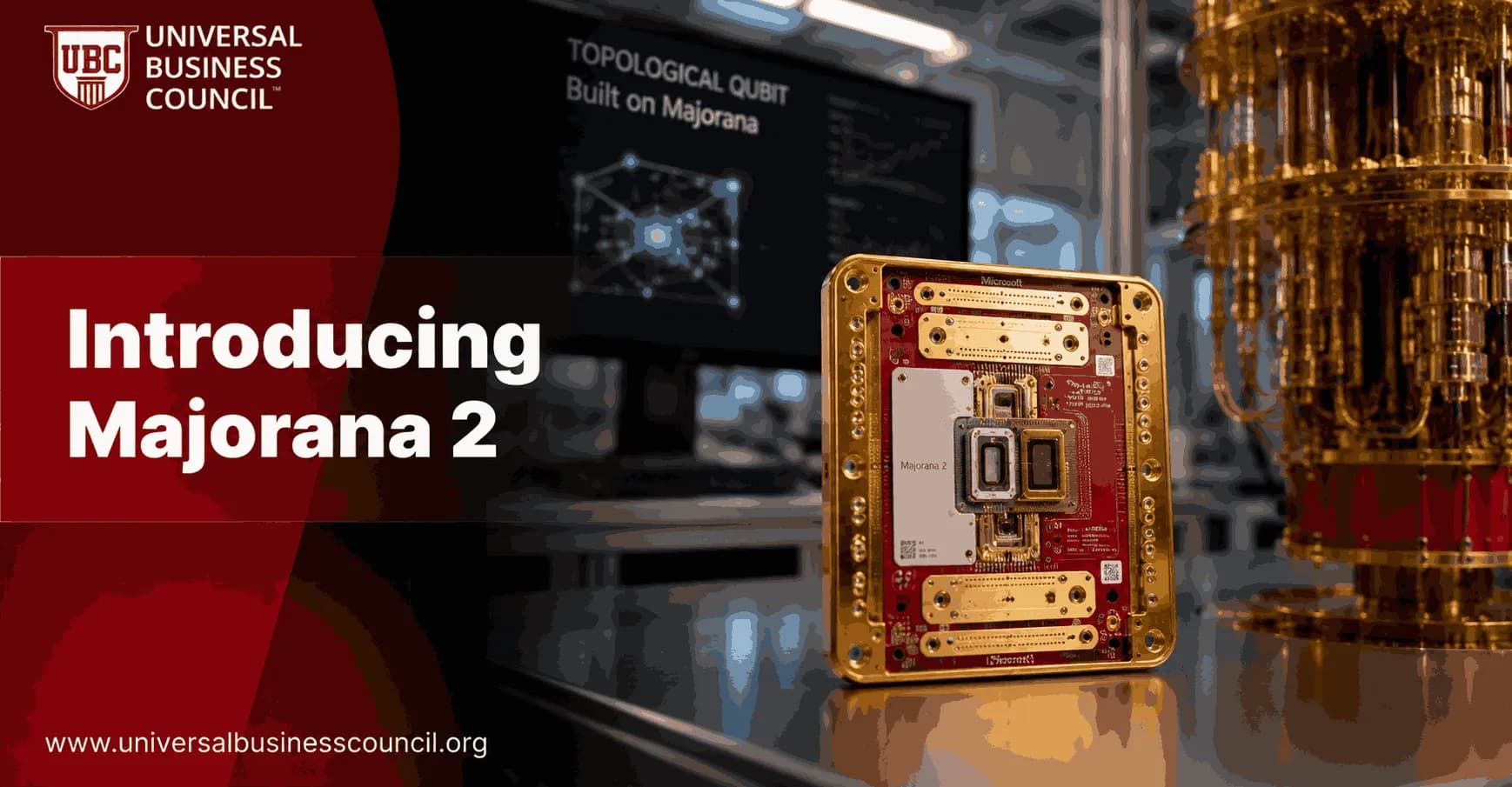
Majorana 2 is Microsoft's second-generation topological quantum processor. Its qubits maintain their quantum state for a mean of 20 seconds. Some individual devices have recorded lifetimes exceeding one minute. This compares to one-to-twelve-millisecond lifetimes in Majorana 1, representing a 1,000-fold improvement in stability. Zulfi Alam, Corporate Vice President of Microsoft Quantum, described the leap using a disarmingly simple analogy: going from a phone you charge every day to one you charge every few years.

Moreover, Majorana 2 was built differently from any quantum chip that has come before it. Critical parts of the device are designed atom by atom. The materials challenge at the heart of its design integrating lead as a superconductor into a semiconductor fabrication process was solved with the direct assistance of Microsoft's agentic AI research platform, Microsoft Discovery.
This article tells the full story of Majorana 2: the physics behind it, the materials innovation that enabled it, the AI that helped build it, the competitive landscape surrounding it, the scientific debate it has generated, and what it means for every professional working in technology, business, and research.
Understanding the Problem Majorana 2 Was Built to Solve
Why Qubit Stability Has Been the Central Barrier in Quantum Computing
Every quantum computer in existence today faces the same fundamental challenge: qubits are extraordinarily fragile. They lose their quantum state through a process called decoherence when disturbed by thermal fluctuations, electromagnetic interference, cosmic rays, or even the vibrations of nearby laboratory equipment. Most conventional quantum systems measure qubit coherence times in microseconds. This extreme fragility means that quantum computations must be completed almost instantaneously, before decoherence destroys the information the qubits are carrying.
Furthermore, short qubit lifetimes create a compounding problem for error correction. Fault-tolerant quantum computing requires each logical qubit a reliable, error-corrected unit of quantum information to be encoded across many physical qubits. The error correction process itself takes time. If the physical qubits decohere before error correction is complete, the computation fails. Therefore, extending qubit lifetime is not merely a performance improvement; it is a prerequisite for the error correction architecture that fault-tolerant quantum computing requires.
Why Microsoft Chose a Different Approach
The majority of quantum computing organisations including Google, IBM, and Amazon build their quantum systems on superconducting transmon qubits. These devices are relatively mature and have been scaled to hundreds of qubits, but they suffer from error rates that require enormous overhead in error correction hardware.
Microsoft chose a fundamentally different path: topological quantum computing. Rather than fighting qubit fragility at the software and architecture level, Microsoft sought to design qubits that are intrinsically more resistant to errors at the hardware level. This approach requires more demanding materials science and longer development timelines. However, it targets a structural reduction in error rates that Microsoft believes will ultimately make fault-tolerant quantum computation more achievable than the alternatives.
Majorana 2 is the most compelling evidence yet that this architectural bet is paying off though the scientific debate about the underlying evidence is ongoing and significant.
What Is Majorana 2? The Architecture Explained
Topological Qubits and Majorana Zero Modes
Majorana 2 is built around topological qubits quantum bits that store information not in the state of a single particle but distributed across two spatially separated points in a material called a topoconductor. The quasiparticles at these two points are known as Majorana Zero Modes. They arise at the ends of superconducting nanowires placed in contact with a semiconductor under specific conditions of temperature, magnetic field, and material quality.
Because the quantum information is shared between two physically distant points, any localised disturbance, a temperature fluctuation, a stray electromagnetic pulse cannot corrupt the information without affecting both ends simultaneously. This nonlocal encoding provides intrinsic protection that conventional localised qubits do not possess.
Tetrons: The Basic Unit of the Majorana Architecture
The operational qubit in Majorana 2 is the tetron — a device consisting of two parallel superconducting nanowires connected at their ends. Each end hosts a Majorana Zero Mode. The four Majorana Zero Modes in a tetron collectively store one topological qubit. Gate-defined controls allow the qubit to be operated and measured while maintaining its topological protection.
Critical parts of these devices are constructed at the atomic level designed atom by atom to maintain the precise material quality and geometric constraints that the topological phase requires. This atomic-scale precision is one reason why topological quantum hardware has been slower to develop than alternatives, and also one reason why agentic AI tools capable of managing complex manufacturing workflows have become central to the programme.
The Topological Gap: Protection Quantified
The topological gap is the energy barrier separating the qubit's protected state from an error-inducing state. The larger this gap, the more energy environmental noise must supply to corrupt the qubit. In Majorana 2, the topological gap is more than double that of Majorana 1, directly driving the 1,000-fold improvement in qubit lifetime.
The Materials Science at the Heart of Majorana 2
From Aluminium to Lead: A Counterintuitive Decision
The most consequential technical decision in the creation of Majorana 2 was replacing aluminium, the standard superconducting material used in Majorana 1 and widely employed across quantum computing, with lead. Lead has a larger superconducting gap than aluminium, which enables a larger topological gap in the finished device. The larger topological gap provides greater protection to the qubit directly enabling the 20-second mean lifetime.
Chetan Nayak described this choice at Build 2026 as counterintuitive. Lead is uncommonly used in precision semiconductor devices precisely because of a fundamental physical challenge: lead dissolves in water. Semiconductor fabrication uses water extensively for cleaning and processing. Introducing lead into standard fabrication sequences means the material washes away before the device can be completed. The team spent years developing entirely new processing sequences that avoided the aqueous steps that would dissolve the lead while still achieving the device quality needed for topological qubit formation.
In the words of the team's own leadership: it was a large change, and it led to large improvements in device quality.
Indium Arsenide Antimonide: The Semiconductor Update
Alongside the superconductor change, Majorana 2 updates its semiconductor active region from pure indium arsenide used in Majorana 1 to a composite of indium arsenide and indium arsenide antimonide. This composite semiconductor produces a more stable topological phase by improving the quality and uniformity of the quantum well in which the Majorana Zero Modes form. The two materials changes work together: neither alone would produce the full performance improvement.
Designed Atom by Atom
The HPCwire technical coverage of the announcement confirmed that critical parts of the Majorana 2 quantum devices are designed at the atomic level. To maintain device quality, impurity materials are used to keep each atom in its correct position within the device structure. This atomic-precision manufacturing is one of the most demanding aspects of topological quantum hardware fabrication and is a direct reason why AI-assisted manufacturing management has become essential to the programme.
Microsoft Discovery: The Agentic AI That Helped Build the Chip
What Microsoft Discovery Does
Microsoft Discovery is Microsoft's agentic AI platform for frontier research and development. It deploys autonomous AI agent teams guided by human scientific expertise to accelerate the most computationally demanding stages of scientific workflows. These include materials simulation, experimental design, process parameter optimisation, defect identification, and quality management across manufacturing runs.
At Microsoft Build 2026, alongside the Majorana 2 announcement, Microsoft made Discovery generally available as a platform for external researchers and organisations. A local version of Discovery's core capabilities can be downloaded free of charge and used with a GitHub Copilot account extending the same AI-assisted research infrastructure that helped build Majorana 2 to the broader scientific community.
For marketing professionals and business strategists working in sectors that will be reshaped by quantum-AI convergence, understanding how to communicate these developments effectively requires a Marketing Certification that incorporates AI-driven strategy and technology communication frameworks providing the language and methodology to translate complex scientific advances into compelling, commercially relevant narratives for diverse audiences.
How Agentic AI Solved the Lead Manufacturing Problem
The challenge of integrating lead into a semiconductor fabrication process without allowing it to dissolve during aqueous processing steps presented a parameter space that was too large for human researchers to navigate efficiently through sequential experimentation. Microsoft Discovery's AI agents simulated material behaviours, modelled alternative processing chemistries, predicted outcomes of different fabrication sequences, and identified the viable manufacturing pathways that the human team could then validate experimentally.
While the broader materials research programme that led to Majorana 2 began before the availability of agentic AI tools, Microsoft confirmed that Discovery is now being used more extensively for future Majorana materials work. The implication is clear: as the chip programme scales toward higher qubit counts and more complex device architectures, agentic AI will be an increasingly central component of both design and manufacturing.
For technology professionals who want to build the credentials needed to work with AI-assisted research platforms, advanced computing infrastructure, and the developer tools powering scientific hardware like Majorana 2, a Tech Certification provides the practical, verified technical knowledge needed to operate confidently in this rapidly evolving environment. Furthermore, those specifically wanting to develop expertise in how autonomous AI agents work the agent architectures, deployment patterns, and orchestration systems that power platforms like Microsoft Discovery will find an Agentic AI certification provides the structured, specialised knowledge that separates practitioners who understand these systems from those merely familiar with the terminology.
The Broader Significance: AI Accelerates Scientific Hardware Development
Majorana 2 establishes a documented precedent that agentic AI can solve key materials and manufacturing challenges in frontier hardware development. This matters beyond quantum computing. If AI agents can compress a years-long materials engineering challenge into a manageable development timeline for a quantum chip, the same model applies to semiconductor design, pharmaceutical materials, energy storage chemistry, and any domain where experimental parameter spaces are too vast for human researchers alone.
Key Specifications and Performance Data
Current Chip Size: 12 Qubits
At the time of the Build 2026 announcement, the current Majorana 2 chip contains 12 qubits. Zulfi Alam, Corporate Vice President of Microsoft Quantum, confirmed this directly, noting that achieving a commercially useful quantum computer by 2029 would require millions of qubits, a scale that demands both continued materials progress and significant advances in manufacturing yield and chip architecture.
Mean Qubit Lifetime: 20 Seconds
The mean qubit lifetime of Majorana 2 exceeds 20 seconds, with individual devices recording lifetimes of up to one minute. Majorana 1's qubits had lifetimes between one and twelve milliseconds making the mean improvement greater than 1,000-fold. The Microsoft team described this using a consumer analogy: it is equivalent to going from a mobile phone that needs charging every day to one that needs charging every few years.
Topological Gap: More Than Doubled
The topological gap in Majorana 2 is more than double that of Majorana 1. This structural improvement is the physical basis for the extended qubit lifetime not simply a performance measurement but a change in the underlying energy landscape protecting the qubit from decoherence.
Operation Speed and Physical Size
Qubit operations complete in one microsecond, and individual qubits measure one-hundredth of a millimetre. Both specifications are relevant for long-term scalability: fast operations enable more error correction cycles within a coherence window, and compact physical size is essential for eventually achieving millions of qubits on a single chip.
Long-Term Architecture Goal: One Million Qubits on a Single Chip
Microsoft's stated long-term goal is to achieve one million qubits on a single chip small enough to hold in the palm of a hand. Majorana 2 with 12 qubits represents the earliest validated hardware milestone on the path toward that architecture establishing the materials and device physics on which all future scaling will depend.
The 2029 Roadmap: What Microsoft Is Committing To
A First-Ever Public Timeline
The most strategically significant aspect of the Majorana 2 announcement is not a technical specification, it is the public commitment to 2029. Microsoft had consistently declined to name a year for a scalable quantum computer throughout the entire history of its quantum programme. The June 2, 2026 announcement marked the first time the company put a year on the record.
Chetan Nayak wrote in Microsoft's official blog post accompanying the announcement: the team is accelerating its roadmap to a scalable, practical quantum computer having cut its timeline in half and aims to reach this target by 2029. He framed this milestone as a major step on the path to a fault-tolerant quantum computer capable of solving problems that affect all of humanity.
The Competitive Landscape in 2026
The 2029 target places Microsoft in direct alignment with IBM, which committed ten billion dollars to quantum machines in May 2026 and simultaneously spun off a separate company to build quantum chips for others backed by government support. Google, Amazon, and several Chinese quantum teams are pursuing comparable timelines. Therefore, 2029 is shaping up as the year when the first commercially meaningful quantum computing capability may emerge across multiple competing approaches simultaneously.
DARPA Quantum Benchmarking Initiative
Microsoft's participation in the DARPA Quantum Benchmarking Initiative provides structured external validation of its progress claims. This independent evaluation framework subjects Microsoft's results to scrutiny beyond its own publications, offering a pathway for the 2029 roadmap claims to be assessed against objective, independently verified criteria.
The Scientific Community's Response
Significant Progress, Significant Debate
The scientific reception to Majorana 2 has been divided. On one side, the 1,000-fold improvement in qubit lifetime from milliseconds to 20 seconds represents a change in physical regime that is difficult to dismiss as a measurement artefact. The doubling of the topological gap provides structural evidence of the energy barrier that topological protection theory predicts.
On the other hand, the supporting manuscript is a preprint that had not yet undergone formal peer review at the time of the announcement. Scientific American reported on June 2, 2026, that independent physicists raised concerns about the evidence, noting a mixed publication history that includes a 2021 Nature paper retraction when Microsoft's team retracted a high-profile result after external experts showed the data could have come from material imperfections rather than a topological qubit.
Some independent physicists maintain that the fundamental evidence for topological qubit formation in Microsoft's devices has not yet been independently reproduced across multiple laboratories at scale.
Why the Debate Matters and What Resolves It
The debate matters because the difference between a genuine topological qubit and an artefact of measurement would mean the difference between a valid 2029 roadmap and a delayed one. What will resolve it is formal peer review, multi-laboratory reproduction of the qubit lifetime results, and the structured independent evaluation provided by DARPA's Quantum Benchmarking Initiative.
For professionals building careers at the intersection of AI and scientific research including those working with AI-assisted research platforms like Microsoft Discovery understanding how AI systems work, where they create genuine advantage, and where their outputs require validation is a foundational competency. An AI Certification provides the structured, comprehensive foundation in AI principles, architectures, and real-world applications that enables professionals to engage with AI-assisted scientific and engineering workflows critically, effectively, and responsibly.
What Majorana 2 Means for the World
Cryptography and Cybersecurity
A fault-tolerant scalable quantum computer would be capable of breaking widely deployed public-key cryptographic protocols including RSA and elliptic-curve cryptography, the foundations of secure communications, financial transactions, and digital identity systems globally. Microsoft's 2029 roadmap makes post-quantum cryptography migration more urgent, not less. Every organisation handling sensitive data should be assessing its cryptographic infrastructure against the quantum threat timeline now.
Medicine and Drug Discovery
Quantum computers could simulate molecular interactions at a level of accuracy that classical computers fundamentally cannot achieve, enabling the design of new drugs, vaccines, and therapies with a precision and speed that current laboratory methods cannot match. The progress represented by Majorana 2 moves this potential application meaningfully closer to realisation.
Materials Science and Energy
Designing better batteries, more efficient solar cells, more effective catalysts, and novel superconducting materials all require modelling quantum mechanical interactions that are computationally intractable for classical systems. A scalable quantum computer would open this entire design space to systematic, high-fidelity exploration with transformative implications for clean energy, manufacturing, and industrial chemistry.
Climate and Environmental Modelling
Complex climate simulations, atmospheric chemistry models, and carbon capture material design all involve molecular-scale interactions that benefit from quantum simulation. A fault-tolerant quantum computer could contribute to climate science and environmental engineering at a level of fidelity not previously achievable.
FAQs
What Is Majorana 2?
Majorana 2 is Microsoft's second-generation topological quantum processor, unveiled at Microsoft Build 2026 on June 2, 2026. It features a lead-based superconducting materials stack, a mean qubit lifetime of 20 seconds, and was developed with the assistance of Microsoft's agentic AI platform, Microsoft Discovery. It represents a 1,000-fold improvement in qubit reliability over Majorana 1.
When Was Majorana 2 Announced?
Majorana 2 was announced on June 2, 2026, at Microsoft Build 2026 in San Francisco, to an audience of developers and technology professionals.
How Does Majorana 2 Differ From Majorana 1?
Majorana 1 used aluminium as its superconducting material and produced qubit lifetimes between one and twelve milliseconds. Majorana 2 replaces aluminium with lead and updates the semiconductor active region, producing a topological gap more than double that of Majorana 1 and a mean qubit lifetime exceeding 20 seconds.
What Did Microsoft Commit to at the Majorana 2 Announcement?
For the first time, Microsoft publicly committed to a specific year for a scalable, commercially viable quantum computer: 2029. This halves the company's previous estimated timeline and was directly enabled by the qubit stability improvements demonstrated in Majorana 2.
How Many Qubits Does Majorana 2 Currently Have?
The current Majorana 2 chip contains 12 qubits. Microsoft's long-term target is one million qubits on a single chip confirming that Majorana 2 is a validated hardware milestone, not a finished commercial product.
What Are Topological Qubits?
Topological qubits store quantum information across spatially separated Majorana Zero Modes exotic quasiparticles at the ends of topoconducting nanowires. Because the information is distributed rather than localised, it is inherently resistant to local environmental disturbances that corrupt conventional qubits.
What Is the Topological Gap?
The topological gap is the energy barrier protecting a topological qubit from environmental noise and decoherence. The larger this barrier, the more stable the qubit. In Majorana 2, the topological gap is more than double that of Majorana 1, which is the primary physical mechanism behind the 1,000-fold improvement in qubit lifetime.
Why Did Microsoft Replace Aluminium With Lead?
Lead has a larger superconducting gap than aluminium at millikelvin temperatures, enabling a significantly larger topological gap and longer qubit lifetimes. The challenge is that lead dissolves in water, making its integration into standard semiconductor fabrication processes a major materials engineering problem that took years to solve.
What Is a Tetron?
A tetron is the basic qubit structure in Microsoft's topological quantum architecture. It consists of two superconducting nanowires with Majorana Zero Modes at their ends. Each tetron encodes one topological qubit across its four Majorana Zero Modes.
What Does "Designed Atom by Atom" Mean?
Critical parts of Majorana 2's quantum devices are constructed at atomic precision each atom placed to maintain the material quality and geometric constraints required for topological qubit formation. This atomic-scale manufacturing is essential for producing consistent, high-quality topological devices and is one reason why AI-assisted manufacturing management has become central to the programme.
What Role Did Microsoft Discovery Play in Building Majorana 2?
Microsoft Discovery's AI agents helped manage the manufacturing complexity of integrating lead into the quantum chip's fabrication process. By simulating material behaviours and identifying viable processing sequences, it helped compress a years-long engineering challenge into a manageable development timeline.
What Is Microsoft Discovery?
Microsoft Discovery is Microsoft's agentic AI platform for frontier research and development. It deploys autonomous AI agent teams guided by human experts to accelerate scientific workflows including materials simulation, experimental design, and manufacturing quality management. It was made generally available at Microsoft Build 2026.
Is Microsoft Discovery Available Outside Microsoft?
Yes. Microsoft Discovery was made generally available at Build 2026. A local version of its core capabilities can be downloaded free of charge and used with a GitHub Copilot account.
How Does Agentic AI Accelerate Scientific Hardware Development?
Agentic AI systems can simulate material properties, model alternative processing sequences, predict fabrication outcomes, and manage manufacturing complexity at a speed and scale that human researchers cannot match through sequential experimentation. This compresses development timelines for frontier hardware — as demonstrated in Majorana 2.
Have Independent Scientists Validated Majorana 2?
As of the announcement, the supporting manuscript is a preprint not yet formally peer-reviewed. Some independent physicists have raised concerns about the evidence, citing a 2021 Nature paper retraction in Microsoft's publication history. Results are undergoing evaluation through DARPA's Quantum Benchmarking Initiative.
What Was the 2021 Nature Paper Retraction?
In 2021, Microsoft retracted a Nature paper after external researchers showed the data could have resulted from material imperfections rather than genuine topological qubit formation. This history is the basis for ongoing scepticism from some independent physicists, and it forms part of the context in which Majorana 2's claims are being evaluated.
How Does Microsoft's Approach Compare to IBM and Google?
IBM and Google use superconducting transmon qubits with higher current qubit counts but higher error rates. Microsoft's topological approach targets intrinsically lower error rates at the hardware level but is less mature and more contested. IBM committed ten billion dollars to quantum in May 2026 with a comparable 2029 timeline, confirming intensifying global competition.
What Is the DARPA Quantum Benchmarking Initiative?
The DARPA Quantum Benchmarking Initiative is an independent evaluation framework that assesses quantum computing progress claims against objective, externally verified criteria. Microsoft's participation provides a structured independent pathway for validating the Majorana 2 results beyond the company's own publications.
What Are the Cybersecurity Implications of Microsoft's 2029 Roadmap?
A commercially viable quantum computer by 2029 would be capable of breaking RSA and elliptic-curve cryptography, the foundations of most current digital security. This makes post-quantum cryptography migration an urgent operational priority for every organisation handling sensitive data, requiring planning and implementation well before 2029.
Related Articles
View All
Artificial Intelligence
Introducing MAI-Voice-2
MAI-Voice-2 is Microsoft's latest innovation in speech AI, offering enhanced voice quality, natural conversations, multilingual support, and improved speech generation capabilities. The model aims to power the next generation of AI assistants, customer service solutions, content creation tools, and enterprise applications.
Artificial Intelligence
Introducing Workspace Agents in ChatGPT
Artificial intelligence is reshaping the way professionals work, communicate, and grow. Furthermore, recent advances have moved AI well beyond simple question-and-answer interactions. Today, workspace agents in ChatGPT represent a bold new step in that evolution. They bring intelligent automation…
Artificial Intelligence
Introducing Claude Opus 4.7
Artificial intelligence continues to evolve at an astonishing pace, reshaping industries, redefining workflows, and transforming how humans interact with technology. Among the latest advancements is Claude Opus 4.7, a powerful iteration in the Claude AI family developed by Anthropic. This model…
Trending Articles
The Role of Blockchain in Ethical AI Development
How blockchain technology is being used to promote transparency and accountability in artificial intelligence systems.
AWS Career Roadmap
A step-by-step guide to building a successful career in Amazon Web Services cloud computing.
Top 5 DeFi Platforms
Explore the leading decentralized finance platforms and what makes each one unique in the evolving DeFi landscape.