

Gemma 4 12B: A Practical Guide to Google's Local Multimodal AI Model
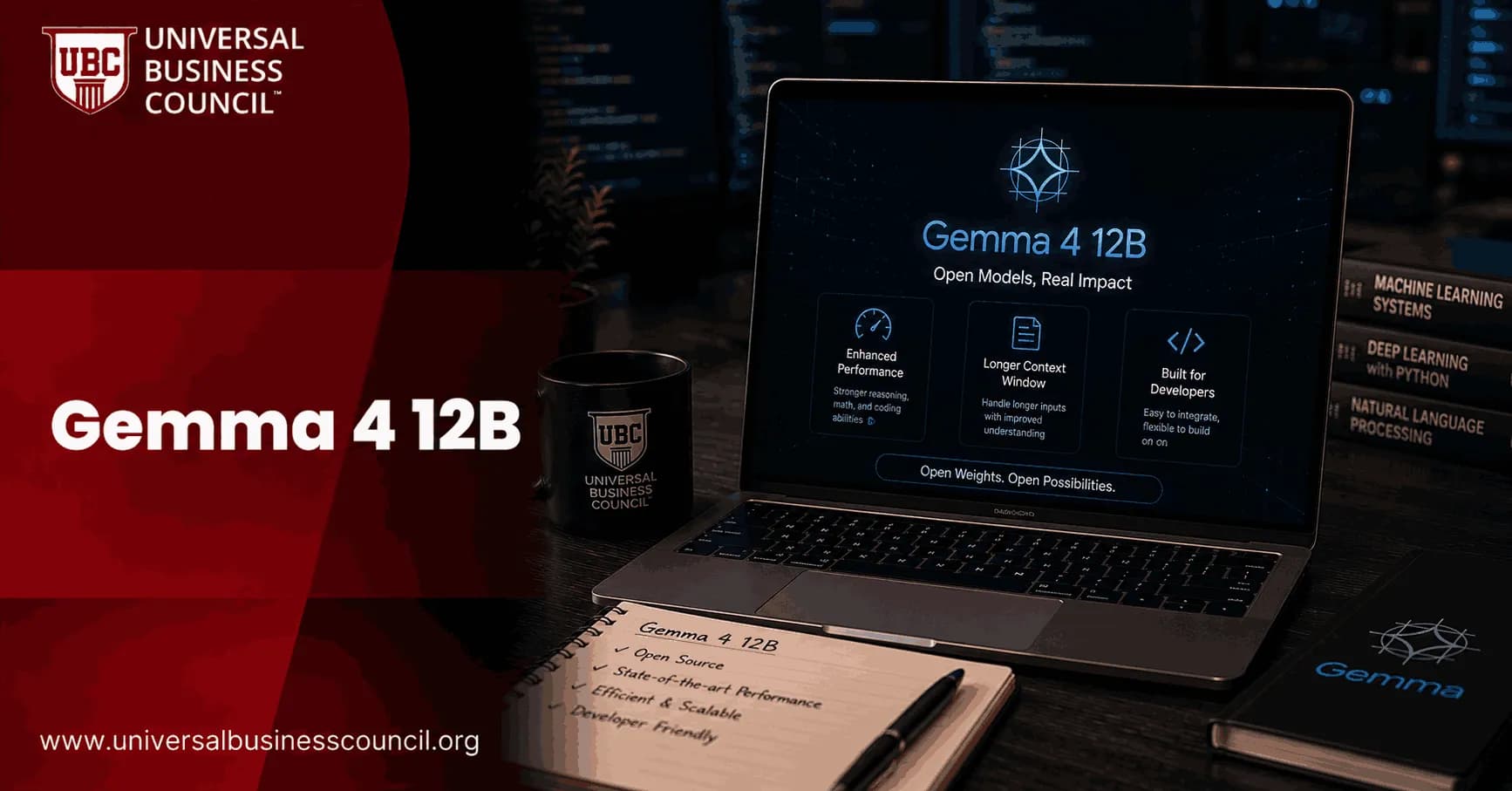
Gemma 4 12B is Google DeepMind's mid-sized open-weight multimodal model designed for professionals, developers, researchers, and organizations that need capable AI reasoning without relying entirely on cloud infrastructure. As part of the broader Gemma 4 family, it combines text, image, and audio input support with a 12 billion parameter footprint that Google positions as practical for local deployment on laptops with 16 GB of VRAM or unified memory.
For business and technology leaders, the model reflects a wider shift in artificial intelligence: advanced models are becoming smaller, more deployable, and more controllable. Rather than treating multimodal AI as a cloud-only capability, Gemma 4 12B is built for local agentic workflows, privacy-sensitive analysis, developer tooling, and enterprise experimentation.

What Is Gemma 4 12B?
Gemma is Google's family of open generative models, derived from research behind Gemini and designed for tasks such as question answering, summarization, coding, reasoning, and multimodal understanding. Gemma 4 12B sits in the middle of the Gemma 4 lineup, bridging smaller edge-focused models and larger server-grade systems.
The Gemma 4 family includes compact models for mobile and edge devices, a 12B unified model, larger dense models, and a 26B Mixture-of-Experts model. The 12B version is notable because it aims to deliver reasoning performance close to the larger 26B MoE model while using less than half the memory footprint, according to Google's public model positioning.
This makes Gemma 4 12B relevant to a broad audience:
Developers building local coding assistants, agents, and AI-enabled applications.
Enterprises evaluating privacy-preserving AI systems for internal workflows.
Researchers studying open multimodal architectures and long-context reasoning.
Technology professionals seeking practical knowledge of modern AI deployment models.
Professionals developing AI literacy may also connect this topic with Universal Business Council learning pathways in artificial intelligence, business analytics, digital transformation, and technology management.
Key Technical Features of Gemma 4 12B
Unified Encoder-Free Multimodal Architecture
One of the most important design choices in Gemma 4 12B is its unified, encoder-free architecture. Traditional multimodal models often use separate encoders for vision, audio, and language. These encoders transform images or audio into representations that are then passed to the language model.
Gemma 4 12B takes a different approach. Google describes the model as feeding visual and audio signals directly into the LLM backbone through linear projection. This can reduce latency and memory overhead because the system does not need separate modality-specific encoder stacks. For local use, this matters: every reduction in memory and computational cost improves the chance that a model can run efficiently on consumer or workstation hardware.
Text, Image, and Audio Inputs
Gemma 4 12B supports text, image, and audio inputs with text output. This gives it a strong foundation for multimodal workflows, including document analysis, screenshot interpretation, transcription-supported reasoning, and local assistants that combine multiple information types.
Example tasks include:
Answering questions about charts, user interfaces, and diagrams.
Summarizing long documents that include both text and images.
Analyzing audio inputs as part of meeting, research, or customer support workflows.
Combining written prompts with visual context for more accurate reasoning.
Long Context Windows
Gemma 4 12B is positioned among the medium Gemma 4 models, which ecosystem documentation describes as supporting context windows up to 256K tokens. Long context is valuable for knowledge work because it allows a model to process much larger inputs in a single session.
In practice, long context can support:
Large codebase analysis and refactoring assistance.
Multi-document research review.
Contract, policy, or compliance analysis.
Long meeting transcripts and project histories.
For managers and analysts, this can reduce the need to manually split information into small fragments before asking the model for help.
Local Deployment and Hardware Requirements
A defining feature of Gemma 4 12B is its local deployment target. Google has indicated that the model can run on laptops with 16 GB of VRAM or unified memory. This places it in a practical category for developers using modern laptops and workstations, not only specialized AI servers.
Local execution offers several operational advantages:
Privacy: Sensitive code, documents, images, or audio can remain on the device or within an on-premise environment.
Latency: Responses can be faster when inference does not require a round trip to a remote cloud API.
Cost control: Teams can reduce recurring API costs for high-volume internal workflows.
Resilience: Local tools can continue working when connectivity is limited or cloud access is restricted.
Gemma 4 models can also run with different precision settings. Default 16-bit precision provides higher fidelity, while quantization can reduce memory requirements and improve inference speed. For enterprise teams, testing multiple quantization levels is an important part of deployment evaluation, because speed, quality, and hardware compatibility must be balanced.
Open Weights and Apache 2.0 Licensing
Gemma 4 12B is released as an open-weight model under the Apache 2.0 license. This is significant because it allows commercial use, modification, and fine-tuning, subject to the standard terms of that license. For organizations, open weights can improve auditability and reduce vendor lock-in.
Open deployment does not remove governance responsibilities. Enterprises should still document model sources, evaluate risks, maintain acceptable use policies, and monitor outputs in production. Professionals pursuing Universal Business Council certifications in artificial intelligence, project management, or business strategy can use models like Gemma 4 12B as practical case studies in AI governance and operational risk management.
Agentic Workflows and Function Calling
Gemma 4 models are positioned for agentic workflows, where a model does more than answer a single question. In agentic systems, the model may plan steps, call tools, retrieve data, write code, or interact with software systems. Ecosystem tools such as Ollama highlight native function-calling support, which is useful for building local agents that can connect to APIs, files, databases, and automation scripts.
Potential examples include:
Developer agents: A local assistant reviews a codebase, proposes changes, runs tests, and explains failures.
Business research agents: A model reads reports, extracts themes, and produces structured summaries.
Operations assistants: An internal tool checks logs, queries systems, and recommends next actions.
Learning assistants: A local tutor reviews course materials, images, and audio notes to support professional development.
Gemma 4 12B also ships with Multi-Token Prediction drafters, which are intended to reduce inference latency by predicting several tokens in parallel. Lower latency is especially relevant for agents because multi-step tasks may require many model calls.
Use Cases for Professionals and Enterprises
Local Coding Assistants
Gemma 4 12B is well suited for local developer tools. Its parameter scale, long context, and local runtime compatibility make it a candidate for code explanation, refactoring, documentation, and debugging. Organizations with proprietary codebases may find local inference valuable because source code does not need to leave the developer environment.
Multimodal Knowledge Work
Because the model can process text and images, it can help users analyze dashboards, diagrams, forms, scanned documents, and screenshots. This is useful in consulting, operations, marketing analytics, product management, and training environments.
Audio-Enabled Workflows
As one of the first mid-sized Gemma models with native audio input, Gemma 4 12B supports local audio reasoning workflows. Teams may use it in meeting analysis, speech-to-text pipelines, multilingual support scenarios, or research interviews where privacy and data residency are important.
Enterprise R&D and Fine-Tuning
Open weights and Apache 2.0 licensing make Gemma 4 12B attractive for experimentation. Enterprises can test domain-specific fine-tuning, retrieval-augmented generation, and local agent frameworks before committing to production architecture. This supports a measured, evidence-based AI adoption strategy.
How Gemma 4 12B Compares in the AI Market
The most important comparison is not only between Gemma 4 12B and larger models. It is between cloud-first AI and local-first AI. Larger cloud-hosted models may still outperform smaller local systems on some complex benchmarks, but local models provide advantages in privacy, control, cost predictability, and customization.
Gemma 4 12B is part of a trend toward powerful on-device multimodal AI. Similar open model ecosystems increasingly compete on context length, licensing flexibility, tool calling, and hardware efficiency. For decision-makers, the right question is not simply which model is largest. The better question is which model offers the best fit for a specific workflow, risk profile, hardware environment, and governance requirement.
Conclusion: Why Gemma 4 12B Matters
Gemma 4 12B is a meaningful development in open multimodal AI because it combines a practical 12B parameter size, text-image-audio input support, long-context capability, local deployment, and an Apache 2.0 license. It is designed to bring advanced reasoning and agentic workflows to laptops and workstations, making it relevant for developers, enterprises, educators, and technology professionals.
For organizations, the model should be evaluated not as a novelty but as part of a broader AI strategy. Its value lies in the balance between capability and control: strong multimodal reasoning, local execution, open weights, and practical integration with developer tooling. Professionals who want to deepen their understanding of these trends can explore Universal Business Council certification pathways in artificial intelligence, business analytics, digital transformation, and technology leadership as a structured next step.
FAQs
1. What Is Gemma 4 12B?
Gemma 4 12B is a 12-billion-parameter open AI model from Google's Gemma family, designed for tasks such as text generation, reasoning, coding, summarization, and conversational AI applications.
2. Who Developed Gemma 4 12B?
Gemma 4 12B was developed by Google as part of its open-model ecosystem, providing developers and researchers with access to advanced AI capabilities.
3. What Does “12B” Mean in Gemma 4 12B?
The "12B" refers to the model's approximately 12 billion parameters, which are the internal values used to learn patterns and generate outputs.
4. What Are the Main Capabilities of Gemma 4 12B?
The model can perform content generation, question answering, coding assistance, summarization, reasoning, translation, and conversational tasks.
5. How Does Gemma 4 12B Compare to Smaller Models?
Compared to smaller models, Gemma 4 12B generally offers stronger reasoning, better language understanding, improved context handling, and higher-quality outputs.
6. Is Gemma 4 12B Open Source?
Gemma models are released with open weights and licensing terms that allow developers to build, customize, and deploy AI applications, subject to Google's licensing requirements.
7. What Industries Can Use Gemma 4 12B?
Industries such as healthcare, finance, education, software development, customer support, marketing, and research can benefit from its capabilities.
8. Can Gemma 4 12B Be Used for Coding Tasks?
Yes, Gemma 4 12B can assist with code generation, debugging, documentation, code explanations, and software development workflows.
9. What Hardware Is Required to Run Gemma 4 12B?
Hardware requirements vary depending on deployment methods, quantization techniques, context length, and performance expectations, but modern GPUs are commonly used.
10. Can Gemma 4 12B Run Locally?
Yes, many developers run Gemma 4 12B locally using optimized inference frameworks and quantized versions to reduce hardware requirements.
11. How Does Gemma 4 12B Handle Long Contexts?
The model is designed to process substantial amounts of context, helping it maintain coherence across longer conversations and documents.
12. Is Gemma 4 12B Suitable for Enterprise Applications?
Yes, businesses can use it for workflow automation, knowledge management, customer support, content creation, and internal AI solutions.
13. How Does Gemma 4 12B Support AI Research?
Researchers can use the model for experimentation, benchmarking, fine-tuning, model evaluation, and developing new AI applications.
14. Can Gemma 4 12B Be Fine-Tuned?
Yes, organizations and developers can fine-tune the model on domain-specific datasets to improve performance for specialized use cases.
15. How Does Gemma 4 12B Compare to Proprietary AI Models?
Comparisons often focus on reasoning ability, cost, deployment flexibility, customization options, privacy controls, and overall performance.
16. What Are the Benefits of Using Gemma 4 12B?
Benefits include deployment flexibility, local hosting options, customization capabilities, reduced vendor dependency, and strong AI performance.
17. What Are the Limitations of Gemma 4 12B?
Like all language models, it may occasionally generate inaccurate information, misunderstand context, or require human review for critical decisions.
18. How Can Businesses Deploy Gemma 4 12B Securely?
Organizations can implement access controls, monitor usage, secure training data, apply governance policies, and regularly evaluate model outputs.
19. What Are Common Use Cases for Gemma 4 12B?
Common use cases include chatbots, virtual assistants, content generation, coding copilots, document analysis, research assistance, and workflow automation. Humanity has discovered that if a model can read, write, and summarize, someone will immediately ask it to handle the meeting notes.
20. What Is the Future of Gemma 4 12B and Open AI Models?
The future includes stronger reasoning capabilities, improved efficiency, multimodal functionality, better customization options, and broader adoption of open AI models across enterprise and consumer applications.
Related Articles
View AllArtificial Intelligence
Jev Model Architecture
Explore the Jev model architecture, including its System One design, parallel sampler, RLCD training, structured inputs, typed outputs, and calibrated probabilistic decisions.
Artificial Intelligence
What Is a System One Model?
Learn what a System One Model is, how it differs from traditional LLMs, and how it delivers fast, typed, probabilistic decisions for software automation.

Artificial Intelligence
Jev AI: Complete Guide
A complete guide to Jev AI, covering TypeSafe AI’s System One Model, its architecture, typed decisions, calibrated probabilities, automation use cases, and differences from traditional LLMs.
Trending Articles
The Role of Blockchain in Ethical AI Development
How blockchain technology is being used to promote transparency and accountability in artificial intelligence systems.
AWS Career Roadmap
A step-by-step guide to building a successful career in Amazon Web Services cloud computing.
Top 5 DeFi Platforms
Explore the leading decentralized finance platforms and what makes each one unique in the evolving DeFi landscape.