

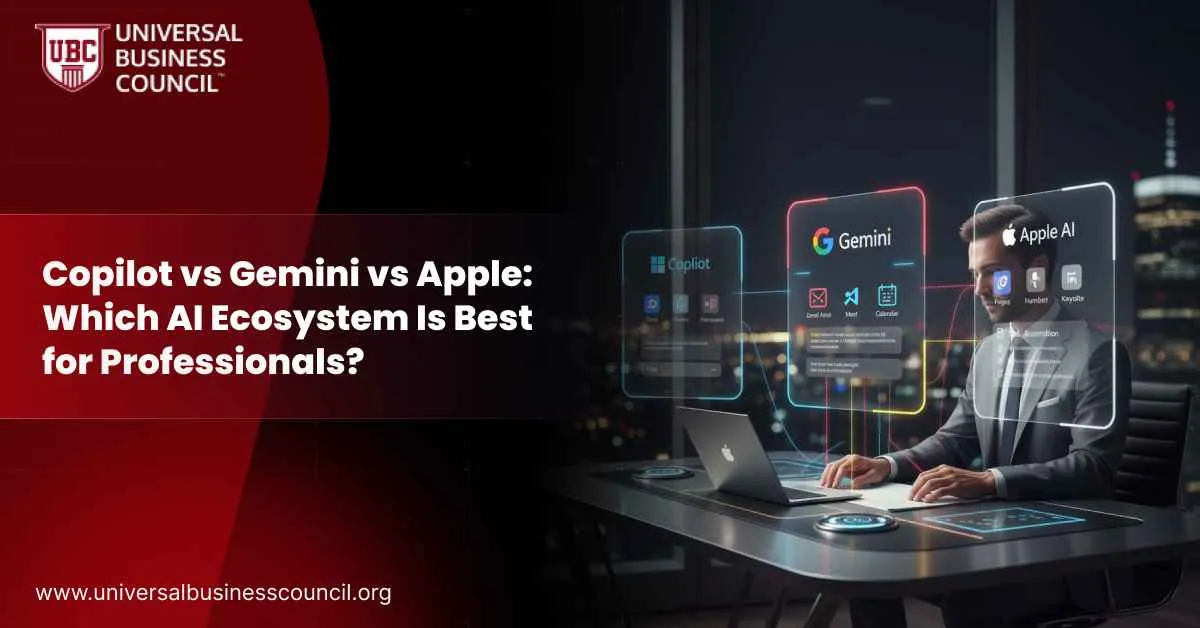
 If you’re a professional deciding between Microsoft Copilot, Google Gemini, or Apple Intelligence, the choice will shape how you work every day. These ecosystems are no longer experimental add-ons. They are running meetings, drafting reports, and managing workflows. Microsoft focuses on productivity and enterprise systems. Google pushes adaptability across apps and creativity. Apple emphasizes privacy and smooth device integration. For professionals who want to connect these tools to business growth, the Marketing and Business Certification is a strong starting point.
Microsoft Copilot: Productivity at Scale
Microsoft has built Copilot into the heart of its ecosystem. Inside Word, Excel, PowerPoint, and Outlook, Copilot speeds up professional tasks — from writing proposals to analyzing sales data. Teams integration adds real-time meeting summaries and task tracking. With Copilot Studio, AI agents can now complete actions inside apps, even legacy tools with no APIs. For enterprises, this creates huge gains in automation. But there are limits. The Recall feature on Copilot+ PCs, which takes frequent screenshots, triggered major privacy concerns before being made optional. A separate report revealed Copilot accessed millions of sensitive company files by default, showing the importance of strict governance. Copilot is powerful, but it requires organizations to balance productivity with oversight.Google Gemini: Flexibility and Creativity
Google’s Gemini has become a daily assistant that reaches across apps and platforms. It handles multi-app prompts, so you can research, draft an email, and set a meeting in one flow. Gemini is available on Android, iOS, and web, and even extends into gaming through Sidekick. For developers, Gemini 2.5 Pro is available in GitHub Copilot, showing how it’s gaining traction in professional coding environments. Gemini excels in creativity and adaptability. It supports brainstorming, writing, coding, and scheduling across services. However, compared to Microsoft, it has fewer compliance guarantees, which matters for large enterprises. For freelancers, creators, or cross-platform professionals, Gemini often feels like the most versatile partner.Apple Intelligence: Privacy and Integration
Apple Intelligence is built to feel seamless rather than overwhelming. The latest iOS 26 update added live translation in calls and meetings, plus intelligent actions through Shortcuts. Many features run on-device, with heavier requests processed in Apple’s Private Cloud Compute and deleted immediately afterward. This design offers both speed and privacy. Apple isn’t yet as enterprise-focused as Microsoft or as flexible as Google. Still, for professionals who value confidentiality and device harmony, Apple delivers a reliable option. Reports suggest Apple is exploring ways to integrate Google Gemini into Siri, which could bring more creative strength into Apple’s ecosystem.Professional AI Ecosystem Comparison in 2025
| Ecosystem | Strengths for Professionals | Weaknesses / Risks |
| Microsoft Copilot | Deep integration with Office apps; enterprise compliance; Copilot Studio automation | Privacy concerns with Recall; broad access to sensitive files if mismanaged |
| Google Gemini | Versatile across apps; supports creative and coding tasks; works on all major platforms | Fewer enterprise compliance guarantees; less transparent data handling |
| Apple Intelligence | Privacy-first design; smooth hardware and software integration; live translation features | Limited enterprise focus; advanced features only on latest devices |
| Cross-app Coordination | Gemini strongest for chaining tasks across services | Apple more device-bound; Microsoft best inside Office but weaker outside it |
| Security and Compliance | Microsoft leads with regulatory support and controls | Apple strong in individual privacy; Google less robust in enterprise compliance |




Leave a Reply