

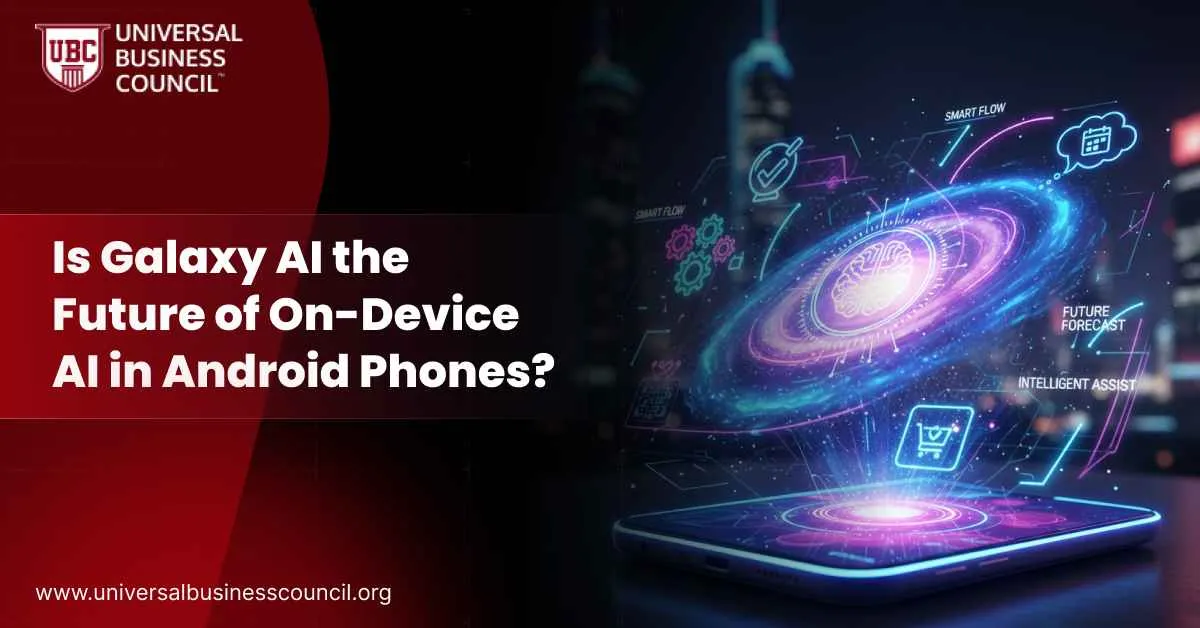
 Samsung has made no secret of its ambitions with Galaxy AI. From live translation to generative photo edits, the company wants to position its devices as leaders in everyday AI. The real question is whether Galaxy AI represents the future of on-device intelligence for Android phones—or if it’s just a stepping stone.
If you’re looking at how businesses can align with these trends, the Marketing and Business Certification offers a path to understand how AI is already shaping consumer technology choices.
Samsung has made no secret of its ambitions with Galaxy AI. From live translation to generative photo edits, the company wants to position its devices as leaders in everyday AI. The real question is whether Galaxy AI represents the future of on-device intelligence for Android phones—or if it’s just a stepping stone.
If you’re looking at how businesses can align with these trends, the Marketing and Business Certification offers a path to understand how AI is already shaping consumer technology choices.
What Galaxy AI Offers Right Now
Galaxy AI is already widely available on Samsung’s flagship devices. Features such as Live Translate, Circle to Search, transcript summaries, and writing support run locally for quick, low-latency performance. Samsung also integrated Gemini Live, adding conversational capabilities powered by Google’s models. The company has announced plans to bring Galaxy AI to over 400 million devices by the end of 2025. This scale makes it one of the largest AI rollouts in the smartphone world, giving Samsung a clear advantage in reach.Why On-Device AI Matters
Running AI tasks directly on a device brings faster response times, better reliability in areas with poor connectivity, and stronger privacy controls. Samsung’s semiconductor division is investing heavily in processors and frameworks designed for on-device AI, from language to imaging. The ProVisual Engine, introduced with the Galaxy S24 lineup, is an example of how hardware and AI are converging. These capabilities make Galaxy AI feel less like an app and more like a core part of the phone’s identity. It shows Samsung’s intention to use on-device processing as a way to differentiate itself from competitors.The Challenges for Galaxy AI
Despite its progress, Galaxy AI doesn’t yet deliver a full on-device solution. Heavy tasks such as complex generative edits or long-context reasoning still rely on the cloud. This hybrid design limits the promise of complete local control. Hardware fragmentation is another issue. Not all Galaxy devices have the same Neural Processing Units or memory capabilities. That means features may be uneven across Samsung’s vast lineup, with premium models delivering the best results while budget models lag behind. Privacy also remains a concern. While Samsung lets users toggle “on-device only” settings, doing so can reduce functionality. And because Samsung partly relies on Google’s Gemini for advanced features, its model quality depends on that partnership.Galaxy AI vs the Ideal Future of On-Device AI
| Aspect | Galaxy AI Today | The Ideal On-Device AI Future |
| Reach | Targeting 400 million devices by 2025 | Universal across all models and tiers |
| Features | Translation, summaries, generative edits, writing tools | Full multimodal reasoning, video generation, long-context tasks |
| Hardware Integration | ProVisual Engine, device NPUs | Dedicated AI processors across all devices |
| Privacy | Mix of local and cloud processing | 100% local with minimal server fallback |
| Cost | Default features remain free | Continued free access without limits |


Leave a Reply