

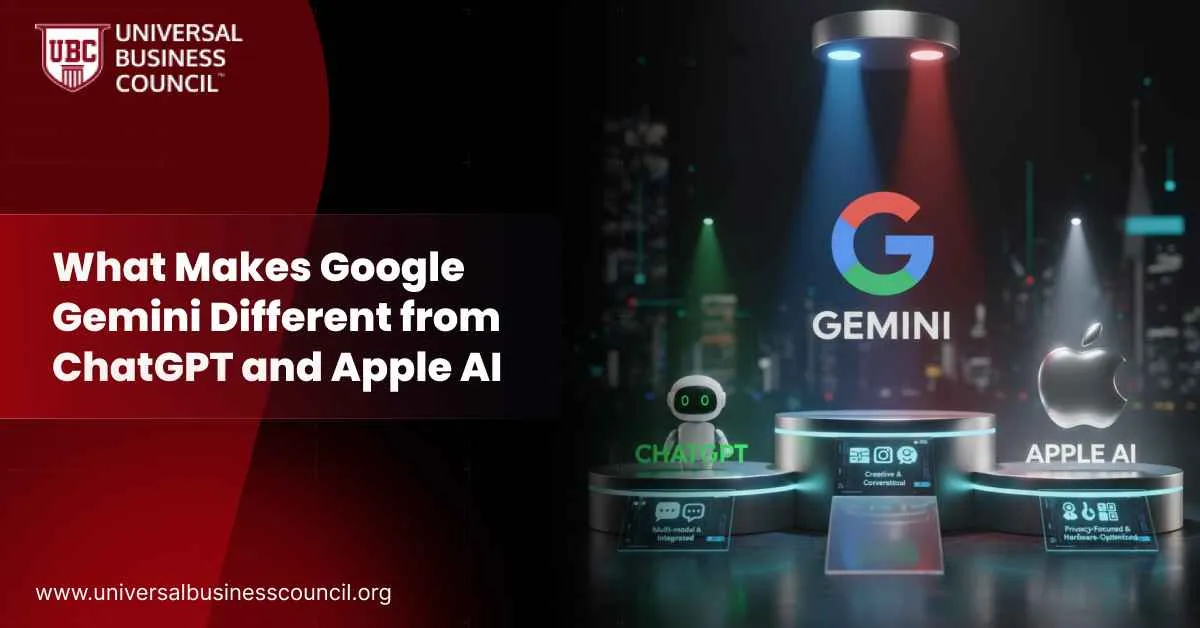
 Google, OpenAI, and Apple are all pushing their vision of artificial intelligence, but each has a distinct approach. Google Gemini stands out for its multimodal abilities and deep integration across Google’s apps. ChatGPT shines in conversational flow and creativity. Apple is focusing on privacy-first AI that runs directly on devices. Knowing these differences matters, because the tools you choose can shape how you work and create. For professionals who want to understand how such shifts influence industries, a Marketing and Business Certification is a strong way to see the business value behind AI adoption.
How Google Gemini Works
Gemini is built as a multimodal system, meaning it can process and generate text, images, audio, and even video. Unlike many other AI models, it can handle extremely large context windows, sometimes up to a million tokens, which lets it analyze entire books or long codebases at once. With Gemini 2.5, Google introduced reasoning steps where the model processes its thoughts before producing a final answer, aiming to boost accuracy. Gemini also benefits from Google’s ecosystem. It connects with Gmail, Drive, Maps, and Chrome, where it is rolling out as an agentic browsing assistant capable of booking services or summarizing across tabs. To dig deeper into how such systems are designed, tech certifications can provide the technical foundation needed to understand applied AI at scale.How Gemini Compares to ChatGPT and Apple AI
ChatGPT, developed by OpenAI, emphasizes natural conversation and creative flexibility. It works well with plugins and APIs, allowing users to expand its functionality with third-party tools. However, its context handling is more limited compared to Gemini’s massive token capacity. In extended chats, ChatGPT often maintains thread consistency better, while Gemini sometimes struggles with incomplete responses. Apple AI, branded as Apple Intelligence, takes another route. Instead of competing on raw model power, Apple is embedding AI directly into its devices. Running much of the intelligence on-device helps maintain privacy and ensures user data isn’t always shared with external servers. It’s about blending AI into daily apps like Siri, Messages, and the camera, while staying consistent with Apple’s strong privacy stance. To learn how AI fits into these different ecosystems and how to apply them in practice, AI certs offer structured guidance on using AI across real-world scenarios.Key Differences Between Gemini, ChatGPT, and Apple AI
| Feature | Google Gemini | ChatGPT | Apple AI |
| Multimodality | Strong: text, image, audio, video | Primarily text + some image | Limited, focused on device apps |
| Context Window | Up to 1M tokens | Smaller but effective | Device-limited |
| Ecosystem Integration | Deep in Google apps (Drive, Gmail, Chrome) | Flexible plugins, APIs | Native iOS integration |
| Reasoning Approach | Processes thoughts before answering | Relies on latent reasoning | Focused on user task execution |
| Conversational Flow | Sometimes less smooth in long chats | Strong and consistent | Task-driven, less conversational |
| Privacy Focus | Cloud-based with security layers | Cloud + optional APIs | On-device by default |
| Media Generation | Images, audio, video (via Veo) | Limited image generation | Basic creative tasks |
| Target Users | Heavy productivity and research users | General users, creative professionals | Apple ecosystem users |
| Strength | Scale and multimodal power | Conversational depth and plugins | Privacy and device integration |
| Weakness | Struggles with long threads at times | Smaller context windows | Limited heavy AI capabilities |


Leave a Reply