If you are applying to college right now, this question is probably sitting in the back of your mind: do colleges check for AI in application essays, and can they tell if you used it?The realistic answer is yes, colleges may scrutinize essays for AI use, but not in the dramatic, detector-driven way most students imagine. Admissions teams care far more about authenticity, consistency, and rule compliance than about chasing a percentage score from an AI tool.This becomes clearer when you look at how institutions handle integrity and decision making more broadly, which is why discussions around responsible AI use often overlap with leadership and policy thinking taught inMarketing and Business Certification programs that focus on judgment, accountability, and trust.
What admissions officers are actually evaluating
College essays are not technical audits. They are human evaluations.Admissions readers are trying to answer a few core questions:
Does this sound like a real student rather than a polished marketing piece
Does the voice feel natural and age-appropriate
Are the experiences specific, personal, and grounded in real moments
Does the writing style match the rest of the application
AI only becomes a problem when it replaces the student’s thinking instead of supporting it.
Are colleges using AI detectors?
This is where anxiety usually spikes.In practice, most colleges do not rely on AI detection tools as a deciding factor. These tools are inconsistent and produce false positives regularly. Admissions offices know this.What actually happens instead:
Decisions are never made on a single automated signal
An essay flagged by a detector is not automatically rejected. A human still reads it.
Why detectors flag perfectly normal essays
Many students panic after running their essays through multiple tools and seeing conflicting results. One tool says human-written. Another claims high AI probability.This happens because detectors often confuse:
Clear structure with automation
Neutral tone with machine writing
Strong grammar with AI assistance
Formal language with generation
None of these indicate misconduct on their own.
What actually raises concern during review
Human readers notice different things than algorithms.Red flags tend to include:
Writing that feels generic or emotionally empty
Overly polished language that does not match a student voice
Buzzwords without lived experience
Essays that sound nothing like short answers or recommendations
Ironically, trying too hard to sound impressive often creates more suspicion than simple, honest writing.
Why school policies matter more than tools
Every college sets its own rules.Many institutions now state clearly that:
Limited assistance like grammar checks may be acceptable
Students are responsible for following stated guidelines
This means the real risk is not being caught by a detector. The real risk is violating a school’s policy.Understanding where assistance ends and authorship begins is a systems issue, not a trick question. That is why structured thinking around technology use is often emphasized inTech Certification programs that cover ethics, documentation, and accountability.
What “checking” looks like in real admissions workflows
When colleges do question an essay, it usually happens in one of three ways:
Human judgment: the essay feels inconsistent or unnatural
Policy enforcement: the school has explicit rules against AI-written content
Process support: tools surface anomalies, humans decide next steps
There is no universal automated system rejecting students based on AI probability.
Why draft history matters
One of the strongest protections students have is process evidence.Keeping outlines, drafts, and revisions shows:
This issue is not really about college essays. It reflects a bigger transition.AI is entering education, work, and communication everywhere. The challenge is learning how to use it without crossing ethical lines. Organizations face the same challenge at scale, which is why governance and responsible adoption are core themes in advanced learning paths such asDeep Tech Certification programs.
Practical guidance students actually follow
Based on repeated advice from counselors and admissions professionals:
These habits matter far more than trying to outsmart a detector.
Final answer
So, do colleges check for AI in application essays?They may look closely, but not through a single automated score. What they care about is authenticity, consistency, and integrity.If your essay reflects your experiences, sounds like you, and follows the school’s rules, you are on solid ground. If your strategy depends on hiding AI use or gaming detection tools, that is where the real risk begins.


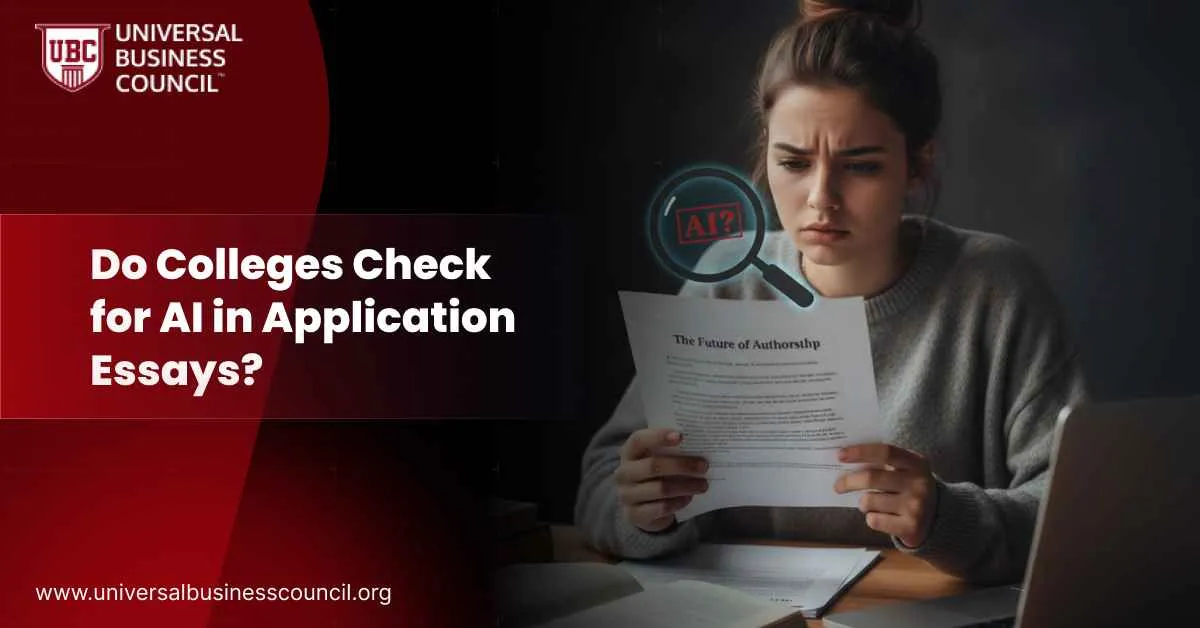 If you are applying to college right now, this question is probably sitting in the back of your mind: do colleges check for AI in application essays, and can they tell if you used it?
The realistic answer is yes, colleges may scrutinize essays for AI use, but not in the dramatic, detector-driven way most students imagine. Admissions teams care far more about authenticity, consistency, and rule compliance than about chasing a percentage score from an AI tool.
This becomes clearer when you look at how institutions handle integrity and decision making more broadly, which is why discussions around responsible AI use often overlap with leadership and policy thinking taught in Marketing and Business Certification programs that focus on judgment, accountability, and trust.
If you are applying to college right now, this question is probably sitting in the back of your mind: do colleges check for AI in application essays, and can they tell if you used it?
The realistic answer is yes, colleges may scrutinize essays for AI use, but not in the dramatic, detector-driven way most students imagine. Admissions teams care far more about authenticity, consistency, and rule compliance than about chasing a percentage score from an AI tool.
This becomes clearer when you look at how institutions handle integrity and decision making more broadly, which is why discussions around responsible AI use often overlap with leadership and policy thinking taught in Marketing and Business Certification programs that focus on judgment, accountability, and trust.


Leave a Reply