Personal Intelligence in Google AI Mode is Google’s attempt to make AI answers feel less generic and more personally useful. Instead of relying only on public web pages, AI Mode can tailor responses using your own context, as long as you allow it. That context may include your past searches, Maps activity, and if you explicitly opt in, signals from Gmail and Google Photos.From a growth and user behavior perspective, this is a major shift. Search is no longer just about relevance at scale, but relevance to one individual. That is why this feature is often discussed alongside frameworks fromMarketing and Business Certification programs, where personalization, trust, and user experience are central concerns.
What personal intelligence means
Personal Intelligence is a personalization layer built into Google AI Mode. Its purpose is to reduce repetition and guesswork by letting the AI factor in what it already knows about you.At a basic level, it can use your previous searches and location patterns. At a deeper level, if you choose to connect additional apps, it can reference information from your Gmail and Photos.The promise is simple. You ask a normal question, and AI Mode fills in some of the context automatically instead of asking you to explain everything again.
How personalization works
Baseline personalization
Even without connecting Gmail or Photos, AI Mode can personalize answers using signals Google already collects through Search and Maps.This includes:
Recent and frequent searches
Location patterns
Past interactions with similar queries
This is the default experience for most users and is often enough to improve planning and follow-up questions.
Connected apps layer
If you opt in, AI Mode can also reference Gmail and Google Photos.This enables stronger personalization for tasks like:
Travel planning using booking emails
Shopping recommendations based on past purchases
Lifestyle suggestions inferred from photo activity
An important detail many users miss is that connecting these apps allows multiple Search services to access that data, not only AI Mode.
Which AI model powers it
Google states that AI Mode runs on Gemini 3 or Gemini 3 Pro, depending on plan and feature access.The key capability here is not just language generation, but context retrieval and orchestration. The system decides when to pull personal signals, when to rely on the open web, and how to combine them safely. Understanding that difference between personalization and automation is something many people explore through aTech Certification, especially when working with complex AI systems.
Who can access personal intelligence
Baseline access
To use AI Mode with basic personalization, users generally need:
To be signed in to a personal Google account
To be 18 or older
To have Web and App Activity enabled
To have Search personalization turned on
To be in a supported region, currently the United States
Connected Gmail and Photos access
The deeper personalization layer has stricter requirements:
Baseline personalization is included as long as your activity and personalization settings are enabled.The connected Gmail and Photos experience is currently tied to paid plans:
Google AI Pro at $19.99 per month
Google AI Ultra at $249.99 per month
Users not on these plans can still benefit from activity-based personalization.
Where users encounter it
Most users access Personal Intelligence through:
Google Search, where an AI Mode tab appears once enabled
Google Account settings, where personalization and connected apps are managed
How to enable it
Step one: enable AI Mode
Go to Search Labs and turn on AI Mode. Once enabled, you should see the AI Mode option inside Google Search.
Step two: confirm personalization settings
In your Google Account:
Turn on Web and App Activity
Turn on Search personalization
If either is disabled, AI Mode responses will feel generic.
Step three: connect apps only if needed
If you want deeper personalization:
Go to Search personalization settings
Find the Personal Intelligence connected apps section
Connect Gmail and Google Photos
If you do not see this option, it usually means you do not meet one of the eligibility requirements.
Common use cases
Trip planning
AI Mode can use booking emails and past travel behavior to avoid repeating details and to tailor suggestions more accurately.
Shopping and discovery
Recommendations can reflect brands you engage with and categories you revisit, making search feel closer to a personal assistant.
Lifestyle suggestions
In some cases, Photos activity can influence recommendations. Some users find this helpful. Others find it uncomfortable.
Pros and cons
Benefits
Less prompt effort because context is already available
Faster planning and decision making
Better continuity across related searches
Limitations
Details can still be wrong, so verification matters
Privacy discomfort is common even though everything is opt-in
Confusion about what comes from connected apps versus inferred activity
Privacy and control considerations
This feature works because of permissions, not magic.What users often misunderstand is that Personal Intelligence depends on what you allow, not just what the AI can do.Key points to watch:
Connected apps expand the scope of accessible data
Shared devices can lead to awkward personalization
Personal context can make incorrect answers feel more convincing
Understanding how data flows, permissions, and governance work is a core topic in advanced system design, often explored inDeep Tech Certification paths.
Practical tips from users
Start with baseline personalization before connecting apps
Use AI Mode for high-level planning, then verify details
Ask follow-ups like “what did you base that on” if an answer feels too confident
Disconnect Gmail or Photos if the experience feels intrusive
Can it be turned off
Yes. You can disable Search personalization or Web and App Activity, and you can disconnect Gmail and Photos at any time.If the connect option does not appear, the most common reasons are region, language, age, plan eligibility, or AI Mode not being enabled in Search Labs.
Conclusion
Personal Intelligence in Google AI Mode is not about flashy features. It is about reducing repetition and making search feel more aware of your context. At its core, it uses signals Google already has, like search and Maps activity. With explicit consent, it can go further by referencing Gmail and Photos.For many users, the baseline experience is enough. It improves discovery and planning without crossing comfort boundaries. The connected apps layer is powerful, but it comes with real tradeoffs around privacy, scope, and trust.The smart approach is gradual. Start small, understand what data is being used, and only enable deeper personalization if the value is clear. When users stay in control, Personal Intelligence can make search genuinely more useful.


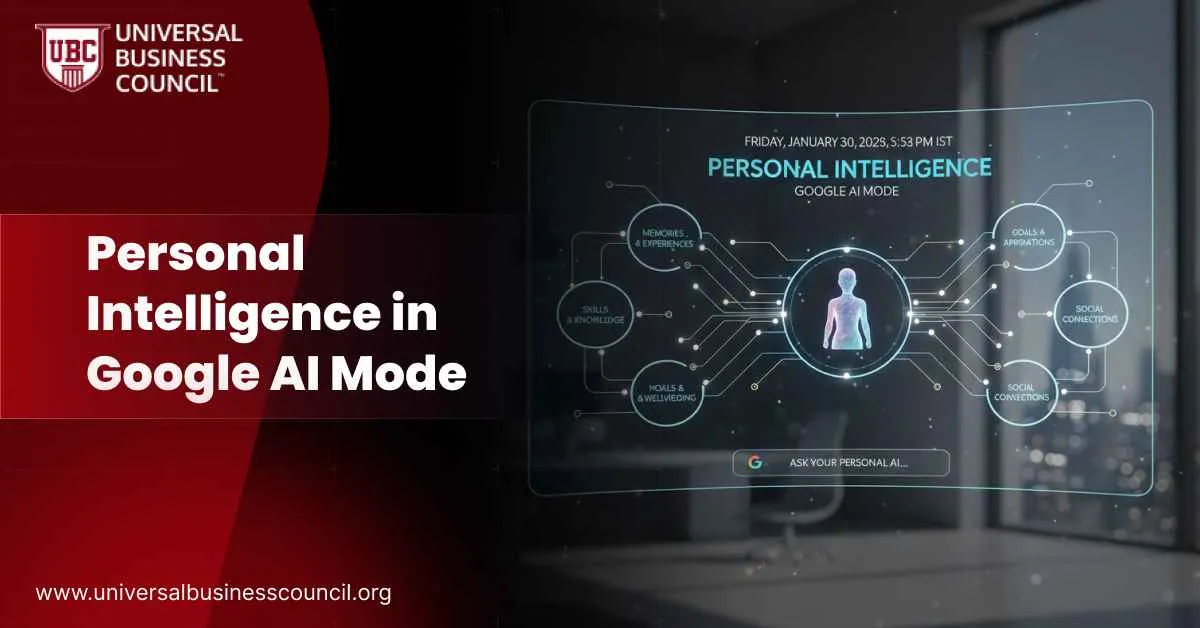 Personal Intelligence in Google AI Mode is Google’s attempt to make AI answers feel less generic and more personally useful. Instead of relying only on public web pages, AI Mode can tailor responses using your own context, as long as you allow it. That context may include your past searches, Maps activity, and if you explicitly opt in, signals from Gmail and Google Photos.
From a growth and user behavior perspective, this is a major shift. Search is no longer just about relevance at scale, but relevance to one individual. That is why this feature is often discussed alongside frameworks from Marketing and Business Certification programs, where personalization, trust, and user experience are central concerns.
Personal Intelligence in Google AI Mode is Google’s attempt to make AI answers feel less generic and more personally useful. Instead of relying only on public web pages, AI Mode can tailor responses using your own context, as long as you allow it. That context may include your past searches, Maps activity, and if you explicitly opt in, signals from Gmail and Google Photos.
From a growth and user behavior perspective, this is a major shift. Search is no longer just about relevance at scale, but relevance to one individual. That is why this feature is often discussed alongside frameworks from Marketing and Business Certification programs, where personalization, trust, and user experience are central concerns.


Leave a Reply