

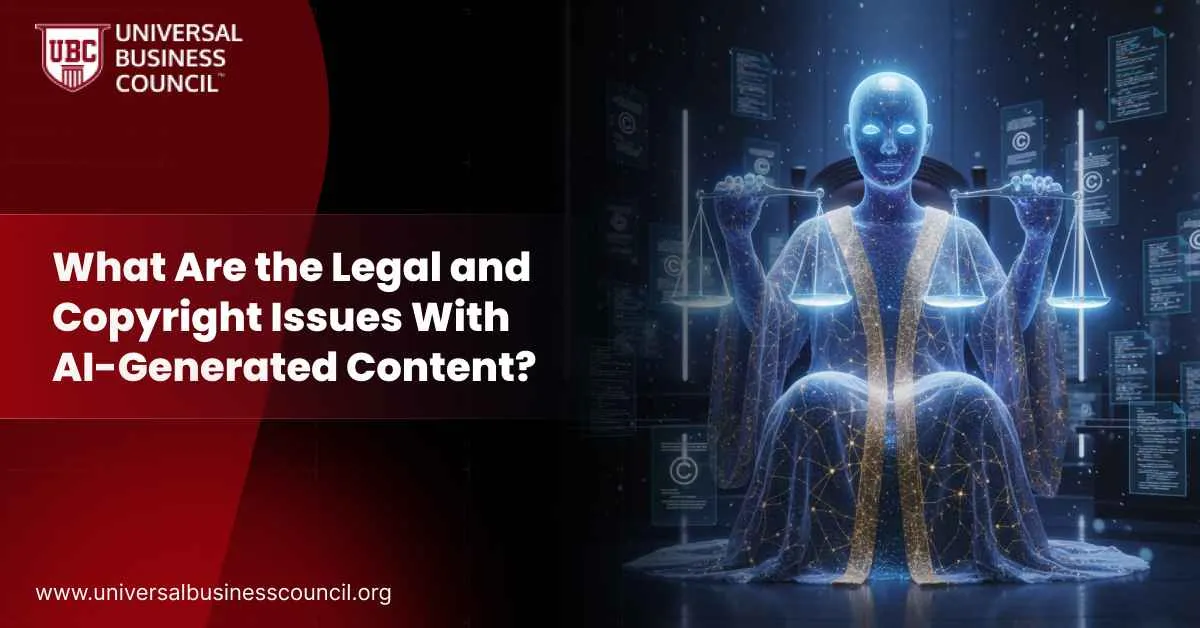
 The surge of generative AI has sparked one of today’s most urgent legal debates: who owns AI-generated content, and when does it cross into copyright infringement? Courts around the world are grappling with whether works produced by machines can be copyrighted, how training data should be treated, and who carries liability when disputes arise. These questions don’t just affect tech companies—they impact creators, businesses, and anyone using AI tools. For those who want to understand how these issues connect to industry practices, a Marketing and Business Certification can help make sense of how law and commerce intersect in the AI era.
Human Authorship and Copyright Eligibility
One of the clearest points in current law is that copyright usually requires a human author. In the U.S., courts and the Copyright Office have ruled that works created entirely by AI, with no human creative input, are not eligible for copyright protection. However, if a person provides meaningful guidance—through prompts, edits, or creative direction—the final work may qualify as a human-AI collaboration. China has gone a step further, recognizing copyright in AI-assisted works when there is original intellectual contribution from a person. For professionals aiming to understand the mechanics of how AI outputs fit into real systems, pursuing tech certifications is a practical way to connect law, technology, and application.Training Data and the Fair Use Debate
Another hot topic is whether using copyrighted material to train AI models is considered fair use. Some U.S. rulings have favored AI developers, arguing that training transforms the original works into something new and does not replace the market for the original. Yet other cases have sided with content owners, stressing that mass copying of copyrighted material without permission can amount to infringement. This split has created uncertainty for developers and users alike. To navigate such gray areas, studying AI certs is a way to build a structured understanding of how artificial intelligence operates within regulatory and ethical frameworks.Infringement Liability and Ownership
When an AI system generates content that resembles copyrighted works, the question arises: who is responsible? Liability could fall on the AI developer, the company offering the service, or the end user who created the content. Some platforms offer indemnification to protect users, but these protections vary and rarely eliminate all risks. The complexity of ownership also adds confusion—if an AI cannot hold rights, but a human’s role is minimal, who legally owns the result? Understanding the balance between responsibility and accountability is becoming essential. The Agentic AI certification provides a deeper view into how governance and responsibility can be built into AI models.Recent Cases Shaping the Debate
| Case / Company | Issue and Ruling |
| Anthropic Settlement (2025) | Agreed to pay $1.5B after claims of pirated data use in training |
| Meta Fair Use Win | Court accepted training on copyrighted books as fair use in one case |
| Disney & Universal vs Midjourney | Alleged unauthorized use of film IP to train generative AI |
| Thomson Reuters vs Ross Intelligence | Court ruled copying legal content for training was not fair use |
| Getty Images vs Stability AI | Lawsuit over scraping images without permission |
| U.S. Copyright Office | Rejected copyright claims for fully AI-generated works |
| China Court Decisions | Allowed copyright for AI works with human contribution |
| Policy Tracker (UK & EU) | Push for transparency on datasets and compensation rules |
| Creative Industry Complaints | Artists, authors, and musicians challenging AI model practices |
| Public Opinion | Split between viewing AI training as innovation vs exploitation |


Leave a Reply