

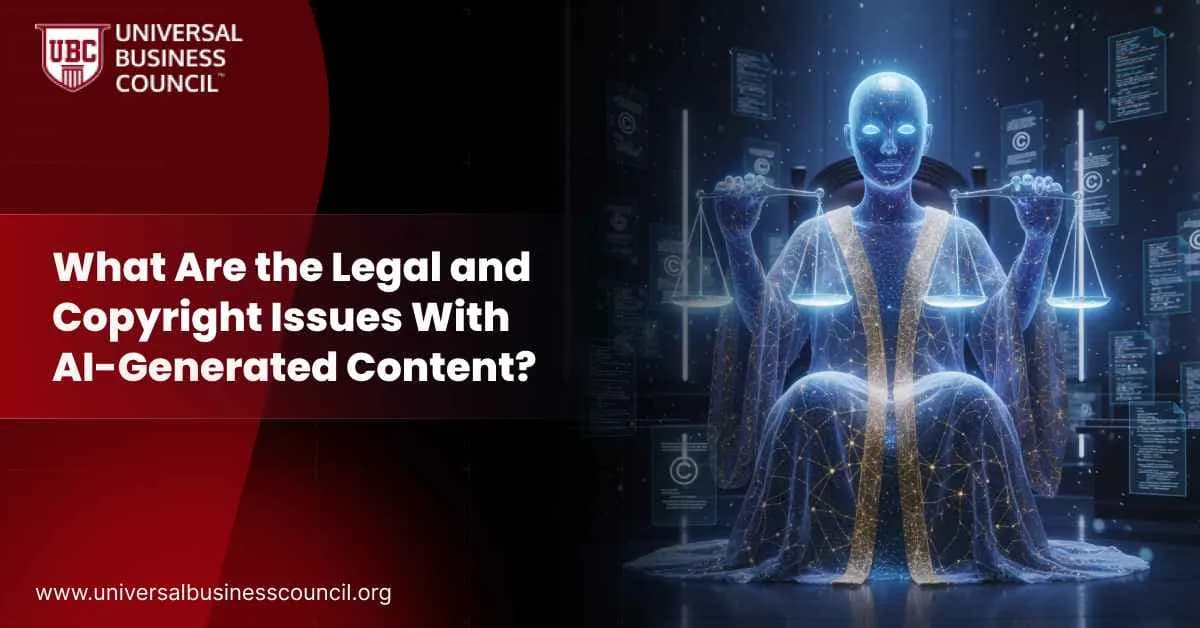
What Are the Legal and Copyright Issues With AI-Generated Content?

Human Authorship and Copyright Eligibility
One of the clearest points in current law is that copyright usually requires a human author. In the U.S., courts and the Copyright Office have ruled that works created entirely by AI, with no human creative input, are not eligible for copyright protection. However, if a person provides meaningful guidance—through prompts, edits, or creative direction—the final work may qualify as a human-AI collaboration. China has gone a step further, recognizing copyright in AI-assisted works when there is original intellectual contribution from a person. For professionals aiming to understand the mechanics of how AI outputs fit into real systems, pursuing tech certifications is a practical way to connect law, technology, and application.Training Data and the Fair Use Debate
Another hot topic is whether using copyrighted material to train AI models is considered fair use. Some U.S. rulings have favored AI developers, arguing that training transforms the original works into something new and does not replace the market for the original. Yet other cases have sided with content owners, stressing that mass copying of copyrighted material without permission can amount to infringement. This split has created uncertainty for developers and users alike. To navigate such gray areas, studying AI certs is a way to build a structured understanding of how artificial intelligence operates within regulatory and ethical frameworks.Infringement Liability and Ownership
When an AI system generates content that resembles copyrighted works, the question arises: who is responsible? Liability could fall on the AI developer, the company offering the service, or the end user who created the content. Some platforms offer indemnification to protect users, but these protections vary and rarely eliminate all risks. The complexity of ownership also adds confusion—if an AI cannot hold rights, but a human’s role is minimal, who legally owns the result? Understanding the balance between responsibility and accountability is becoming essential. The Agentic AI certification provides a deeper view into how governance and responsibility can be built into AI models.Recent Cases Shaping the Debate
| Case / Company | Issue and Ruling |
| Anthropic Settlement (2025) | Agreed to pay $1.5B after claims of pirated data use in training |
| Meta Fair Use Win | Court accepted training on copyrighted books as fair use in one case |
| Disney & Universal vs Midjourney | Alleged unauthorized use of film IP to train generative AI |
| Thomson Reuters vs Ross Intelligence | Court ruled copying legal content for training was not fair use |
| Getty Images vs Stability AI | Lawsuit over scraping images without permission |
| U.S. Copyright Office | Rejected copyright claims for fully AI-generated works |
| China Court Decisions | Allowed copyright for AI works with human contribution |
| Policy Tracker (UK & EU) | Push for transparency on datasets and compensation rules |
| Creative Industry Complaints | Artists, authors, and musicians challenging AI model practices |
| Public Opinion | Split between viewing AI training as innovation vs exploitation |
Broader Issues and Policy Shifts
Beyond courtrooms, policymakers are pushing for updated copyright frameworks to handle generative AI. Proposals include mandatory transparency in training datasets, opt-out systems for creators, and compensation models to ensure rights holders benefit. At the same time, critics warn that current laws may be stretched too far, threatening innovation and fair use principles. The debate is not just legal—it is also cultural. Some argue that AI is destabilizing the concept of copyright itself, since many AI works emerge without clear ownership. To explore the future of these emerging rules and innovations, a deep tech certification offers insights into how legal, ethical, and technical layers intersect.Global and Cultural Perspectives
Different regions are approaching the problem in distinct ways. The U.S. leans heavily on fair use doctrine, leading to split rulings. Europe is pushing transparency and accountability, aligning with its broader digital rights agenda. In Asia, courts like those in China are more open to treating AI outputs as copyrightable if humans are involved. These global differences highlight how technology evolves differently under local laws and cultures. For creators and companies operating across borders, this patchwork means extra care is needed when publishing or commercializing AI-generated content.Conclusion
AI-generated content has forced copyright law into uncharted territory. The key questions—who owns it, what counts as fair use, and who is liable—are still being debated in courts worldwide. For creators, developers, and businesses, the safest path is to treat AI content as a tool, not a replacement for human authorship, and to stay informed as policies evolve. The answers are not final yet, but the debates already shape how people create, share, and protect work in the age of AI.Related Articles
View All
Artificial Intelligence
Gemini 4 Argon: Features, Pricing, and Availability
Gemini 4 Argon is Google’s new flagship AI model for coding, science, finance, law and security. See its main features, API and subscription pricing, and where you can access it today.
Artificial Intelligence
What Is Meta Muse Wonder? Features and How It Works
Meta Muse Wonder is a new frontier AI model built for agents with Active Memory and Active Focus. Learn what it is, how it works, its features, pricing and how to access it.
Artificial Intelligence
What Is Google Playground? Features and How It Works
What is Google Playground? Learn how Google's new AI platform turns text prompts into playable browser games, which models power it, its features, pricing and access, Unity Spark plans, rival tools, and limits.
Trending Articles
The Role of Blockchain in Ethical AI Development
How blockchain technology is being used to promote transparency and accountability in artificial intelligence systems.
AWS Career Roadmap
A step-by-step guide to building a successful career in Amazon Web Services cloud computing.
Top 5 DeFi Platforms
Explore the leading decentralized finance platforms and what makes each one unique in the evolving DeFi landscape.