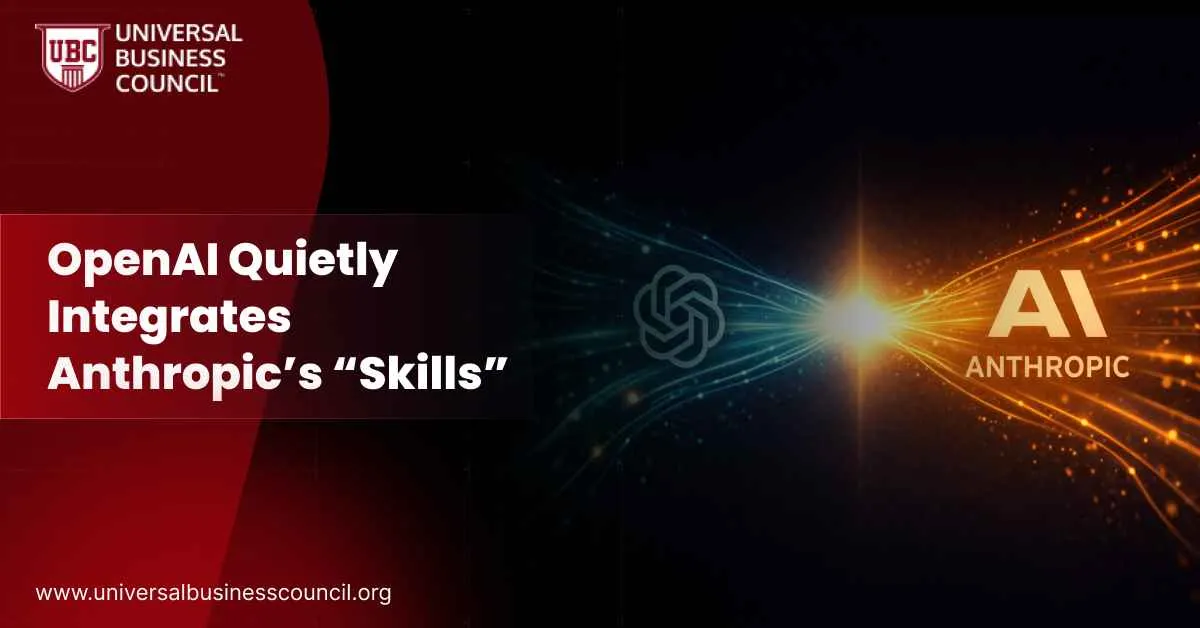
In late 2025, while public attention stayed fixed on benchmark charts and model releases, a quieter but more consequential shift was unfolding inside the AI ecosystem. OpenAI began adopting a structural idea that did not originate in-house. It came from Anthropic, and it was called “skills.” This change did not arrive with a launch event, a blog headline, or a demo video. Instead, it surfaced gradually through developer tools, internal references, and subtle confirmations from engineers. Yet this quiet move may matter more than many headline-grabbing model upgrades.At its core, the adoption of skills signals a change in how AI agents are built, scaled, and trusted in real-world environments. For professionals following AI closely, especially those building long-running systems or enterprise workflows, this shift explains why agents in 2025 feel different from agents in 2024. It also explains why OpenAI’s architecture choices increasingly resemble Anthropic’s, even as the two companies compete fiercely at the model level. For readers building foundational understanding through programs likeTech Certification, this moment is an important case study in how technical standards spread across rival organizations when they solve real problems.
The Problem AI Agents Could Not Escape
Before skills entered the conversation, AI agents faced a structural limitation that no amount of model scaling could fully fix. Agents were brittle. They relied on massive prompts, bloated system instructions, and long conversational histories to maintain context. Every new task added more tokens, more cost, and more opportunities for failure.Developers noticed the pattern quickly. Agents performed well in short demos but struggled in long-running tasks. They forgot earlier decisions. They repeated steps. They drifted into irrelevant reasoning. Even with models like GPT-5.1 and Claude Opus 4.5, coherence degraded as tasks stretched across hours instead of minutes.This was not primarily a model intelligence problem. It was an architectural one. Agents lacked a structured way to store, retrieve, and reuse procedural knowledge. Everything lived in the prompt. And prompts do not age well.
Anthropic Introduced Skills in October 2025
Anthropic addressed this problem directly in October 2025 when it introduced skills as part of its agent tooling. Rather than treating agents as monolithic reasoning engines, Anthropic broke agent behavior into modular, reusable components.A skill, in Anthropic’s design, is a folder containing structured instructions. At the center is a markdown file, commonly named skill.md, which defines what the skill does, when it should be used, and how it should behave. Additional files can include references, examples, or executable scripts.The key innovation was progressive disclosure. Instead of loading all instructions into the context window at once, the agent first reads only the skill’s name and description. Full instructions are pulled in only when the task requires that skill. This dramatically reduces token usage and improves focus.Anthropic engineers described this internally as a way to preserve coherence over long horizons. Agents no longer needed to carry their entire “brain” in memory at all times. They could fetch capabilities on demand.
Why Skills Solved a Real Pain Point
The immediate benefits of skills were practical, not theoretical.First, they reduced token bloat. Developers reported cutting tens of thousands of tokens from agent runs simply by moving procedural logic into skills.Second, they improved determinism. Because skills can include scripts or tightly scoped instructions, agent behavior became more predictable. This mattered for regulated environments and enterprise workflows where creativity is less important than reliability.Third, skills made agent systems composable. Teams could share skills across projects. A compliance skill written once could be reused everywhere. Institutional knowledge stopped being trapped inside prompts written by one engineer six months earlier.These advantages quickly became visible outside Anthropic. And that is where OpenAI enters the story.
OpenAI’s Quiet Shift Begins
OpenAI did not announce that it was adopting skills. There was no press release. Instead, signs emerged in fragments.In November 2025, developers noticed references to skill-like folders inside OpenAI’s internal tooling. Around the same time, OpenAI’s CLI tools began supporting structured instruction loading that mirrored Anthropic’s approach. By early December, OpenAI engineers confirmed in private discussions that skills were being tested inside ChatGPT workflows and internal agent systems.This timeline matters. It places OpenAI’s adoption shortly after Anthropic’s public release, suggesting rapid internal validation rather than long-term parallel development.The most telling signal was not documentation, but behavior. OpenAI agents started exhibiting the same characteristics Anthropic had highlighted: lower token usage, more consistent long-running task execution, and clearer separation between reasoning and procedure.For organizations tracking deep architectural trends rather than surface features, this was a clear sign that skills had crossed a threshold. That kind of cross-lab adoption is rare unless a solution addresses a fundamental constraint. Professionals studying systems-level change through paths likeDeep Tech Certification will recognize this as a classic example of standards emerging through necessity rather than consensus.
How Skills Differ From MCP
It is important to separate skills from another major standard gaining traction at the same time: the Model Context Protocol, or MCP.MCP focuses on how external tools communicate with models. It defines interfaces, permissions, and data flows. Skills, by contrast, focus on internal agent behavior. They define how an agent thinks, remembers, and executes tasks.Simon Willison, a respected voice in the developer community, highlighted this distinction clearly in November 2025. He noted that MCP often requires tens of thousands of tokens and custom tooling, while skills can be written in plain markdown and shared as simple folders. Any model capable of reading files can use skills. No specialized infrastructure is required.This simplicity is part of why skills spread so quickly. They are accessible to non-engineers. They fit existing workflows. And they do not lock users into a single vendor.
Benchmarks Were Not the Real Story
Around the same time OpenAI was adopting skills, benchmark conversations dominated headlines. GPT-5.2 tied Gemini 3 Pro on the Artificial Analysis Intelligence Index. It ranked first on GDP Val, a benchmark designed to measure end-to-end white-collar task completion. Claude Opus 4.5 continued to lead on certain agent benchmarks.These results mattered, but they were not the main driver of architectural change. Skills addressed something benchmarks could not measure well: long-term coherence.In enterprise environments, success is not about answering a single question correctly. It is about completing a process over hours or days without losing context. Skills made that possible in a way raw model improvements had not.
The Broader Industry Convergence
OpenAI’s move fits into a larger pattern visible throughout 2025. Competing labs increasingly adopted each other’s standards. MCP spread across OpenAI, Google, and Microsoft. Skills followed a similar path.This convergence reflects a recognition that fragmentation hurts everyone. When agents rely on incompatible architectures, ecosystems stall. Shared standards accelerate adoption, even among rivals.One OpenAI engineer described this privately as a “choose battles carefully” moment. Compete on models. Cooperate on structure.
Why This Matters for Enterprises
For businesses deploying AI at scale, skills change the economics and risk profile of agent systems.They make auditing easier. A skill can be reviewed independently of the model. They improve onboarding. New team members can understand agent behavior by reading skill files instead of deciphering massive prompts. They support governance. Versioned skills create traceability.These qualities explain why enterprise-focused teams began experimenting with skills in late 2025, often without waiting for official vendor guidance. For leaders responsible for adoption, training, and change management, insights fromMarketing and Business Certification programs increasingly emphasize this operational layer rather than model branding alone.
Conclusion
Skills represent a shift in how intelligence is packaged. Instead of asking models to remember everything, we give them access to structured capabilities. This mirrors how human organizations operate. No one carries the entire company handbook in their head. They consult it when needed.By quietly adopting Anthropic’s skills, OpenAI signaled that this approach works. It also signaled a willingness to learn from competitors when the solution is better.In hindsight, October and November 2025 may be remembered less for benchmark jumps and more for this structural alignment. Agents became less magical and more dependable. Less theatrical and more useful.That is usually how real progress looks.


 In late 2025, while public attention stayed fixed on benchmark charts and model releases, a quieter but more consequential shift was unfolding inside the AI ecosystem. OpenAI began adopting a structural idea that did not originate in-house. It came from Anthropic, and it was called “skills.” This change did not arrive with a launch event, a blog headline, or a demo video. Instead, it surfaced gradually through developer tools, internal references, and subtle confirmations from engineers. Yet this quiet move may matter more than many headline-grabbing model upgrades.
At its core, the adoption of skills signals a change in how AI agents are built, scaled, and trusted in real-world environments. For professionals following AI closely, especially those building long-running systems or enterprise workflows, this shift explains why agents in 2025 feel different from agents in 2024. It also explains why OpenAI’s architecture choices increasingly resemble Anthropic’s, even as the two companies compete fiercely at the model level. For readers building foundational understanding through programs like Tech Certification, this moment is an important case study in how technical standards spread across rival organizations when they solve real problems.
In late 2025, while public attention stayed fixed on benchmark charts and model releases, a quieter but more consequential shift was unfolding inside the AI ecosystem. OpenAI began adopting a structural idea that did not originate in-house. It came from Anthropic, and it was called “skills.” This change did not arrive with a launch event, a blog headline, or a demo video. Instead, it surfaced gradually through developer tools, internal references, and subtle confirmations from engineers. Yet this quiet move may matter more than many headline-grabbing model upgrades.
At its core, the adoption of skills signals a change in how AI agents are built, scaled, and trusted in real-world environments. For professionals following AI closely, especially those building long-running systems or enterprise workflows, this shift explains why agents in 2025 feel different from agents in 2024. It also explains why OpenAI’s architecture choices increasingly resemble Anthropic’s, even as the two companies compete fiercely at the model level. For readers building foundational understanding through programs like Tech Certification, this moment is an important case study in how technical standards spread across rival organizations when they solve real problems.


Leave a Reply