

Google’s Deep Research Agent

What Google’s Deep Research Agent Is
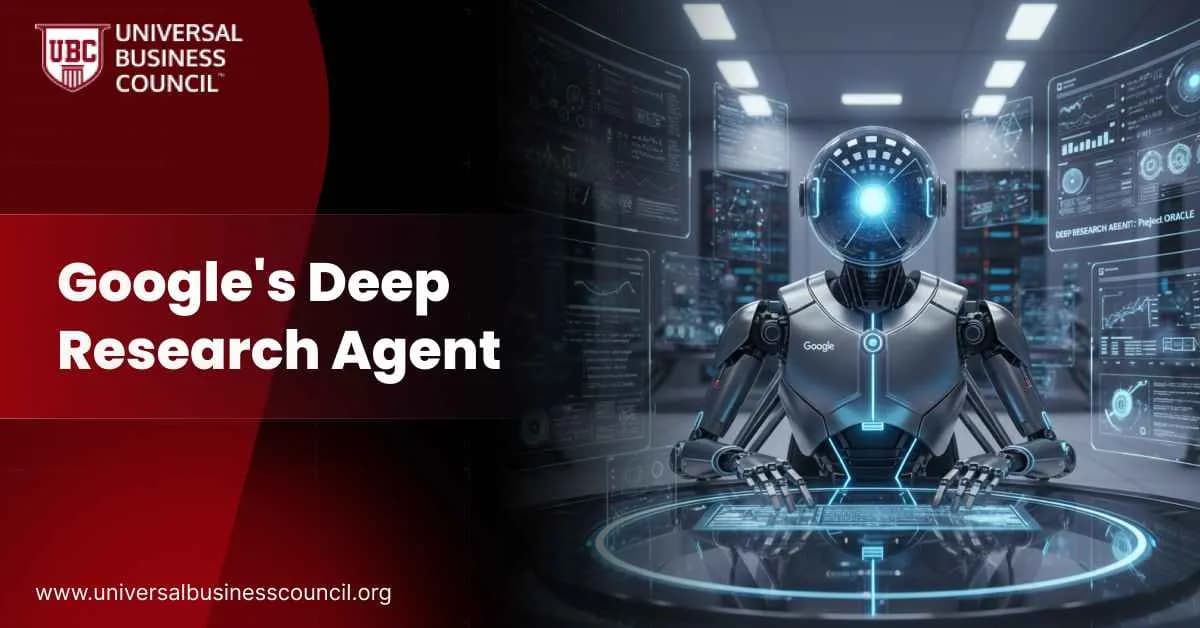
Google’s Deep Research Agent is an autonomous research system built on the Gemini model family. Its core purpose is to handle multi-step research tasks that require planning, iteration, and synthesis across many sources. Instead of generating a single response from a prompt, the agent breaks a task into sub-questions, searches for relevant material, evaluates what it finds, and then assembles a long-form output. This makes it suitable for use cases such as market intelligence, policy analysis, competitive research, academic literature reviews, and internal knowledge synthesis. The emphasis is on completeness and structure rather than speed.How the Agent Actually Works
The agent follows a plan–execute–refine loop. First, it creates a research plan based on the user’s request. Then it performs iterative searches, reads documents, and identifies missing context. If gaps appear, it adjusts its plan and continues searching. Only after this process does it generate a final report. This workflow is designed to reduce shallow synthesis and unsupported claims. By forcing the system to search and verify before writing, Google aims to improve reliability, especially for topics that span time, regulation, or technical complexity.Gemini Models and the December 2025 Upgrade
A major update arrived on 11 December 2025, when Google confirmed that the Deep Research Agent was upgraded to run on Gemini 3 Pro. This version improved long-context reasoning, planning depth, and source management. It also enhanced the agent’s ability to maintain coherence across lengthy research outputs. Gemini 3 Pro allows the agent to track multiple threads of inquiry at once, making it more effective for broad research questions that cannot be answered through a single search or dataset.Where It Lives in Google’s Ecosystem
Google has positioned the Deep Research Agent as a foundational capability rather than a standalone product. It is accessible through the Interactions API, allowing developers to embed deep research workflows into custom applications. It is also available through Google AI Studio for experimentation and prototyping. By 8 December 2025, Google announced deeper integration of Gemini Deep Research into Workspace tools such as Gmail, Drive, and Chat. This allows the agent to combine public information with a user’s internal documents, enabling more context-aware research reports for enterprise use.Developer Access and Practical Use Cases
Developers can use the Deep Research Agent to build tools that go beyond retrieval or summarization. Typical use cases include:- Competitive and market analysis for strategy teams
- Regulatory and policy research
- Scientific and technical literature synthesis
- Internal due diligence and background research
Reliability, Guardrails, and Trust
One of the main challenges with long-form AI research is trust. Google has emphasized that Deep Research is designed to be more transparent in how it reaches conclusions. The agent’s structured approach makes it easier to review findings and understand how information was assembled. Benchmarks released alongside the December 2025 upgrade showed improved performance on long-context reasoning and multi-source synthesis tasks compared to earlier Gemini-based tools. While no system is perfect, the design goal is to reduce hallucinations by anchoring outputs in iterative search and evaluation.Why This Matters for Organizations
For organizations, the value of Google’s Deep Research Agent lies in time compression and consistency. Tasks that once required hours or days of manual research can now be completed faster, with human experts focusing on interpretation and decision-making rather than information gathering. This changes how teams work. Analysts spend less time compiling data and more time applying judgment. Managers receive structured reports instead of fragmented notes. Over time, this can reshape research-heavy workflows across marketing, finance, policy, and technology functions.The Deeper Technical Direction
At a systems level, Google’s Deep Research Agent represents a move toward agentic AI, where models are not just generators of text but active participants in complex workflows. These systems plan, act, observe outcomes, and adjust their behavior accordingly. Building and maintaining such agents involves challenges in orchestration, latency management, evaluation, and cost control. These are areas typically addressed through advanced systems and infrastructure expertise, which aligns closely with the domains covered by Deep Tech Certification programs focused on large-scale, real-world AI systems.Conclusion
Google’s Deep Research Agent is still evolving, but its direction is clear. AI tools are moving away from instant answers and toward sustained analytical work. As these systems mature, they are likely to become standard components of professional research and decision-making environments. Rather than replacing human researchers, the agent shifts where human effort is applied. The work moves from gathering information to evaluating it. In that sense, Google’s Deep Research Agent is not just a new AI feature, but a signal of how knowledge work itself is changing.Related Articles
View All
Artificial Intelligence
Can Google’s AI Models Achieve Recursive Self-Improvement?
Explore whether Google’s AI models can achieve recursive self-improvement, how systems like SIMA 2 and AlphaEvolve demonstrate iterative improvement, and what technical limitations still remain.
Artificial Intelligence
Gemini 4 Argon: Features, Pricing, and Availability
Gemini 4 Argon is Google’s new flagship AI model for coding, science, finance, law and security. See its main features, API and subscription pricing, and where you can access it today.

Artificial Intelligence
What Is Meta Muse Wonder? Features and How It Works
Meta Muse Wonder is a new frontier AI model built for agents with Active Memory and Active Focus. Learn what it is, how it works, its features, pricing and how to access it.
Trending Articles
The Role of Blockchain in Ethical AI Development
How blockchain technology is being used to promote transparency and accountability in artificial intelligence systems.
AWS Career Roadmap
A step-by-step guide to building a successful career in Amazon Web Services cloud computing.
Top 5 DeFi Platforms
Explore the leading decentralized finance platforms and what makes each one unique in the evolving DeFi landscape.