

Can Google’s AI Models Achieve Recursive Self-Improvement?
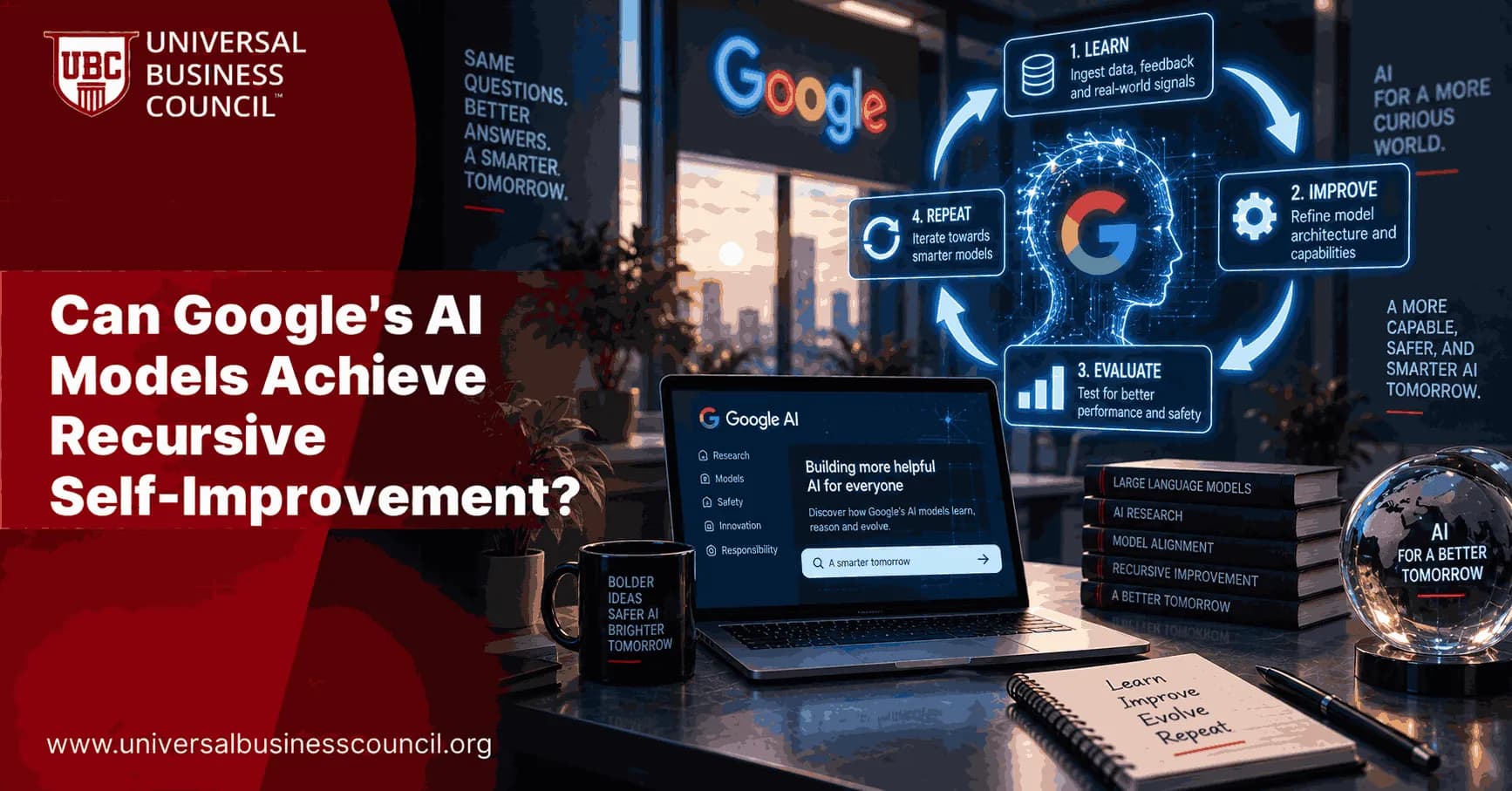
Google has become one of the most closely watched companies in the recursive self-improvement conversation, largely because of real, documented results rather than pure speculation. Through DeepMind's work on systems like AlphaEvolve, Google has shown AI genuinely improving pieces of its own infrastructure, including the very training pipeline that powers its Gemini models. As this kind of tangible progress draws attention across industries, professionals in fields like marketing, who increasingly build strategy around AI capability announcements, are also taking note, and many reinforce their broader understanding through a Marketing Certification to better anticipate how these developments might eventually filter into the tools they rely on daily.
This article looks specifically at what Google's AI systems have actually demonstrated, how close that comes to genuine recursive self-improvement, and where the real boundaries of that progress currently sit.

What Google DeepMind's AlphaEvolve Actually Does
AlphaEvolve is an AI system built by Google DeepMind that generates, tests, and refines computer code and algorithms using an evolutionary approach, producing many candidate solutions, evaluating which perform best, and continuing to refine the strongest results over repeated cycles.
Understanding exactly how a system like this works technically requires a solid grounding in machine learning concepts, and professionals looking to evaluate these claims seriously often pursue Artificial Intelligence Certifications, which typically cover the training methods and evaluation techniques needed to judge whether a given result reflects genuine self-improvement or a narrower, task-specific optimization.
How AlphaEvolve's Process Works
The system generally follows a repeating cycle:
Code generation: Google's Gemini language models generate multiple candidate solutions to a given problem
Automatic evaluation: A built-in scoring system tests each candidate against defined performance metrics
Selection and refinement: The strongest candidates are kept and refined further, while weaker ones are discarded
Iteration: This cycle repeats, often across millions of iterations, gradually converging on stronger solutions
The Documented Results So Far
According to DeepMind's own published retrospectives, AlphaEvolve has delivered measurable improvements across several real production systems, including recovering a meaningful share of Google's global data center compute capacity, reducing errors in genomic sequencing models, and proposing more efficient quantum circuit designs. Perhaps most notably, it has also been used to speed up the training process for the Gemini models that power the system itself, a genuine example of an AI tool improving infrastructure connected to its own lineage.
Why This Counts as Meaningful Progress, Not Full Recursive Self-Improvement
The results are significant, but it's important to be precise about what they do and don't represent.
What Makes It Genuinely Impressive
It operates across multiple domains, from data center scheduling to quantum computing, using the same general-purpose approach
It discovered optimizations that human engineers had not previously identified
It has been running in production for an extended period with measurable, verified results
It directly touched infrastructure connected to training future AI models, showing a real, if narrow, self-referential improvement loop
Where It Still Falls Short of True Recursive Self-Improvement
Each application relies on a human-defined scoring function that tells the system what "better" means for that specific task
The system optimizes within a bounded problem space rather than redesigning its own core architecture independently
Human oversight remains involved in deploying, validating, and directing where the system gets applied
The improvements are task-specific rather than reflecting open-ended, general-purpose self-enhancement across all capabilities
Broadening technical understanding of exactly where these boundaries sit is valuable for anyone following this space closely, and a well-rounded Tech Certification helps professionals stay grounded in what's actually been demonstrated versus what remains theoretical extrapolation from genuinely impressive but narrower results.
Where Similar Iterative AI Concepts Are Emerging Elsewhere
While Google's work represents some of the most concrete evidence of AI-driven self-improvement in production systems, related iterative concepts are also appearing in entirely different, more creative corners of the AI industry. One emerging application is AI microdrama, where generative AI helps bring serialized stories, characters, and fictional worlds to life. These systems often refine narrative elements like character consistency and pacing across episodes based on audience response, offering a much smaller-scale, creative parallel to the same core principle behind AlphaEvolve: generate, evaluate, and refine, repeated over successive iterations.
What This Means for the Broader Recursive Self-Improvement Debate
Google's results matter because they move the recursive self-improvement conversation out of pure theory and into documented, production-level evidence, even if that evidence remains bounded rather than open-ended. AlphaEvolve shows that AI can meaningfully improve specific technical systems, including some tied to its own training infrastructure, but it has not demonstrated the kind of general, autonomous, architecture-level self-redesign that fuels the more speculative side of this debate.
Those who want to track this evolving space with genuine technical depth, rather than relying on surface-level headlines, often pursue a Deep Tech Certification, which provides the grounding needed to evaluate future announcements from companies like Google critically as new results continue to emerge.
Final Thoughts
Google's AI models, particularly through systems like AlphaEvolve, have delivered some of the most concrete, real-world evidence yet that AI can meaningfully improve specific components of its own supporting infrastructure. That said, this remains a bounded, human-guided form of optimization rather than the fully autonomous, open-ended recursive self-improvement that theoretical AI safety discussions describe. The honest takeaway is that Google has made genuine, measurable progress in a narrow but important sense, while the broader, more expansive version of recursive self-improvement remains a milestone that hasn't yet been reached.
FAQs
1. Can Google’s AI Models Achieve Recursive Self-Improvement?
Google's AI research demonstrates several important components of recursive self-improvement, but this should not be confused with fully autonomous RSI across an entire AI development pipeline. Systems such as AlphaEvolve and SIMA 2 show increasingly automated improvement loops.
2. What Is Recursive Self-Improvement in Google AI?
In this context, RSI means an AI system repeatedly improving its capabilities, algorithms, or training process and using the resulting improvements to drive subsequent improvement cycles. Google DeepMind identifies recursive improvement as one possible pathway from AGI toward ASI, while noting significant uncertainties and bottlenecks.
3. What Is AlphaEvolve?
AlphaEvolve is a Gemini-powered coding agent designed to discover and optimize algorithms. It combines Gemini models with automated evaluators and an evolutionary framework that selects promising solutions and uses them to generate further candidates.
4. Does AlphaEvolve Demonstrate Recursive Self-Improvement?
AlphaEvolve demonstrates an iterative algorithm-improvement loop, rather than unrestricted autonomous RSI. It generates programs, evaluates them, retains promising solutions, and uses those solutions to guide further searches.
5. Has AlphaEvolve Improved Google's AI Systems?
Yes. Google DeepMind reports that AlphaEvolve improved a matrix-multiplication kernel used in Gemini by 23%, resulting in a reported 1% reduction in Gemini's training time. Google also says AlphaEvolve has been used to improve AI training processes, including training the LLMs underlying AlphaEvolve itself.
6. Does This Mean Gemini Is Improving Itself?
Not in the unrestricted sense. AlphaEvolve is a separate system that uses Gemini models and automated evaluation to search for improvements. The fact that it has contributed to processes used to train Gemini-related models is evidence of AI-assisted and iterative improvement, not proof that Gemini independently redesigns and deploys its own successor.
7. What Is SIMA 2's Role in AI Self-Improvement?
SIMA 2 is a Gemini-powered agent for interacting with virtual 3D worlds. Google DeepMind reports that SIMA 2 can learn through trial and error, use Gemini-based feedback, and generate experience through self-directed play.
8. Can SIMA 2 Improve Without New Human Demonstrations?
In the described research setup, yes. After initially learning from human demonstrations, SIMA 2 can learn new games through self-directed play without additional human-generated data. Its generated experience can then be used to train subsequent versions.
9. Is SIMA 2 an Example of Recursive Self-Improvement?
It is a bounded example of iterative self-improvement. Google describes its own experience being used to train a more capable subsequent version, which resembles an important component of RSI. However, it remains a research system with specific environments, objectives, and limitations rather than an unrestricted self-improving AI.
10. Can Gemini Improve Its Own Algorithms?
Gemini can participate in systems that generate and test algorithmic improvements. AlphaEvolve demonstrates this by using Gemini models to propose code and automated evaluators to determine which candidates perform better.
11. Can Google AI Generate Better AI Training Methods?
Google's systems can already search for improvements to algorithms and AI training processes. AlphaEvolve has been reported to optimize parts of AI training and inference, reducing engineering effort and improving computational efficiency.
12. What Is the Biggest Limitation of Google's Current AI Self-Improvement?
A major limitation is scope and verification. Current systems can optimize clearly defined objectives when reliable evaluation is available, but broad AI development involves many difficult-to-measure properties, and promising computational results still require appropriate validation. Google notes, for example, that in scientific applications the highest-scoring AI-generated candidates may still need real-world experimental validation.
13. Can Google AI Research Automate the AI Development Process?
Google is increasingly automating parts of research. Its Co-Scientist system, for example, uses multiple Gemini-based agents to generate, critique, refine, and evolve scientific hypotheses, while a supervisor agent coordinates the process.
14. Can Google AI Improve Without Human Intervention?
Some individual improvement loops can operate without additional human-generated examples once the system, objectives, and evaluation framework have been established. SIMA 2 provides an example of self-generated experience being used across generations. However, this does not mean Google's AI systems independently control every stage of their own development.
15. Could Google AI Eventually Achieve Fully Autonomous RSI?
It is possible in principle, but current evidence does not establish that Google has achieved unrestricted autonomous RSI. Google DeepMind treats recursive improvement as a potential future pathway and discusses substantial research questions and bottlenecks surrounding it.
16. What Would Google AI Need for Full Recursive Self-Improvement?
A more complete RSI system would need to independently identify important weaknesses, develop solutions, modify relevant systems, run experiments, verify improvements, allocate resources, and safely deploy successful changes. It would then need to repeat this process using its improved capabilities.
17. Could AlphaEvolve Help Google Move Toward RSI?
Yes. AlphaEvolve automates a meaningful part of the algorithm discovery and optimization process. Google has also said it plans to expand the use of self-improving algorithms across additional real-world challenges.
18. What Safety Measures Are Relevant to Google's Self-Improving AI?
As AI agents become more capable, Google DeepMind says it is developing an AI Control Roadmap that uses trusted AI systems to supervise agents' reasoning, actions, and plans. The framework is intended to detect and respond to potentially harmful behavior as AI capabilities increase.
19. Is Google Close to Artificial Superintelligence Through RSI?
There is no established timeline that shows when RSI would produce ASI. Google DeepMind describes recursive improvement as one possible pathway from AGI to ASI, alongside other possibilities, and emphasizes uncertainty about how quickly AI capabilities could progress.
20. What Is the Current Status of Recursive Self-Improvement at Google?
Google has demonstrated several increasingly sophisticated forms of AI-assisted and iterative self-improvement. AlphaEvolve can evolve algorithms, while SIMA 2 can generate experience that contributes to training later versions, but these systems should not be described as proof of unrestricted autonomous RSI. The current evidence is better characterized as significant progress toward more automated improvement loops rather than completion of the full RSI concept.
Related Articles
View All
Artificial Intelligence
Can Today’s AI Models Really Achieve Recursive Self-Improvement?
Explore whether today’s AI models can truly achieve recursive self-improvement, what forms of self-optimization are possible, and the technical and safety barriers that remain.

Artificial Intelligence
Can Large Language Models Achieve Recursive Self-Improvement?
Explore whether large language models can achieve recursive self-improvement, how self-optimization might work, and the technical, architectural, and safety barriers that remain.

Artificial Intelligence
Recursive Self-Improvement in AI: Benefits, Risks, Challenges, and Future Impact
Explore recursive self-improvement in AI, including its potential benefits, technical challenges, safety risks, and possible impact on the future of artificial intelligence.
Trending Articles
The Role of Blockchain in Ethical AI Development
How blockchain technology is being used to promote transparency and accountability in artificial intelligence systems.
AWS Career Roadmap
A step-by-step guide to building a successful career in Amazon Web Services cloud computing.
Top 5 DeFi Platforms
Explore the leading decentralized finance platforms and what makes each one unique in the evolving DeFi landscape.