

Responsible AI for Small and Medium-Sized Businesses
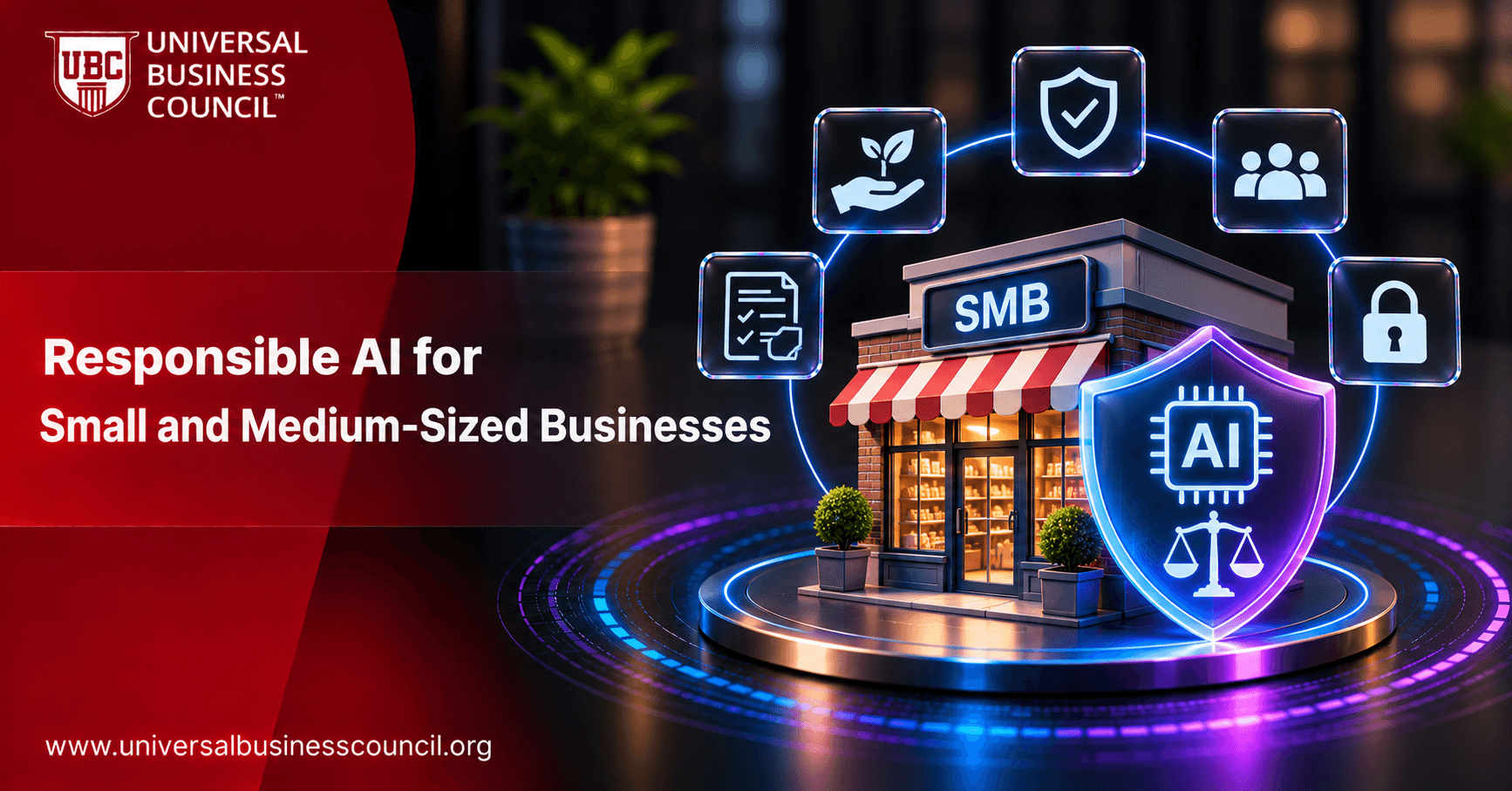
Most small and medium-sized businesses do not build AI. They meet it inside the software they already pay for: the accounting package that flags anomalies, the email platform that writes subject lines, the customer support tool that drafts replies. That makes responsible AI for small and medium-sized businesses less about data science and more about buying, configuring and supervising tools wisely. This guide explains the risks that matter most to smaller organizations, a manageable set of controls and the habits that keep AI use lawful and trustworthy without a dedicated compliance team. For professional grounding in the field, see the certified responsible AI expert certification. This is general information, not legal advice.
What is responsible AI for an SMB?
For a smaller business, responsible AI means using AI tools in ways that protect customers, employees and the company, comply with the law and can be explained if someone asks. It covers what tools staff use, what data goes into them, how outputs are checked and who is accountable.

The scale is different from a large enterprise, but the duties are not. Privacy, consumer protection, anti-discrimination, confidentiality and contract obligations apply regardless of headcount.
Where SMB risk usually sits
Smaller businesses tend to face a predictable set of exposures.
Data leaving the building
Staff paste customer details, contracts or financial information into public AI tools to save time. That can breach privacy law, confidentiality duties and customer contracts, and the data may be stored or used for training under the tool's terms.
Unchecked outputs
AI can produce confident errors. A wrong figure in a quote, an invented clause in a contract or an inaccurate answer to a customer can cause loss and liability. Because small teams move fast, review steps are easily skipped.
Hiring and people decisions
Tools that screen applicants, score performance or monitor staff may create discrimination and privacy risks, even when purchased off the shelf. The business remains responsible for the outcomes.
Customer-facing automation
Chatbots, automated emails and targeting tools affect how customers experience the brand. Misleading claims, unclear disclosure and mishandled complaints create reputational and legal problems.
Vendor dependence
Smaller firms rely heavily on suppliers and often accept standard terms without review. That can leave them exposed on data use, security and continuity.
Sensitive data entered into public tools
Unchecked AI outputs sent to customers or used in decisions
Biased or unlawful people-related decisions
Poorly disclosed or poorly supervised automation
Vendor terms nobody has read
A manageable set of controls
You do not need dozens of policies. A few well-chosen steps cover most of the risk.
Know what you use
Make a simple list of AI tools and AI features in your software, who uses them and for what. Ask staff openly, since informal tools are common. Note which ones touch personal or confidential data.
Set clear rules for staff
Write a short, plain-language policy covering which tools are approved, what data must never be entered, which tasks require human review and how to report mistakes. Explain it in a short team session. Technical staff or advisers who support your systems benefit from sound foundations, which many develop through tech certifications.
Make the safe option the easy option
If an approved tool is clunky, staff will use something else. Choose business versions of tools that offer data protection terms, and set them up so that sensitive data is handled properly.
Check before you trust
Require a person to review AI output before it reaches a customer, a regulator or a decision about a person. The higher the stakes, the more careful the review.
Be open with customers
Tell customers when they are dealing with AI, offer an easy route to a human and keep promises about what the system can do. Avoid exaggerated claims about "AI-powered" accuracy.
Review suppliers
Before adopting a tool, read the data and security terms, and ask a few key questions: Does it train on our data? Where is data stored? How are incidents reported? Keep the answers on file.
People, records and reputation
Trust is the SMB's strongest asset.
Hire and onboard with care
Employees and contractors with access to customer data should be properly vetted. Credential and background checks, supported by services such as HireValid, help confirm that people are who they say they are and hold the qualifications they claim.
Keep simple records
Maintain the tool list, the policy, supplier answers and notes on any incidents or decisions. If a customer, insurer or regulator asks, you can show what you did. Integrity-focused record keeping connects to topics in deep tech certifications.
Communicate truthfully
Use AI to improve marketing and service, but keep claims honest. A digital marketing course can help small teams use AI-assisted marketing effectively while respecting advertising and consumer rules.
Plan for problems
Decide in advance who to call and what to do if AI exposes data or produces a harmful error: contain, correct, notify as required and learn.
Growing the program over time
Start small and add controls as risk grows. Revisit your approach when you adopt a new tool, start using sensitive data, enter a new market or sign a larger customer. Customers and partners increasingly ask smaller suppliers about AI practices, and a clear, honest answer can be a competitive advantage.
Conclusion
Responsible AI for small and medium-sized businesses is mainly about using tools wisely. Know what AI you use, set simple rules on data and review, check outputs before relying on them, be open with customers and review suppliers. Vet key people, keep simple records, communicate truthfully and prepare for problems. A modest, consistent program protects customers and the business and builds trust that supports growth.
Frequently asked questions
These are the questions small business owners ask most about AI.
1. Do small businesses need AI rules?
Yes. Legal duties apply regardless of size.
2. What is the first step?
List the AI tools and features you use and what data they touch.
3. Can employees use public AI tools?
Only for approved tasks and never with sensitive or confidential data.
4. What should an AI policy include?
Approved tools, data limits, review rules and how to report mistakes.
5. How long should the policy be?
Short enough to be read, often one or two pages.
6. Do we need to check AI output?
Yes, before it reaches customers or informs decisions.
7. Is using AI in hiring risky?
It can be, so keep humans in charge and check for unfair outcomes.
8. Must we tell customers about AI?
Be open where they interact with AI, and follow any legal disclosure rules.
9. What should we ask software vendors?
About data use, training, storage, security and incident reporting.
10. Are business versions of AI tools safer?
Often, because they offer stronger data terms, but check the contract.
11. What if a customer asks about our AI practices?
Share a clear summary of your policy, controls and supplier checks.
12. Do we need a dedicated AI officer?
Not usually. Assign one person to own it.
13. How do we handle a data leak through AI?
Contain it, notify as required, fix the cause and record what happened.
14. Can we use AI for marketing?
Yes, with accurate claims and respect for privacy and advertising rules.
15. How do we verify contractors?
Check credentials and backgrounds within legal limits.
16. What records should we keep?
Tool list, policy, supplier answers and incident notes.
17. How often should we review our approach?
When tools, data or business activities change, and at least yearly.
18. Does insurance cover AI errors?
It depends on your policy, so ask your insurer.
19. Where can we get help?
From qualified advisers and public guidance for small businesses.
20. What is the biggest mistake?
Letting staff adopt AI tools with no rules or oversight.
Related Articles
View All
Artificial Intelligence
Responsible AI Training for Businesses: How to Upskill Teams in AI Ethics and Governance
Learn how businesses can train and upskill their teams in responsible AI practices. Explore how structured training helps employees understand AI ethics, governance, risk management, data privacy, bias prevention, and accountability while supporting the safe and effective use of AI across the organization.
Artificial Intelligence
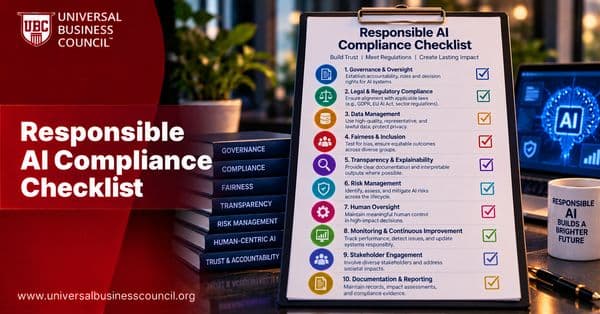
Responsible AI Compliance Checklist for Businesses
Explore a practical responsible AI compliance checklist for businesses to support ethical AI development and deployment. Learn how to assess AI risks, ensure data privacy, address algorithmic bias, maintain transparency, establish accountability, and align AI systems with relevant regulatory requirements.

Artificial Intelligence
Responsible AI in Insurance: Underwriting, Claims and Customer Fairness
Explore how responsible AI can improve insurance underwriting, claims processing, and customer service while protecting fairness. Learn how insurers can reduce algorithmic bias, improve transparency, protect customer data, and make accountable AI-driven decisions.
Trending Articles
The Role of Blockchain in Ethical AI Development
How blockchain technology is being used to promote transparency and accountability in artificial intelligence systems.
AWS Career Roadmap
A step-by-step guide to building a successful career in Amazon Web Services cloud computing.
Top 5 DeFi Platforms
Explore the leading decentralized finance platforms and what makes each one unique in the evolving DeFi landscape.