

Responsible AI Compliance Checklist for Businesses
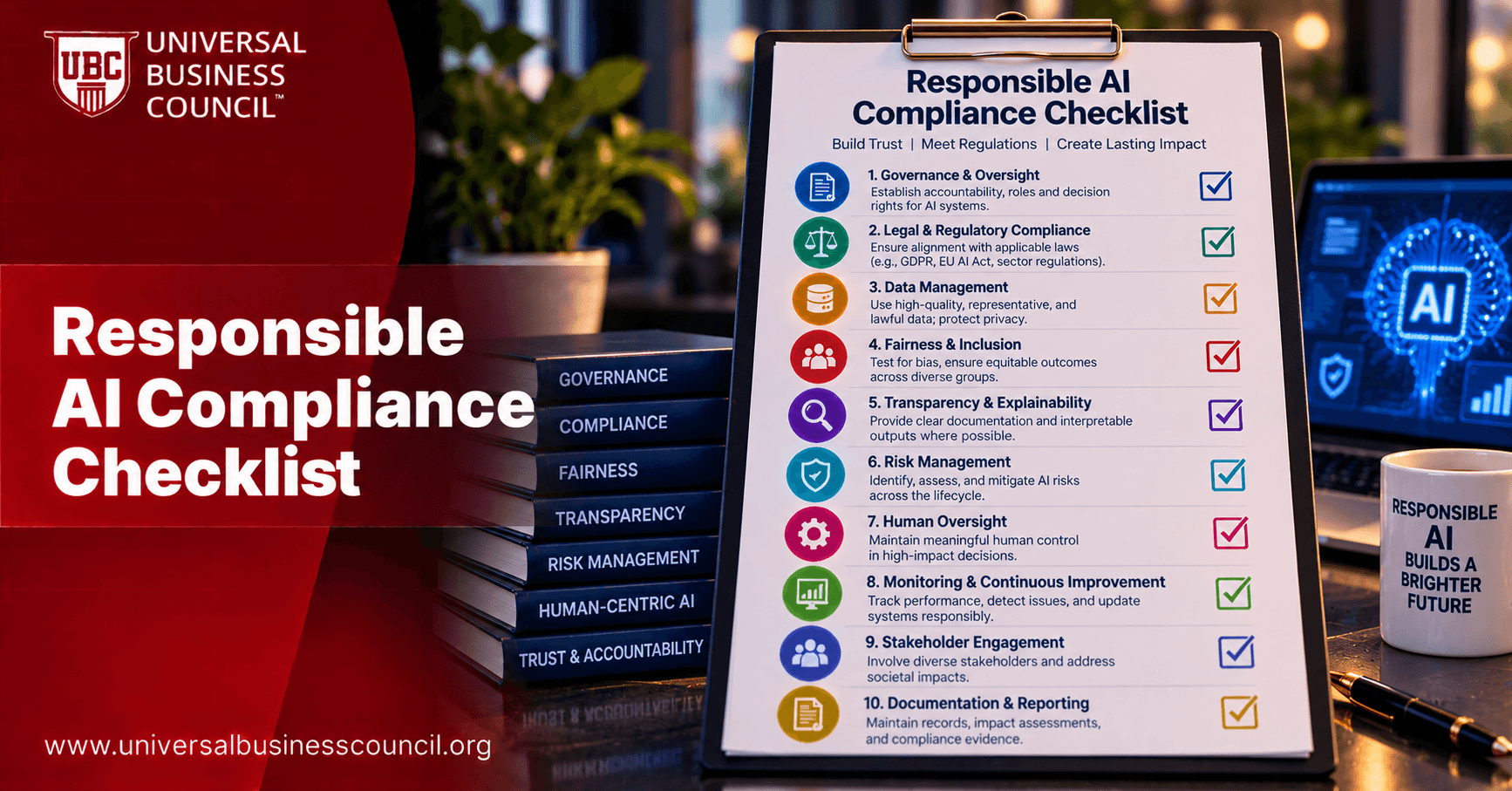
A checklist cannot replace judgment, but it can stop the obvious gaps before they become findings. Businesses adopting AI face a growing mix of legal duties, contractual requirements and stakeholder expectations, and many struggle to know whether the basics are covered. This responsible AI compliance checklist sets out the questions every business should be able to answer, grouped by area, with guidance on what good evidence looks like. Professionals who want a recognized foundation can explore the certified responsible AI expert certification. This guide is general information and not legal advice, and requirements vary by region and sector, so use it alongside advice specific to your situation.
What is a responsible AI compliance checklist?
A responsible AI compliance checklist is a structured list of controls and questions used to check that AI systems and the processes around them meet legal, regulatory, contractual and internal policy requirements. It helps organizations spot missing controls, assign actions and show evidence to auditors, customers and regulators.

A checklist works best as a living tool. It should be tailored to the organization's sector and risk profile, used at set points in the lifecycle and updated as rules and technology change. Ticking a box is not enough, because each item should be supported by a record that someone else could review.
How to use the checklist
Apply the checklist at three moments: when a new AI use is proposed, before it is released and at regular intervals afterward. Higher-risk systems get the full list, while lower-risk uses can use a shortened version. For each item, record the status, the evidence, the owner and any actions with deadlines. Keep completed checklists as part of the system's file.
The checklist by area
Use the nine areas below as a working list, and record the evidence, owner and next action for each item.
1. Governance and accountability
Start with ownership, since everything else depends on it. Confirm that:
An executive sponsor and a governance body are in place
Every AI system has a named owner
Roles for legal, risk, security, privacy and data teams are defined
Decision rights for launch, pause and retirement are written down
Policies are approved, communicated and reviewed on a schedule
2. Inventory and risk classification
Check that a register of AI systems exists and is kept current, including tools bought from vendors and informal tools used by staff. Each system should have a recorded purpose, data sources, affected groups and risk tier, with classification criteria documented so that results are consistent. High-risk systems should be flagged for deeper review and senior approval.
3. Data and privacy
AI compliance often turns on data. Confirm that the organization has a lawful basis and appropriate permissions for the data it uses, that sensitive data is minimized and protected and that retention and deletion rules are applied. Check data quality, representativeness and lineage, and make sure that data sharing with vendors is covered by agreements. Privacy and security teams should review AI projects before launch.
4. Testing for fairness, safety and security
Before release, higher-risk systems should be tested and the results recorded. Typical checks include:
Bias and fairness testing across relevant groups
Accuracy and reliability testing under realistic conditions
Robustness testing against unexpected or adversarial inputs
Security review of models, data pipelines and access controls
Testing of fallback and human-review procedures
Record who tested, what was tested, the results, issues found and how they were resolved.
Spotting weak evidence
A test result without a date, an owner or a record of how issues were resolved is weak evidence. Reviewers should be able to trace each result back to the exact version of the system it covered.
5. Transparency and human oversight
Check that people are told when AI is involved in significant decisions where required, and that explanations are available in plain language. Confirm that human oversight is meaningful, with reviewers who have the authority, information and time to challenge outputs. Make sure there is a complaints and appeals route, and that outcomes are tracked.
6. Vendors, people and credentials
Check that third-party AI has been through due diligence and that contracts include documentation, audit, incident notification and exit terms. Confirm that staff and contractors who build or oversee AI hold the credentials they claim, and that background checks follow policy. Verification services such as HireValid support credential and background verification.
7. Monitoring, incidents and records
Compliance continues after launch. Confirm that monitoring is in place for performance, fairness, drift, security and complaints, with thresholds that trigger review. Check that an incident response plan exists, that incidents are logged and that lessons are applied. Records should be organized and retained according to policy, and secure, tamper-evident storage supports audit readiness. Professionals interested in technologies for integrity and traceability can explore deep tech certifications.
8. Training and culture
Verify that employees receive training suited to their role, that completion is tracked and that staff know how to raise concerns without fear of reprisal. Technical literacy supports better questions from legal, risk and business teams, and some professionals build it through tech certifications.
9. Public statements and marketing
Check that claims about AI products and practices are accurate, supported by evidence and approved by the right reviewers. Avoid overstating accuracy, safety or fairness, and avoid describing ordinary software as intelligent when it is not. A digital marketing course can help communication teams promote AI-enabled products accurately and within legal and ethical limits.
Turning the checklist into action
A completed checklist is only the start. Group findings by severity, assign each action to an owner with a deadline and report progress to the governance body. Track recurring gaps, because they reveal weaknesses in policy or training and not just in individual projects. Re-run the checklist at set intervals and when systems, data or rules change.
Conclusion
A responsible AI compliance checklist helps businesses cover the essentials: governance and accountability, inventory and risk classification, data and privacy, testing, transparency and oversight, vendors and people, monitoring and records, training and honest communication. Its value lies in the evidence behind each answer and in the actions that follow. Tailor it to your sector and risk profile, use it at key points in the lifecycle and keep it current. Where the rules differ by region or sector, confirm the specifics with qualified advisors.
Frequently asked questions
These are the questions businesses ask most about AI compliance checklists.
1. What is a responsible AI compliance checklist?
A structured list of controls used to check that AI systems meet legal, contractual and internal requirements.
2. Who should use it?
Compliance, risk, legal, product, data and engineering teams, along with system owners.
3. When should we use it?
At proposal, before release and at regular intervals afterward.
4. Is a checklist enough for compliance?
No. It supports compliance but needs judgment, evidence and follow-up actions.
5. Do all AI systems need the full list?
No. Use a shortened list for lower-risk uses and the full list for higher-risk systems.
6. What evidence should we keep?
Assessments, test results, approvals, monitoring reports, incident logs and training records.
7. What governance items are essential?
An executive sponsor, a governance body, named system owners and written decision rights.
8. Why do we need an AI inventory?
You cannot govern what you cannot see, and the inventory is the basis for risk classification.
9. What data checks matter?
Lawful basis, data quality, representativeness, minimization, security and retention rules.
10. What testing is expected?
Bias, accuracy, robustness and security testing, with results recorded.
11. What is meaningful human oversight?
Review by people with the authority, information and time to challenge AI outputs.
12. Do we need to tell people AI is used?
Often yes for significant decisions, and requirements vary by region and sector.
13. How do we check vendors?
Through due diligence, documentation requests and contract terms covering audit and incidents.
14. How do we verify staff credentials?
By checking certificates, work history and background, often with verification services.
15. What should we monitor?
Performance, fairness, drift, security events and complaints.
16. How long should records be kept?
According to your retention policy and applicable legal requirements.
17. Who needs training?
Anyone who builds, buys, approves or uses AI, with role-specific content.
18. How should AI claims be reviewed?
By legal and technical reviewers who check them against documented performance and limits.
19. What do we do with gaps?
Assign owners and deadlines, report progress to governance and track recurring issues.
20. How often should we update the checklist?
On a set schedule and whenever laws, technology or business use change.
Related Articles
View All
Artificial Intelligence
Why Is Responsible AI Important for Businesses in 2027?
Discover why responsible AI is important for businesses in 2027. Explore how ethical AI practices support regulatory compliance, build customer trust, reduce risks, improve decision-making, and promote innovation while helping organizations develop fair, transparent, and accountable AI systems.
Artificial Intelligence
Responsible AI Policies: How to Create an Enterprise AI Policy
Understand what responsible AI policies are and why organizations need them to guide the ethical development and use of artificial intelligence. Explore key policy components, including data privacy, fairness, transparency, accountability, risk management, and human oversight to support responsible AI adoption.

Artificial Intelligence
AI Audit Explained: How to Audit AI Systems for Safety, Fairness and Compliance
Learn what an AI audit is and how to evaluate AI systems for safety, fairness, transparency, and regulatory compliance. Explore key audit steps, risk assessment methods, bias detection techniques, and monitoring practices that help organizations build trustworthy and responsible AI systems.
Trending Articles
The Role of Blockchain in Ethical AI Development
How blockchain technology is being used to promote transparency and accountability in artificial intelligence systems.
AWS Career Roadmap
A step-by-step guide to building a successful career in Amazon Web Services cloud computing.
Top 5 DeFi Platforms
Explore the leading decentralized finance platforms and what makes each one unique in the evolving DeFi landscape.