

How to Build a Responsible AI Governance Framework
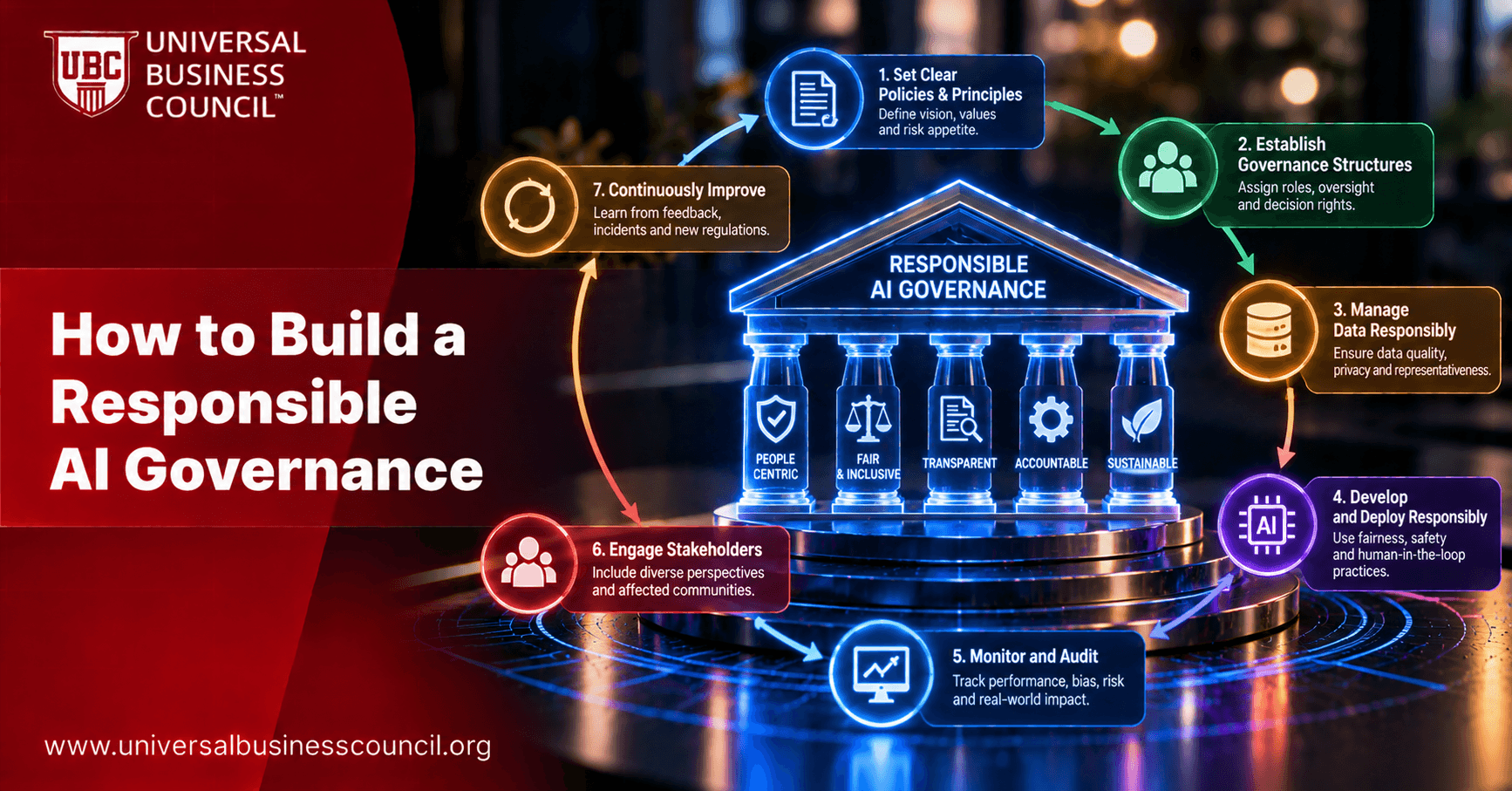
A governance framework is useful only if people follow it. The best ones are short enough to remember, specific enough to act on and built into the way teams already work, rather than sitting in a binder nobody opens.
This guide shows how to build a responsible AI governance framework step by step, from taking stock of current AI use to setting policies, roles, controls and measures of success. If you're looking for structured training to support the work, the Certified Responsible AI Expert certification from Universal Business Council is one option worth reviewing. The sections below start with the basics and then walk through the build.

What is a responsible AI governance framework?
A responsible AI governance framework is the structured set of principles, policies, roles, processes and controls that guides how an organization develops, buys, deploys and monitors AI. It aims to make AI fair, safe, transparent, secure, privacy-respecting and accountable, while also meeting legal obligations and business goals.
A good framework has four qualities. It is risk-based, so stronger controls apply where potential harm is greater. It is lifecycle-wide, covering design through retirement. It is practical, with clear owners and steps. And it is adaptable, so it can change as technology and regulation change.
Step 1: Take stock of your AI landscape
You can't govern what you can't see. Start with an inventory of all AI use, including models built in-house, tools bought from vendors, AI features inside existing software and generative AI tools that employees use on their own.
List each system, its purpose, owner, data used and users or people affected
Note whether it is customer-facing, makes or supports decisions about people or handles sensitive data
Identify gaps in documentation, testing and monitoring
Also assess your current maturity. Many organizations find that they already have some controls, such as privacy reviews or model validation, that can be extended rather than rebuilt.
Step 2: Define principles and scope
Write a short statement of responsible AI principles in plain language, such as fairness, transparency, accountability, privacy, safety and human oversight. Link them to company values and to external references like the OECD AI Principles. Then define scope: which systems, teams and third parties the framework covers.
Step 3: Set up roles and structure
Leadership and committee
Appoint an executive sponsor with real authority. Form a cross-functional governance committee with members from legal, compliance, risk, security, data science, engineering, product, HR and business units. Give it a charter that sets its decision rights and meeting rhythm.
System ownership
Name an accountable owner for every AI system, responsible for risk assessments, documentation, monitoring and incident response. A simple responsibility matrix clarifies who decides, who advises and who is informed.
Specialist support
Governance teams need people with the right expertise, from auditors to data scientists. Organizations often verify credentials and work history before adding people to sensitive roles, and services like HireValid can help confirm qualifications and experience.
Step 4: Classify risk and set control tiers
Create a simple risk classification so that effort matches impact. A common approach uses three or four tiers, based on factors such as the effect on people's rights, safety or finances, the level of automation, the sensitivity of data and the scale of use.
Low risk: internal productivity tools with limited impact, covered by basic acceptable use rules
Medium risk: systems with moderate impact, needing documentation and periodic review
High risk: systems that affect hiring, credit, health, safety or legal rights, needing full assessment, testing, human oversight and approval
Prohibited: uses the organization will not pursue, based on law or values
Align your tiers with external references such as the EU AI Act's risk categories and the NIST AI Risk Management Framework, which organizes work under Govern, Map, Measure and Manage.
Step 5: Write the core policies
A responsible AI policy stating commitments and scope
An acceptable use policy for employees, including generative AI rules on data input, review of outputs and disclosure
Data governance and privacy requirements for training and operation
Model development and validation standards covering fairness, accuracy, robustness and security
Third-party and procurement requirements, including vendor documentation and audit rights
Human oversight, transparency and appeal rules
Incident response and reporting procedures
Keep each policy short, with examples and clear owners. People follow guidance they can read in a few minutes.
Step 6: Build controls into the lifecycle
Embed checks into existing workflows so governance doesn't feel like a separate process.
Intake: every new AI use case is registered and risk-tiered
Design: impact assessments and data reviews for medium and high-risk systems
Build and test: bias, robustness, privacy and security testing, with documented results
Approval: a gate where the owner and committee sign off before launch
Deploy and monitor: tracking of performance, drift, complaints and incidents
Retire: a plan for decommissioning, data deletion and record retention
Tooling helps. Model registries, monitoring dashboards and open-source fairness and explainability toolkits make controls repeatable, and short tech certifications in programming and data skills help governance staff understand what these tools do.
Step 7: Train people and communicate
Provide role-based training: awareness for all staff, practical guidance for builders and buyers and deeper content for reviewers and leaders. Create an easy way for employees to ask questions or report concerns. Communicate externally with care, avoiding exaggerated claims about AI capabilities. A Digital Marketing Course can help communications teams explain your approach clearly and accurately.
Step 8: Measure, audit and improve
Track a few meaningful indicators: percentage of AI systems inventoried and risk-tiered, share of high-risk systems with completed assessments, number and severity of incidents, time to resolve issues and training completion. Run internal audits or independent reviews, and update the framework at least yearly or when laws and technology change. To keep up with the technology side, including AI, blockchain and data integrity, Deep Tech Certifications offer useful background.
Common pitfalls
Writing policies without assigning owners or building controls
Making the framework so heavy that teams bypass it
Ignoring vendor and employee-adopted AI
Treating governance as a one-time project
Skipping executive sponsorship
Conclusion
To build a responsible AI governance framework, take stock of your AI use, define principles, set up roles, classify risk, write focused policies, embed controls into the lifecycle, train people and measure results. Keep it risk-based and practical, and expect to improve it over time.
Start with an inventory and one high-risk use case, learn from the process and expand. The FAQs below answer common questions.
Frequently asked questions
What is a responsible AI governance framework?
A set of principles, policies, roles and controls for managing AI responsibly.
Why do I need one?
To reduce risk, meet regulations and build trust in AI.
Where do I start?
With an inventory of all AI systems and tools in use.
Who should lead it?
An executive sponsor and a cross-functional committee.
What roles are needed?
Sponsor, committee members, system owners, reviewers and specialists.
What is risk tiering?
Grouping AI systems by potential impact so controls match risk.
Which frameworks can I use as a base?
NIST AI RMF, ISO/IEC 42001, OECD AI Principles and EU AI Act categories.
What policies are essential?
Responsible AI, acceptable use, data, validation, vendor and incident policies.
How do I govern generative AI use?
Set rules on approved tools, data input, output review and disclosure.
How do I govern vendor AI?
Use due diligence, documentation requests, contract terms and monitoring.
What is an approval gate?
A checkpoint where a system must pass reviews before launch.
What is an AI impact assessment?
A review of how a system could affect people before deployment.
How do I measure success?
Track coverage, assessments completed, incidents, resolution time and training.
How often should the framework be updated?
At least yearly and when laws or technology change.
Do small companies need a framework?
Yes, a lighter version scaled to their AI use and risk.
What is shadow AI?
AI tools used without approval or oversight.
How do I get employees to follow it?
Keep rules short, embed them in workflows and train people.
What tools help?
Model registries, monitoring dashboards and fairness and explainability toolkits.
What are common mistakes?
Policies without owners, overly heavy processes and ignoring third-party AI.
How long does it take to build?
A basic version can start within weeks and mature over months.
Related Articles
View All
Artificial Intelligence
NIST AI Risk Management Framework: A Practical Implementation Guide
Explore the NIST AI Risk Management Framework and learn how to implement it across the AI lifecycle. Understand its four core functions, Govern, Map, Measure, and Manage, along with practical steps for identifying AI risks, improving accountability, and building trustworthy AI systems.

Artificial Intelligence
AI Governance for Enterprise Leaders: A Step-by-Step Implementation Guide
Learn how enterprise leaders can implement effective AI governance through a step-by-step approach. Explore key strategies for establishing governance policies, defining responsibilities, managing AI risks, ensuring regulatory compliance, and promoting transparency and accountability across enterprise AI initiatives.
Artificial Intelligence
Responsible AI Policies: How to Create an Enterprise AI Policy
Understand what responsible AI policies are and why organizations need them to guide the ethical development and use of artificial intelligence. Explore key policy components, including data privacy, fairness, transparency, accountability, risk management, and human oversight to support responsible AI adoption.
Trending Articles
The Role of Blockchain in Ethical AI Development
How blockchain technology is being used to promote transparency and accountability in artificial intelligence systems.
AWS Career Roadmap
A step-by-step guide to building a successful career in Amazon Web Services cloud computing.
Top 5 DeFi Platforms
Explore the leading decentralized finance platforms and what makes each one unique in the evolving DeFi landscape.