

AI Governance for Enterprise Leaders: A Step-by-Step Implementation Guide
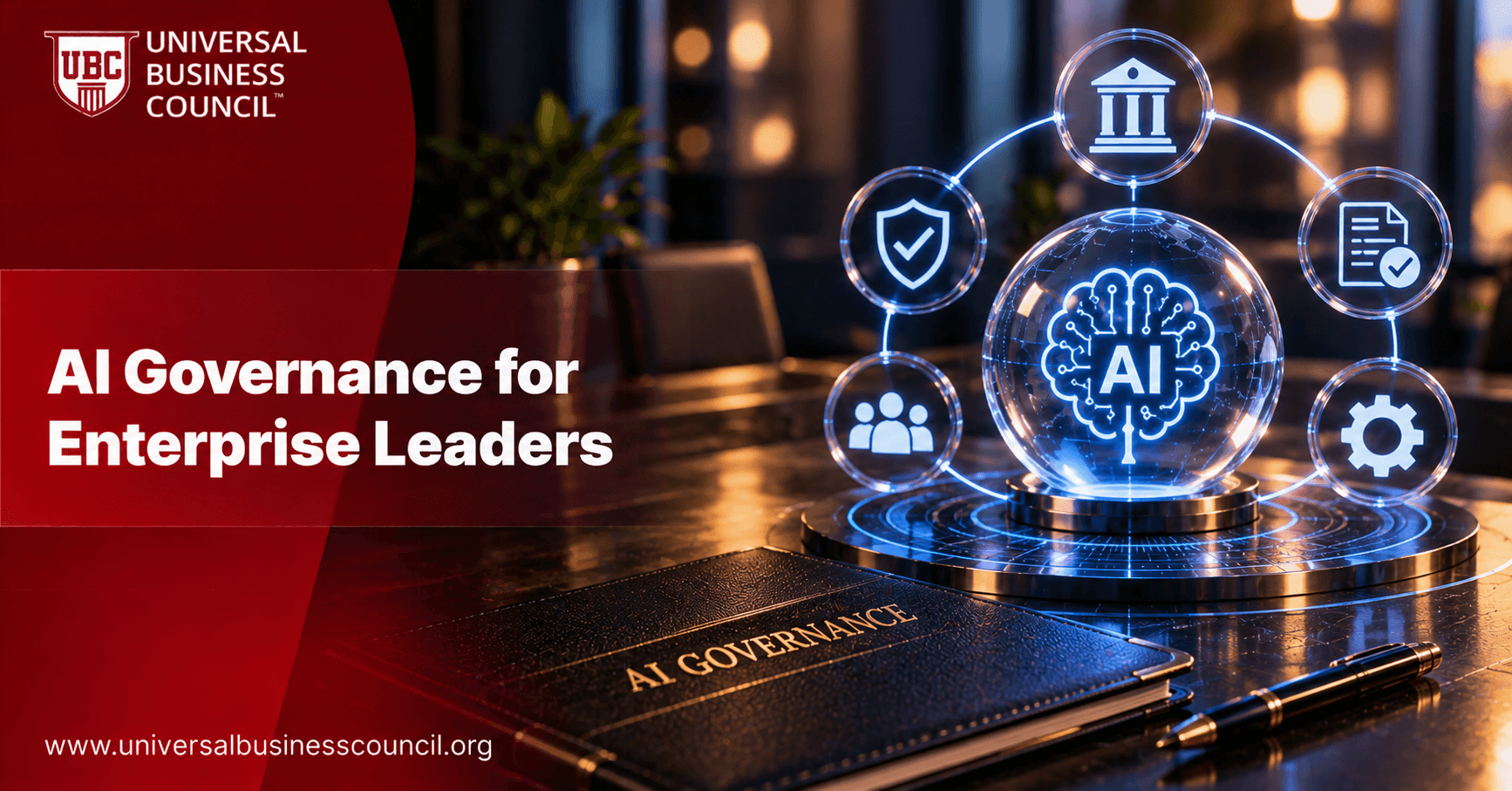
Executives do not need to understand how a neural network is trained, but they do need to know who decides which AI systems go live, what evidence is required first and what happens when a model misbehaves. AI governance is the discipline that answers those questions, and leaders are the ones who must set it in motion.
This guide gives enterprise leaders a practical, step-by-step path to implement AI governance: from defining it and securing sponsorship to building structure, controls and measurement. Leaders who want a formal grounding can look at the Certified Responsible AI Expert certification from Universal Business Council as a companion to the steps below.

What Is AI Governance for Enterprises?
Enterprise AI governance is the combination of structures, policies, processes and controls that directs how an organization develops, buys, deploys and monitors AI. It aims to deliver value from AI while managing risks to people, the business and compliance.
It is broader than compliance and broader than ethics. Compliance asks whether the organization meets the rules. Ethics asks whether it is doing the right thing. Governance is the operating system that makes both happen consistently across hundreds of use cases.
Why Leaders Must Own It
AI governance fails when it is delegated entirely to a technical team. Trade-offs between speed, cost, risk and fairness are business decisions, and they need authority that only leadership holds. Regulators reinforce this: the EU AI Act, the NIST AI Risk Management Framework and ISO/IEC 42001 all expect management involvement, defined accountability and ongoing oversight.
Strong governance also pays back. It reduces rework, avoids costly incidents, shortens procurement and approval cycles and builds the trust customers and partners increasingly ask for.
The Step-by-Step Implementation Guide
Step 1: Secure Sponsorship and Set Ambition
Name an executive sponsor with real authority and agree on the goals: for example, safe scaling of AI, regulatory readiness and customer trust. Set the organization's risk appetite so teams know where the boundaries lie.
Step 2: Take Stock of AI Use
Build an inventory of all AI systems, including vendor tools, AI features inside existing software and generative AI used by employees. For each, record purpose, owner, data, users and affected people. Most organizations discover far more AI than leadership expects.
Step 3: Establish Structure and Roles
Create a cross-functional governance committee with members from legal, compliance, risk, privacy, security, data science, engineering, product and HR. Assign an accountable owner to every AI system and define clear decision rights and escalation paths.
Specialist roles need the right people. Many organizations verify qualifications and employment history before appointing staff to sensitive governance and risk positions, and HireValid can help with that screening.
Step 4: Classify Risk
Group AI use cases into tiers, such as low, medium, high and prohibited, based on potential impact on rights, safety and finances, the degree of automation and the sensitivity of data. Aligning tiers with EU AI Act risk categories makes later compliance easier.
Step 5: Write Policies and Standards
Publish a short responsible AI policy, a generative AI acceptable use policy and standards for data, model validation, vendor management and incident response. Keep them concise, with examples and owners.
Step 6: Embed Controls in the Lifecycle
Intake: register every new use case and assign a tier
Assess: run impact and data reviews for medium and high-risk systems
Test: check accuracy, bias, robustness, privacy and security
Approve: require sign-off before launch for higher tiers
Monitor: track drift, complaints, performance and incidents
Retire: plan decommissioning, data deletion and record retention
Tooling such as model registries and monitoring dashboards makes these controls repeatable, and governance staff understand them better with some technical grounding. Short tech certifications are one route to build that fluency.
Step 7: Train and Communicate
Offer awareness training for everyone, practical guidance for builders and buyers and deeper programs for reviewers and executives. Communicate outward with care and avoid overstating what AI can do. A Digital Marketing Course can help communications teams describe AI use accurately.
Step 8: Measure, Audit and Improve
Report a small set of indicators to leadership each quarter, review them and run audits. Update the program at least yearly.
Metrics Leaders Should Watch
Percentage of AI systems inventoried and risk-tiered
Share of high-risk systems with completed assessments
Number and severity of AI incidents and time to resolve
Vendor AI reviewed before purchase
Training completion by role
Common Pitfalls
The most frequent failures are predictable. Governance is treated as a one-time project, controls are so heavy that teams route around them, vendor AI is ignored and sponsors disengage after the launch. Leaders can avoid these by starting small with one high-risk use case, learning from it and expanding. They should also keep an eye on technology trends in AI and related fields, and Deep Tech Certifications offer helpful background on those developments.
Conclusion
AI governance is a leadership responsibility with a clear sequence: sponsor it, inventory AI, structure roles, classify risk, set policies, embed controls, train people and measure results. Start with one use case, prove the approach and scale. The FAQs below answer common questions from enterprise leaders.
Frequently Asked Questions
What is AI governance?
The structures, policies and controls that direct how an organization uses AI responsibly.
Why should executives care about AI governance?
Because AI risk and value are business decisions that require leadership authority.
Where should leaders begin?
With an executive sponsor and an inventory of all AI use.
Who should sit on the AI governance committee?
Representatives from legal, compliance, risk, privacy, security, data science, engineering, product and HR.
What is risk appetite for AI?
The level of AI-related risk the organization is willing to accept to pursue its goals.
What is an AI inventory?
A register of every AI system with its purpose, owner, data and users.
How are AI systems classified by risk?
By impact on people, automation level, data sensitivity and scale.
Which frameworks help with implementation?
The NIST AI RMF, ISO/IEC 42001, the OECD AI Principles and the EU AI Act.
What policies are needed?
A responsible AI policy, acceptable use rules and standards for data, validation, vendors and incidents.
How is vendor AI governed?
Through due diligence, documentation requests, contract terms and ongoing monitoring.
What is an approval gate?
A checkpoint where higher-risk systems need sign-off before launch.
How do leaders measure success?
By tracking coverage, assessments, incidents, resolution time and training.
How long does implementation take?
A basic version can start within weeks and mature over months.
Does governance slow down innovation?
Well-designed, risk-based governance speeds safe approvals and reduces rework.
What is shadow AI?
AI used without approval or oversight.
How often should governance be reviewed?
At least annually and when laws or technology change.
Do mid-size companies need it?
Yes, scaled to their AI use and risk.
What skills do governance teams need?
Risk, legal, data and technical literacy, plus communication skills.
What are common governance mistakes?
One-time projects, heavy processes, ignoring vendor AI and weak sponsorship.
Related Articles
View All
Artificial Intelligence
NIST AI Risk Management Framework: A Practical Implementation Guide
Explore the NIST AI Risk Management Framework and learn how to implement it across the AI lifecycle. Understand its four core functions, Govern, Map, Measure, and Manage, along with practical steps for identifying AI risks, improving accountability, and building trustworthy AI systems.
Artificial Intelligence
AI Governance vs AI Ethics: Differences, Use Cases and Implementation
Understand the differences between AI governance and AI ethics, including their principles, frameworks, use cases, and implementation approaches. Learn how organizations combine ethical guidelines with governance policies to manage AI risks, ensure accountability, promote transparency, and support responsible AI adoption.
Artificial Intelligence
Responsible AI Policies: How to Create an Enterprise AI Policy
Understand what responsible AI policies are and why organizations need them to guide the ethical development and use of artificial intelligence. Explore key policy components, including data privacy, fairness, transparency, accountability, risk management, and human oversight to support responsible AI adoption.
Trending Articles
The Role of Blockchain in Ethical AI Development
How blockchain technology is being used to promote transparency and accountability in artificial intelligence systems.
AWS Career Roadmap
A step-by-step guide to building a successful career in Amazon Web Services cloud computing.
Top 5 DeFi Platforms
Explore the leading decentralized finance platforms and what makes each one unique in the evolving DeFi landscape.