

AI Governance vs AI Ethics: Differences, Use Cases and Implementation
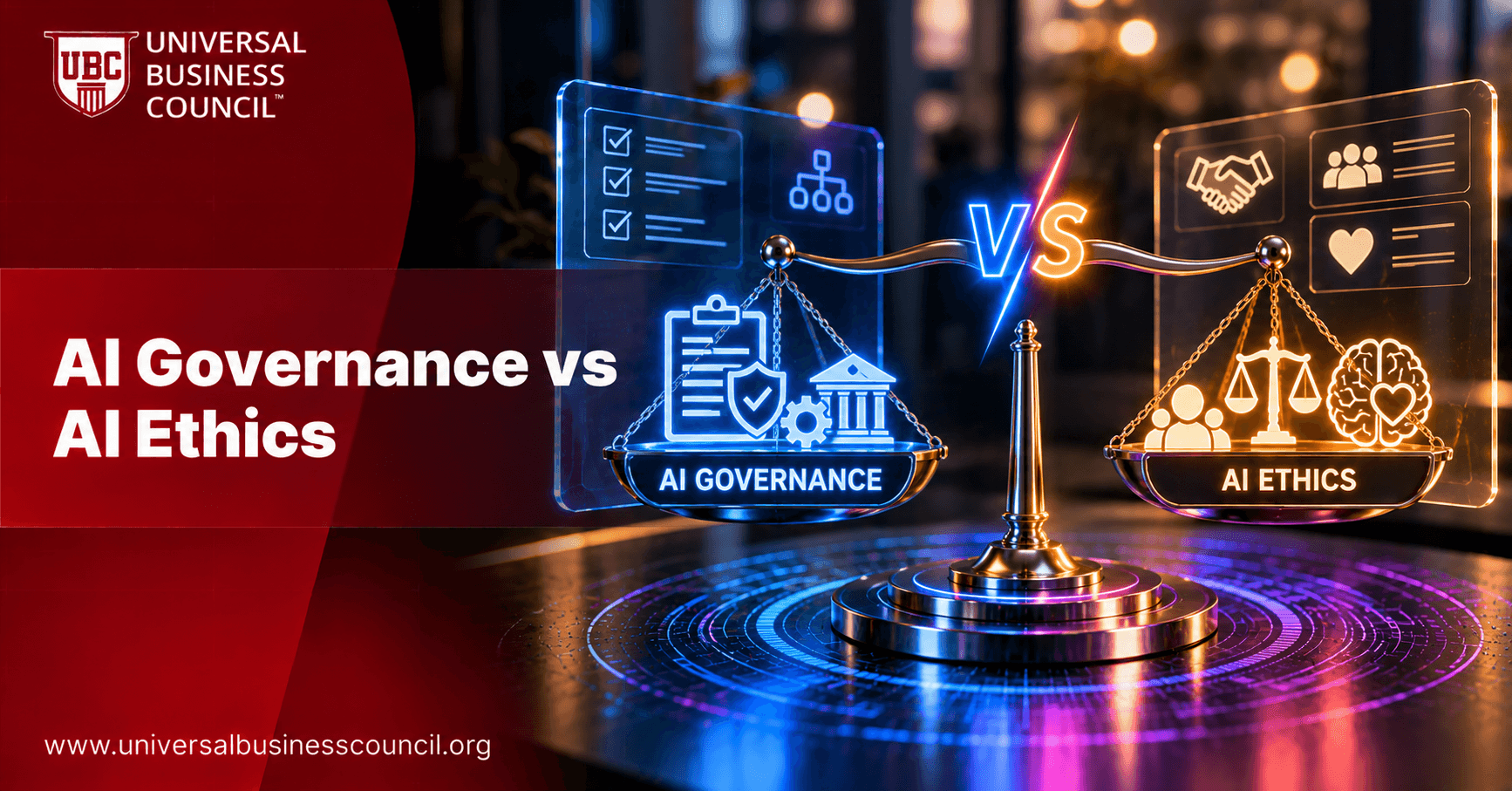
Ethics says what's right. Governance makes sure it happens. That one-line split explains most of the difference between AI ethics and AI governance, and it also explains why companies that have only one of the two usually run into trouble.
This guide compares AI governance vs AI ethics, shows where each applies through use cases and explains how to implement both in an organization. If you want a structured credential to support this work, the Certified Responsible AI Expert certification from Universal Business Council is worth a look. The sections below start with definitions and then move to differences, examples and implementation.

What are AI ethics and AI governance?
AI ethics is the set of values and principles that guide how AI should be designed and used. It addresses questions such as fairness, transparency, privacy, safety, human autonomy and accountability. Ethics is about judgment: what should we do, and what should we avoid, even when no rule forces us?
AI governance is the practical system that puts those values, along with legal and business requirements, into operation. It includes policies, roles, approval processes, risk assessments, testing standards, monitoring and reporting. Governance is about control: who decides, how decisions are made, what evidence is required and what happens when things go wrong.
Key differences between AI governance and AI ethics
Nature: ethics is principle-based and aspirational, while governance is process-based and enforceable
Question asked: ethics asks what is right, while governance asks how we make sure it happens
Output: ethics produces principles, guidelines and debate, while governance produces policies, controls, records and accountability
Scope: ethics can address broad social questions, while governance focuses on the organization's systems, people and obligations
Measurement: ethics is often assessed through judgment and review, while governance is tracked through metrics, audits and compliance checks
Ownership: ethics is shared across the organization, while governance has defined owners, committees and reporting lines
The two are connected. Ethics supplies the direction, governance supplies the machinery. A company with ethical principles but no governance may have nice slogans and no enforcement. A company with governance but no ethical grounding may comply with rules while missing risks the rules haven't caught up with yet.
Where each one applies: use cases
Hiring and HR
Ethics asks whether automated screening is fair to candidates and respects dignity. Governance decides how: requiring bias audits, vendor documentation, human review and candidate notices. HR teams also verify candidate facts using trusted tools, and services like HireValid can support identity, credential and work-history checks while the governance program sets the guardrails for any automated scoring.
Lending and insurance
Ethics asks whether pricing and approval models treat customers justly. Governance defines model validation, fair lending testing, adverse action explanations and monitoring, in line with laws such as the Equal Credit Opportunity Act.
Healthcare
Ethics asks whether a clinical tool respects patient welfare and avoids unequal care. Governance requires validation on diverse populations, clinician training, privacy controls and incident reporting.
Generative AI at work
Ethics asks whether staff should use generative tools for sensitive work and how to avoid deception. Governance sets an acceptable use policy, approved tools, data handling rules, human review of outputs and rules for disclosing AI-generated content.
Customer-facing chatbots and marketing
Ethics asks for honesty about AI use and avoidance of manipulation. Governance sets disclosure rules, content review and escalation to humans. Teams that promote AI products should keep claims accurate, and a Digital Marketing Course can help marketers communicate clearly without exaggeration.
How to implement both
Step 1: Set your ethical foundation
Write a short set of AI principles in plain language, tied to your values and approved by leadership. Examples include fairness, transparency, privacy, safety and human oversight. Consult employees, customers and affected communities where possible.
Step 2: Translate principles into policies
A responsible AI policy that defines scope and commitments
An acceptable use policy for employees
Risk classification rules for AI systems
Data, privacy, security and vendor requirements
Step 3: Create structure and roles
Appoint an executive sponsor, set up a cross-functional AI governance committee with legal, risk, security, data and business members and name an owner for every system. Add an ethics review channel for difficult or novel cases, where judgment matters more than a checklist.
Step 4: Build controls into the lifecycle
Inventory all AI systems, including vendor and employee-adopted tools.
Run risk and impact assessments for higher-risk uses before launch.
Test for fairness, accuracy, robustness, privacy and security.
Require documentation such as model cards and decision logs.
Provide human oversight and appeal routes.
Monitor in production and re-audit on a schedule.
Frameworks help structure all of this. The NIST AI Risk Management Framework, ISO/IEC 42001, the OECD AI Principles and the EU AI Act provide reference points. Technical skills help governance teams work with engineers, and short tech certifications can build that understanding.
Step 5: Train, measure and improve
Train people at every level, track indicators such as the share of systems assessed and the time to resolve incidents, and review the program at least yearly. Emerging technologies are also changing how provenance and audit records are kept, and Deep Tech Certifications offer a wider view of AI, blockchain and related fields.
Conclusion
AI governance vs AI ethics is not a contest. Ethics gives direction by defining what responsible AI looks like, and governance makes that direction real through policies, roles, controls and monitoring. Organizations need both: ethics to ask the hard questions, and governance to answer them consistently and show evidence.
Start by writing clear principles, then build the policies, committees and lifecycle checks that enforce them, beginning with your highest-risk systems. The FAQs below answer common questions.
Frequently asked questions
What is the difference between AI ethics and AI governance?
Ethics defines values and principles, and governance puts them into enforceable processes.
Can a company have governance without ethics?
It can, but it may comply with rules while missing risks the rules don't yet cover.
Can a company have ethics without governance?
It can, but principles without controls are hard to enforce.
Which comes first?
Usually ethical principles, followed quickly by governance to put them into practice.
Who owns AI ethics?
It is shared across the organization, often with leadership sponsorship and an ethics review channel.
Who owns AI governance?
A governance committee and named system owners, with an executive sponsor.
What is an AI ethics board?
A group that reviews difficult or novel AI uses and advises on ethical questions.
What is an AI governance committee?
A cross-functional body that oversees policies, risks and approvals.
Are AI ethics principles legally binding?
Not by themselves, but many overlap with legal duties.
What frameworks support governance?
NIST AI RMF, ISO/IEC 42001, OECD principles and the EU AI Act.
What policies does governance include?
Responsible AI, acceptable use, risk classification, data, vendor and incident policies.
How do ethics and governance apply to hiring AI?
Ethics asks if screening is fair, and governance requires audits, notices and human review.
How do they apply to generative AI?
Through acceptable use rules, data handling, output review and disclosure.
What is an AI risk assessment?
A structured review of potential harms and controls for a system.
What is an AI impact assessment?
A review of how a system might affect people and rights.
How do you measure governance?
With indicators such as systems assessed, audit findings and incident response times.
Do small businesses need both?
Yes, in simple forms scaled to risk.
How often should policies be updated?
At least yearly and when laws, tools or use cases change.
Does governance reduce innovation?
It adds structure, but it reduces rework and helps AI scale safely.
Where should we start?
Write principles, inventory your AI systems and assign owners.
Related Articles
View All
Artificial Intelligence
AI Governance for Enterprise Leaders: A Step-by-Step Implementation Guide
Learn how enterprise leaders can implement effective AI governance through a step-by-step approach. Explore key strategies for establishing governance policies, defining responsibilities, managing AI risks, ensuring regulatory compliance, and promoting transparency and accountability across enterprise AI initiatives.

Artificial Intelligence
GPT-6.1 Terra: Features, Capabilities, and Use Cases
Explore GPT-6.1 Terra, OpenAI’s new mid-tier model. Learn its key features, how it performs on tests, and practical ways to use it in marketing, operations, support and development.
Artificial Intelligence
NIST AI Risk Management Framework: A Practical Implementation Guide
Explore the NIST AI Risk Management Framework and learn how to implement it across the AI lifecycle. Understand its four core functions, Govern, Map, Measure, and Manage, along with practical steps for identifying AI risks, improving accountability, and building trustworthy AI systems.
Trending Articles
The Role of Blockchain in Ethical AI Development
How blockchain technology is being used to promote transparency and accountability in artificial intelligence systems.
AWS Career Roadmap
A step-by-step guide to building a successful career in Amazon Web Services cloud computing.
Top 5 DeFi Platforms
Explore the leading decentralized finance platforms and what makes each one unique in the evolving DeFi landscape.