

What Is AI Governance? Frameworks, Policies and Best Practices
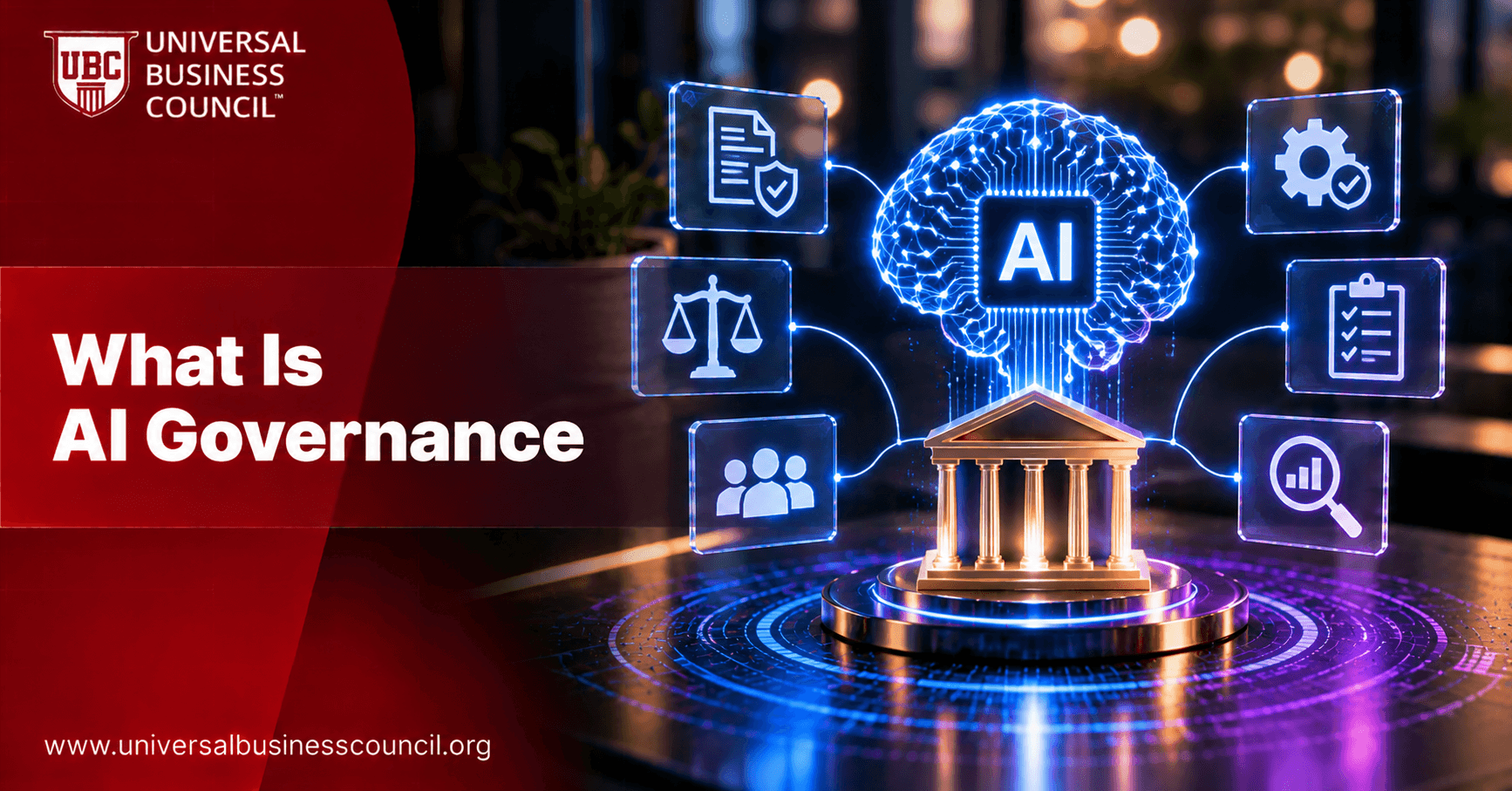
AI governance is the set of rules, roles and checks that keep AI use aligned with a company's goals, laws and values. It answers practical questions: who can approve an AI system, what must be tested first, what happens when something fails and who is responsible for the outcome.
This guide explains what AI governance is, the main frameworks and policies behind it and the best practices that make it work. If you want structured training in the field, the Certified Responsible AI Expert certification from Universal Business Council is a useful option to review. The sections below begin with the basics and then cover frameworks, policies and practice.

What is AI governance?
AI governance is the system of policies, processes, structures and controls an organization uses to manage AI responsibly across its lifecycle, from idea and design to deployment, monitoring and retirement. It covers technical areas such as data quality, testing and security, and organizational areas such as ownership, approvals, training and reporting.
Good governance doesn't exist to block innovation. It exists to make AI use safe, lawful, fair and reliable enough that people can adopt it with confidence. It also helps leaders see where AI is used across the business, which is often the first surprise: many companies discover more AI in use, including third-party and employee-adopted tools, than they expected.
Why AI governance matters
Regulation: laws such as the EU AI Act, plus existing rules on privacy, discrimination and consumer protection, create duties that need processes to meet
Risk: AI can produce biased, inaccurate, insecure or unsafe outcomes, and governance helps catch them early
Trust: customers, employees and partners want evidence that AI is managed responsibly
Consistency: shared rules prevent every team from inventing its own approach
Value: governed AI is easier to scale, because approvals, documentation and monitoring are already in place
Key AI governance frameworks
NIST AI Risk Management Framework
The NIST AI RMF is a voluntary U.S. framework organized around four functions: Govern, which sets culture, roles and policies; Map, which identifies context and risks; Measure, which analyzes and tests; and Manage, which prioritizes and acts on risks. It is widely used because it is flexible and sector-neutral.
ISO/IEC 42001
ISO/IEC 42001 is an international standard for an AI management system. It sets requirements for establishing, running and improving governance processes, and organizations can seek certification against it.
OECD AI Principles
The OECD principles promote AI that is innovative and trustworthy and that respects human rights and democratic values. Many national strategies draw on them.
EU AI Act
The EU AI Act is a binding regulation that takes a risk-based approach. It bans certain practices, sets detailed obligations for high-risk systems, requires transparency for some uses and is being phased in over several years. Companies serving EU users should check how it applies to them.
Sector and local rules
Industries such as finance, healthcare and employment have their own requirements, and some cities and states have added AI-specific rules. Governance programs should map the rules that apply to each use case.
Core policies in an AI governance program
An AI principles statement or responsible AI policy that sets overall commitments
An acceptable use policy for employees, covering approved tools, data handling and prohibited uses
A risk classification policy that tiers systems by potential impact
Data governance and privacy policies for training, testing and operation
Model development and validation standards, including fairness, robustness and security testing
Third-party and vendor management requirements
Human oversight and escalation rules
Incident response and reporting procedures
Monitoring, audit and retirement standards
Best practices for AI governance
Start with an inventory of AI systems, including vendor tools and employee use of generative AI.
Classify systems by risk, and focus the strongest controls on those that affect people's rights, safety, money or opportunities.
Define roles: an executive sponsor, a cross-functional committee, system owners and reviewers from legal, risk, security and data teams.
Build review gates into the development lifecycle, using risk and impact assessments before launch.
Test for fairness, accuracy, robustness, privacy and security, and document the results.
Provide human oversight and clear ways for people to question or appeal automated decisions.
Monitor performance and drift after launch, and re-audit regularly.
Train employees at different levels, from basic awareness to technical depth.
Report to leadership on risks, incidents and progress.
People and skills
Governance depends on capable people. Organizations that add auditors, risk specialists and data scientists often verify credentials and work history first, and services like HireValid can support that step. Technical skills help governance teams work with engineers, and short tech certifications can build them.
Communication and emerging technology
Governance also includes honest external messaging. Claims about AI should be accurate and supported, and a Digital Marketing Course can help teams describe AI features without overpromising. Technology is shifting quickly, and Deep Tech Certifications cover AI, blockchain and related fields that affect data integrity and traceability.
Common challenges
Shadow AI, where staff use unapproved tools
Policies that exist on paper but are not built into workflows
Unclear ownership between business, technology and legal teams
Rapidly changing regulation
Limited resources for testing and monitoring
A practical response is to start small, focus on high-risk uses first and automate documentation and monitoring where possible.
Conclusion
AI governance is the structure that turns good intentions about AI into consistent practice. It combines frameworks such as the NIST AI RMF, ISO/IEC 42001 and the EU AI Act with policies, roles, review gates, testing and monitoring. Done well, it reduces risk, builds trust and helps AI scale.
Begin with an inventory and a risk-based approach, assign clear ownership and improve step by step. The FAQs below answer common questions.
Frequently asked questions
What is AI governance?
The policies, roles and controls that guide responsible AI use across its lifecycle.
Why is AI governance important?
It reduces legal, ethical and operational risk and builds trust.
Who is responsible for AI governance?
Senior leaders, supported by a cross-functional committee and system owners.
What is the NIST AI RMF?
A voluntary framework with four functions: Govern, Map, Measure and Manage.
What is ISO/IEC 42001?
An international standard for an AI management system.
What is the EU AI Act?
A regulation that sets risk-based rules for AI, with strict duties for high-risk systems.
What are the OECD AI Principles?
Guidelines for trustworthy AI that respect human rights and democratic values.
What is an AI inventory?
A list of AI systems in use, with owners, purposes and risk levels.
What is AI risk classification?
Grouping systems by potential impact so controls match the risk.
What is an acceptable use policy for AI?
Rules on which tools and data employees may use and how.
What is shadow AI?
AI tools used without approval or oversight.
How does governance apply to generative AI?
Through rules on data input, review of outputs, accuracy, copyright and security.
What is human oversight?
Humans monitoring AI and having authority to intervene.
What is an AI impact assessment?
A review of how a system could affect people before it is launched.
How often should AI systems be reviewed?
Regularly and after significant changes in data, use or regulation.
What documentation is needed?
Model cards, data sheets, risk assessments, test results and decision logs.
How do you govern third-party AI?
Through due diligence, contracts, documentation requests and ongoing monitoring.
Do small companies need AI governance?
Yes, in lighter form scaled to their use and risk.
Does governance slow innovation?
It adds steps, but it reduces rework and helps AI scale safely.
Where should I begin?
Create an AI inventory, classify risks and assign accountable owners.
Related Articles
View All
Artificial Intelligence
AI Fairness Explained: Metrics, Frameworks and Best Practices
Explore AI fairness, including key metrics, evaluation frameworks, and best practices for reducing bias in machine learning systems. Learn how organizations can promote equitable outcomes, improve model accountability, and build more transparent and inclusive AI solutions.
Artificial Intelligence
AI Governance for Enterprise Leaders: A Step-by-Step Implementation Guide
Learn how enterprise leaders can implement effective AI governance through a step-by-step approach. Explore key strategies for establishing governance policies, defining responsibilities, managing AI risks, ensuring regulatory compliance, and promoting transparency and accountability across enterprise AI initiatives.
Artificial Intelligence
Responsible AI Policies: How to Create an Enterprise AI Policy
Understand what responsible AI policies are and why organizations need them to guide the ethical development and use of artificial intelligence. Explore key policy components, including data privacy, fairness, transparency, accountability, risk management, and human oversight to support responsible AI adoption.
Trending Articles
The Role of Blockchain in Ethical AI Development
How blockchain technology is being used to promote transparency and accountability in artificial intelligence systems.
AWS Career Roadmap
A step-by-step guide to building a successful career in Amazon Web Services cloud computing.
Top 5 DeFi Platforms
Explore the leading decentralized finance platforms and what makes each one unique in the evolving DeFi landscape.