

NIST AI Risk Management Framework: A Practical Implementation Guide
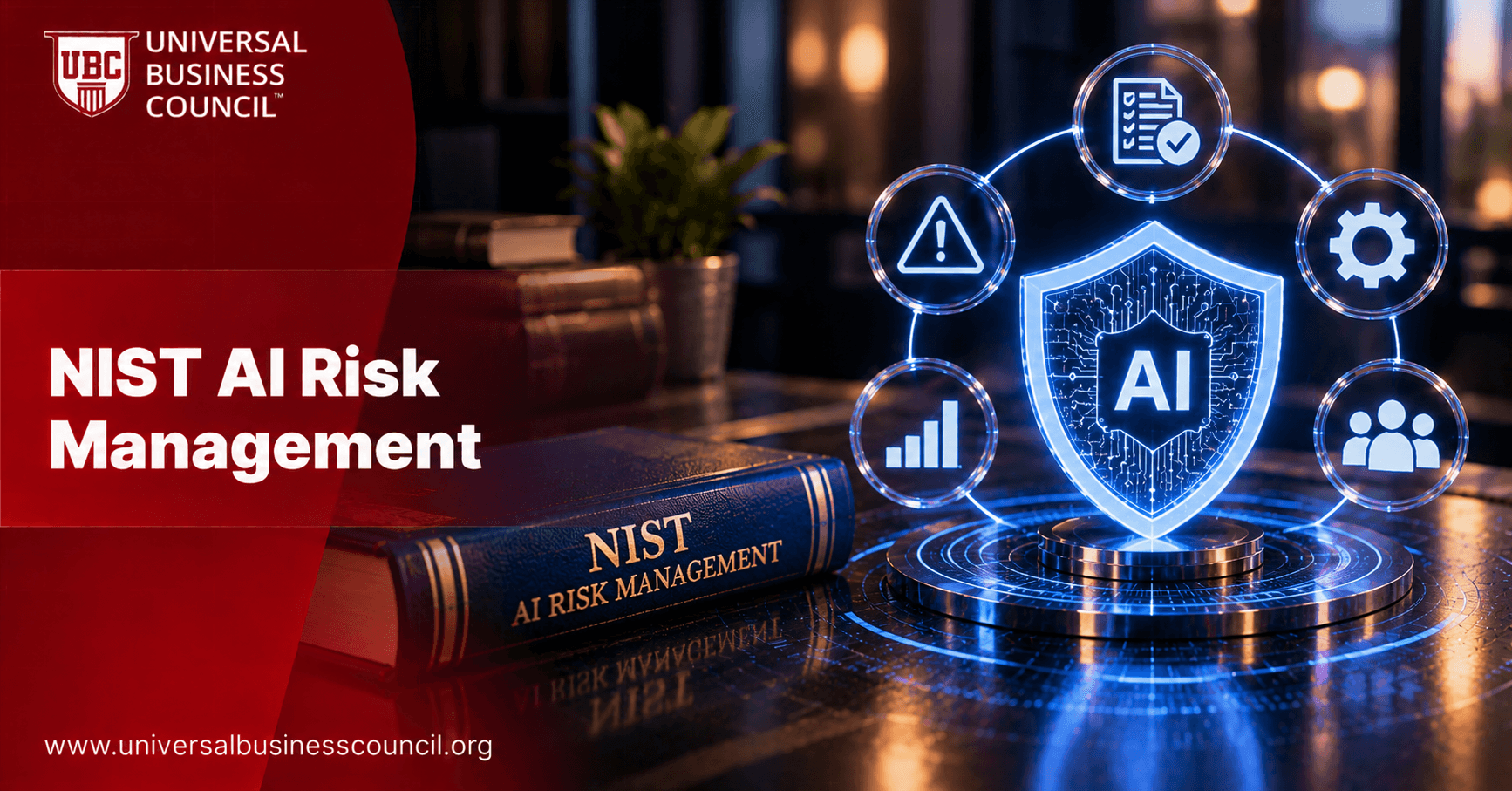
Few documents have shaped how organizations talk about AI risk as much as the NIST AI Risk Management Framework. It is voluntary, flexible and written for practitioners, which makes it a popular starting point for companies of every size. The challenge is not reading it but turning it into daily practice.
This guide explains what the framework is, walks through its four functions and shows how to implement it in a way that fits your organization. For readers seeking structured learning on responsible AI, the Certified Responsible AI Expert certification from Universal Business Council pairs well with the framework.

What Is the NIST AI Risk Management Framework?
The NIST AI Risk Management Framework (AI RMF 1.0) was released by the US National Institute of Standards and Technology in January 2023. It offers voluntary guidance to help organizations identify, assess and manage risks across the AI lifecycle, and to build trustworthiness into the design, development, use and evaluation of AI.
It describes trustworthy AI as valid and reliable, safe, secure and resilient, accountable and transparent, explainable and interpretable, privacy-enhanced and fair with harmful bias managed. NIST has also published a Generative AI Profile that applies the framework to risks specific to generative AI, such as confabulation, data privacy and information integrity.
The framework is not a certification or law. Organizations use it to structure their own programs and to show regulators, customers and partners that they follow a recognized approach.
The Four Core Functions
The framework organizes work into four functions: Govern, Map, Measure and Manage. Govern runs through all the others, while the other three form a repeating cycle.
Govern: Build the Culture and Structure
Govern sets up policies, roles, accountability and risk tolerance. It covers legal and regulatory awareness, workforce training, third-party oversight and a culture where people can raise concerns. Without this function, the others lack authority.
Map: Understand Context and Risks
Map establishes the context of each AI system: its purpose, users, affected people, data, limitations and potential harms. Teams document intended and foreseeable uses and consider benefits as well as risks. Good mapping prevents surprises later.
Measure: Assess and Track
Measure uses testing, metrics and evaluation to analyze the risks identified. This includes checks for accuracy, bias, robustness, security, privacy and explainability, along with ongoing monitoring after deployment. Mixing quantitative tests with qualitative and expert review gives a fuller picture.
Manage: Prioritize and Respond
Manage turns findings into action: prioritizing risks, choosing responses such as mitigating, transferring, avoiding or accepting them and planning incident response and system retirement. It also covers communication with stakeholders.
Step-by-Step Implementation
Step 1: Set Scope and Sponsorship
Decide which AI systems and business units the effort covers and name an executive sponsor. Start with a limited set of important systems rather than trying to cover everything at once.
Step 2: Inventory and Assess Your Starting Point
List AI systems, including vendor tools and employee-adopted generative AI. Compare current practices with the framework to see which controls already exist. NIST offers a companion Playbook with suggested actions that makes gap assessment easier.
Step 3: Establish Governance
Form a cross-functional team, define roles and set policies, risk tiers and approval rules. Staffing matters here, and organizations often check credentials before assigning people to sensitive risk and compliance roles. HireValid can help verify qualifications and experience.
Step 4: Map Each System
Create a short profile for every in-scope system covering purpose, stakeholders, data sources, assumptions, known limits and potential harms. Include groups that could be affected indirectly.
Step 5: Measure and Test
Choose metrics that fit each risk and run tests before launch and at intervals afterward. Record methods and results. Testing tools and scripts often require coding skill, and short tech certifications can help risk teams follow the technical work.
Step 6: Manage and Monitor
Rank risks by likelihood and impact, assign owners to treatments, set thresholds for escalation and monitor continuously for drift, incidents and feedback.
Step 7: Document, Communicate and Improve
Keep evidence of decisions and test results. Share appropriate information with users and stakeholders, and review the program at least yearly. Clear public messaging about AI practices is part of trust, and a Digital Marketing Course can help communications teams explain these practices without overclaiming.
Using the Framework with Other Standards
The AI RMF works alongside other references. ISO/IEC 42001 provides a certifiable management system, ISO/IEC 23894 offers risk management guidance and the EU AI Act sets legal duties. Many organizations use NIST for risk practice, ISO for management structure and the Act for compliance requirements. Mapping controls across them avoids duplicated work.
Common Challenges
Treating it as a checklist instead of an ongoing cycle
Skipping the Map function and jumping to testing
Ignoring third-party and generative AI tools
Failing to assign owners to identified risks
Producing documents without changing behavior
Staying informed on wider technology change helps teams anticipate new risks, and Deep Tech Certifications offer helpful background on emerging fields.
Conclusion
The NIST AI RMF gives organizations a clear, flexible way to manage AI risk through Govern, Map, Measure and Manage. Start small, build governance first, map and test your most important systems and improve continuously. The FAQs below answer common questions.
Frequently Asked Questions
What is the NIST AI RMF?
A voluntary framework from NIST for managing AI risks and building trustworthy AI.
When was it released?
Version 1.0 was released in January 2023.
Is it mandatory?
No, it is voluntary, though regulators and customers often view it favorably.
What are the four functions?
Govern, Map, Measure and Manage.
What does Govern cover?
Policies, roles, accountability, culture and risk tolerance.
What does Map involve?
Understanding each system's context, stakeholders, data and potential harms.
What is included in Measure?
Testing and monitoring for accuracy, bias, robustness, security, privacy and explainability.
What does Manage mean?
Prioritizing risks, responding to them and planning for incidents.
What are the trustworthy AI characteristics?
Valid, safe, secure, accountable, explainable, privacy-enhanced and fair.
What is the NIST AI RMF Playbook?
A companion resource with suggested actions for each part of the framework.
What is the Generative AI Profile?
A NIST profile applying the framework to generative AI risks.
Can you be certified in NIST AI RMF?
No, there is no official certification for the framework itself.
Who should use it?
Any organization that develops, buys or deploys AI.
Does it work for small companies?
Yes, it is flexible and can be scaled to size and risk.
How does it relate to ISO/IEC 42001?
NIST guides risk practice, while ISO/IEC 42001 provides a certifiable management system.
Does it help with EU AI Act compliance?
It supports risk management practices the Act expects, though it does not replace legal compliance.
How do you start implementing it?
Set scope, inventory AI systems, establish governance and map priority systems.
How often should it be reviewed?
At least yearly and when systems or risks change.
What are common implementation mistakes?
Checklist thinking, skipping Map, ignoring vendor AI and having no risk owners.
Related Articles
View All
Artificial Intelligence
AI Governance for Enterprise Leaders: A Step-by-Step Implementation Guide
Learn how enterprise leaders can implement effective AI governance through a step-by-step approach. Explore key strategies for establishing governance policies, defining responsibilities, managing AI risks, ensuring regulatory compliance, and promoting transparency and accountability across enterprise AI initiatives.
Artificial Intelligence
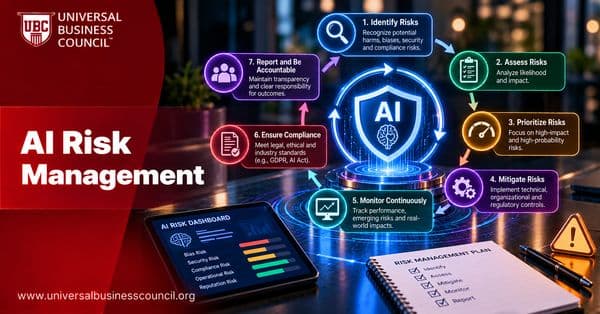
AI Risk Management: Identifying, Assessing and Mitigating AI Risks
Understand what AI risk management is and explore the key strategies organizations use to identify, assess, mitigate, and monitor AI-related risks. Learn how effective risk management supports AI security, fairness, transparency, regulatory compliance, and responsible AI adoption.

Artificial Intelligence
AI Transparency and Accountability: A Practical Guide for Organizations
Learn how organizations can improve AI transparency and accountability through practical governance strategies and responsible AI practices. Explore explainability, documentation, human oversight, risk assessment, and monitoring to build trustworthy AI systems and ensure responsible decision-making.
Trending Articles
The Role of Blockchain in Ethical AI Development
How blockchain technology is being used to promote transparency and accountability in artificial intelligence systems.
AWS Career Roadmap
A step-by-step guide to building a successful career in Amazon Web Services cloud computing.
Top 5 DeFi Platforms
Explore the leading decentralized finance platforms and what makes each one unique in the evolving DeFi landscape.