

AI Risk Management: Identifying, Assessing and Mitigating AI Risks
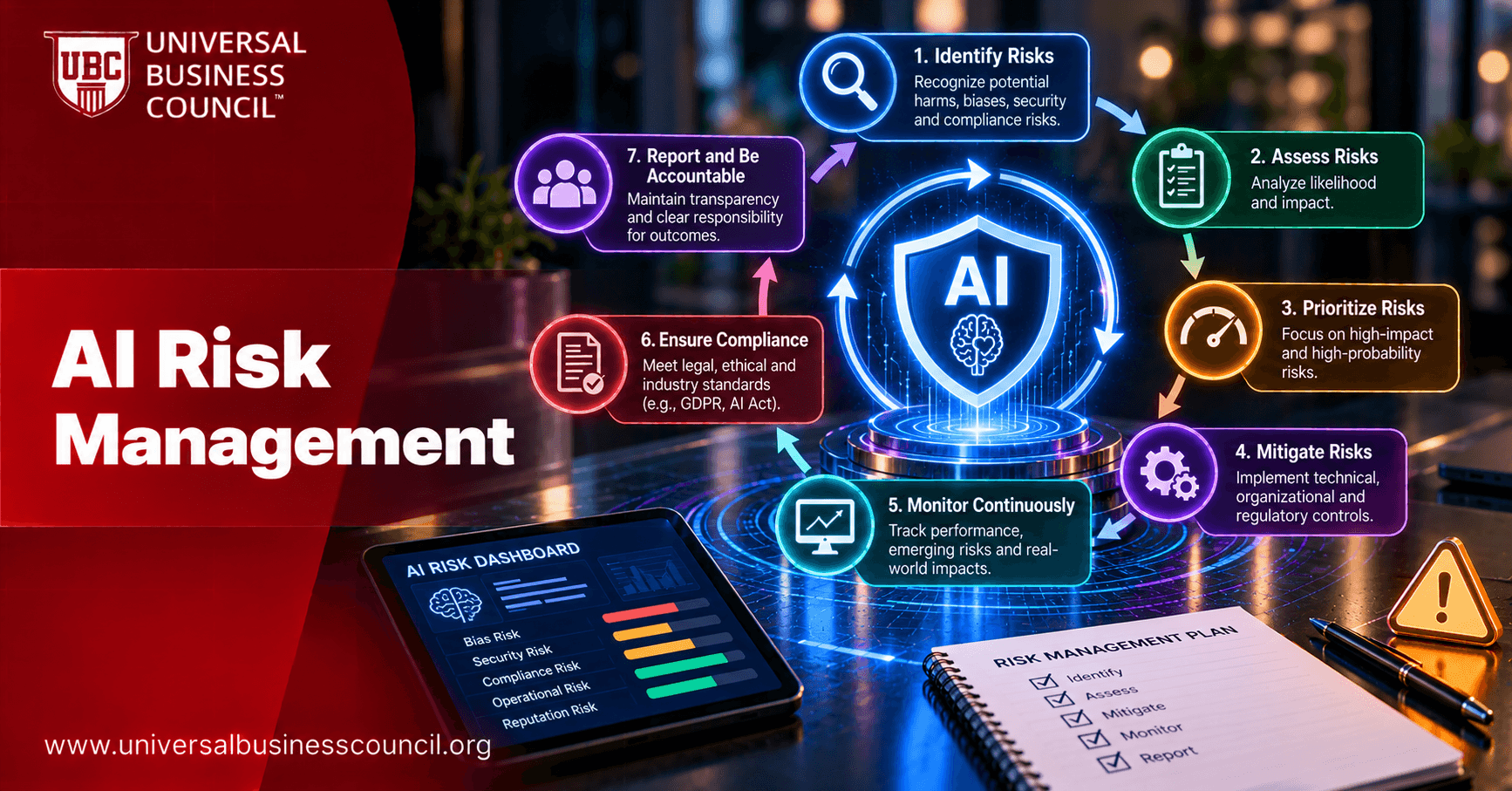
Risk management starts by admitting what could go wrong. AI systems can produce biased outcomes, leak sensitive data, fail silently, be misused or simply behave differently from how their designers expected, and each of those outcomes can bring legal, financial and reputational consequences. A disciplined approach to AI risk management finds problems early, ranks them honestly and applies controls in proportion. This guide explains how to identify, assess and mitigate AI risks, how to monitor them over time and how to document the work. Professionals who want a recognized foundation can explore the certified responsible AI expert certification. This guide is general information and not legal advice, and requirements vary by region and sector.
What is AI risk management?
AI risk management is the structured process of identifying, assessing, mitigating, monitoring and reporting the risks that AI systems create for individuals, organizations and society. It applies familiar risk principles to features that are specific to AI, such as learning from data, statistical error, limited explainability, change over time and wide reach.

It is not a one-time review. It runs through the whole lifecycle of a system, from the idea stage to retirement, and it connects to wider enterprise risk, compliance, security and privacy programs.
Common categories of AI risk
Clear categories help teams look in the right places. Frequently considered risks include:
Bias and unfair outcomes for particular groups
Privacy and data protection failures
Security threats, including manipulation of inputs and data
Safety and reliability problems, including errors and drift
Lack of transparency and explainability
Legal, regulatory and contractual non-compliance
Misuse, whether intentional or accidental
Third-party and supply chain dependencies
Reputational harm and loss of trust
Not every risk applies to every system, and the mix depends on purpose, data, users and context.
Step 1: Identify risks
Identification begins with understanding the system. Document its purpose, the decisions it supports, the data it uses, the people it affects and the environment in which it operates. Then look for how it could fail or cause harm.
Techniques that help
Workshops with technical, legal, risk and business staff often surface issues that individuals miss. Scenario analysis, structured checklists, review of past incidents and consultation with affected users add further coverage. Including people who might be harmed, or who understand them, makes the process much stronger.
Look beyond the model
Many risks sit around the model: poor data, weak human review, confusing user interfaces, unclear accountability or overconfident marketing. A system can be technically sound and still cause harm in a poorly designed process.
Step 2: Assess and prioritize
Once risks are listed, rank them. Assess the likelihood that each will occur and the severity of the impact, considering the number of people affected, whether harm can be reversed and the sensitivity of the context. Use a consistent scale so that results can be compared across systems, and record the reasoning behind the scores. High-stakes uses, such as those affecting employment, credit, health or safety, usually need deeper assessment and senior sign-off. Alongside inherent risk, consider residual risk after controls are applied.
Step 3: Mitigate
For each significant risk, decide whether to avoid it, reduce it, transfer it or accept it, and record who made that decision.
Technical and process controls
Common mitigations include improving data quality and representativeness, testing for bias and robustness, limiting the data a system can access, adding human review for significant decisions, setting confidence thresholds, building fallback procedures and securing models and pipelines. Clear user notices and complaint routes help when something still goes wrong.
Risks should never simply be accepted by default. Acceptance must be a conscious decision by someone with the authority to make it, and it should be documented with a review date.
Step 4: Monitor and respond
Risk changes after launch. Data shifts, users behave in unexpected ways and the world moves on. Monitor performance, fairness measures, security events, drift and complaints, and set thresholds that trigger review. Have an incident response plan that defines how problems are reported, who investigates, when systems are paused and how affected people and regulators are informed. After each incident, record lessons and update controls.
Risk registers and reporting
A risk register is the working record of identified risks, ratings, controls, owners and status. Keep it current and use it for reporting to governance bodies and senior leaders. Concise dashboards showing top risks, overdue actions and incidents help leaders make informed choices. Secure, tamper-evident records strengthen the evidence base for audits, and professionals interested in technologies for integrity and traceability can explore deep tech certifications.
Managing third-party AI risk
External AI brings extra uncertainty because you may not see how the model was built or tested. Ask suppliers for documentation on data, testing, security and limitations, and include incident notification, audit rights and exit terms in contracts. Due diligence should also include the people and companies involved, and verification services such as HireValid support credential and background checks. Responsibility for outcomes stays with the organization that deploys the system.
Building skills and culture
Good risk management depends on people who can recognize and raise concerns. Provide training on AI risks for developers, product owners, procurement, legal and business staff, and encourage open reporting without blame. Technical literacy helps non-specialists challenge assumptions, and some professionals build it through tech certifications.
Honest claims and external communication
Overstating what AI can do is itself a risk. Public claims about accuracy, safety or fairness should be backed by documented testing and should include limits. A digital marketing course can help communication teams describe AI-enabled products accurately and avoid creating legal or reputational exposure.
Conclusion
AI risk management is a continuous cycle of identifying, assessing, mitigating, monitoring and reporting. Teams should look at categories such as bias, privacy, security, reliability, transparency, legal exposure, misuse and third-party dependence, and look beyond the model to the process around it. Risks are ranked by likelihood and severity, treated with technical and process controls, and accepted only by decision-makers with the authority to do so. Monitoring, incident response and a living risk register keep the program honest after launch. With trained people, vendor due diligence and accurate communication, organizations can use AI with confidence and with the evidence to prove it.
Frequently asked questions
These are the questions people ask most about AI risk management.
1. What is AI risk management?
The process of identifying, assessing, mitigating, monitoring and reporting the risks that AI systems create.
2. Why is AI risk different from other IT risk?
AI learns from data, makes statistical errors, can be hard to explain and changes over time.
3. What are common AI risks?
Bias, privacy failures, security threats, reliability problems, opacity, legal non-compliance, misuse and third-party dependence.
4. How do we identify AI risks?
Through workshops, scenario analysis, checklists, incident reviews and input from affected users.
5. How do we assess AI risk?
By rating likelihood and severity on a consistent scale and recording the reasoning.
6. What is residual risk?
The risk that remains after controls have been applied.
7. What are mitigation options?
Avoid, reduce, transfer or accept the risk, with a documented decision.
8. What controls reduce AI risk?
Better data, bias and robustness testing, human review, access limits, fallback procedures and security measures.
9. Who can accept a risk?
A named person with the authority to do so, with the decision recorded and a review date set.
10. What is a risk register?
A living record of risks, ratings, controls, owners and status.
11. What should we monitor after launch?
Performance, fairness, security events, drift and complaints.
12. What is model drift?
A change in model performance over time as data or conditions shift.
13. What is an AI incident?
An event in which an AI system causes or risks harm, such as a serious error, a security breach or a biased outcome.
14. What should an incident plan include?
Reporting routes, investigators, pause criteria, communication steps and lessons learned.
15. How do we manage vendor AI risk?
Through due diligence, documentation requests, contract terms and ongoing review.
16. How do we verify AI suppliers and staff?
By checking credentials, work history and background, often with verification services.
17. Which AI systems are high risk?
Those affecting people's rights, safety, finances or opportunities, such as hiring, credit, health and safety uses.
18. Who needs risk training?
Developers, product owners, procurement, legal, risk and business users of AI.
19. How often should risk be reviewed?
On a schedule based on risk level and whenever the system, data or context changes.
20. Where do we start?
Inventory your AI systems, rank them by impact and assess the highest-impact ones first.
Related Articles
View All
Artificial Intelligence
NIST AI Risk Management Framework: A Practical Implementation Guide
Explore the NIST AI Risk Management Framework and learn how to implement it across the AI lifecycle. Understand its four core functions, Govern, Map, Measure, and Manage, along with practical steps for identifying AI risks, improving accountability, and building trustworthy AI systems.

Artificial Intelligence
ISO/IEC 42001 Explained: AI Management Systems and Certification Requirements
Understand what ISO/IEC 42001 is and how this international standard helps organizations establish, implement, and maintain an Artificial Intelligence Management System (AIMS). Explore its key requirements, benefits, certification process, and role in promoting responsible AI governance, risk management, transparency, and accountability.

Artificial Intelligence
EU AI Act Explained: Risk Categories, Requirements and Business Implications
Understand the EU AI Act, its risk-based categories, key compliance requirements, and business implications. Explore how the regulation classifies AI systems, what obligations apply to different risk levels, and how organizations can prepare for compliance while adopting responsible AI practices.
Trending Articles
The Role of Blockchain in Ethical AI Development
How blockchain technology is being used to promote transparency and accountability in artificial intelligence systems.
AWS Career Roadmap
A step-by-step guide to building a successful career in Amazon Web Services cloud computing.
Top 5 DeFi Platforms
Explore the leading decentralized finance platforms and what makes each one unique in the evolving DeFi landscape.