

EU AI Act Explained: Risk Categories, Requirements and Business Implications
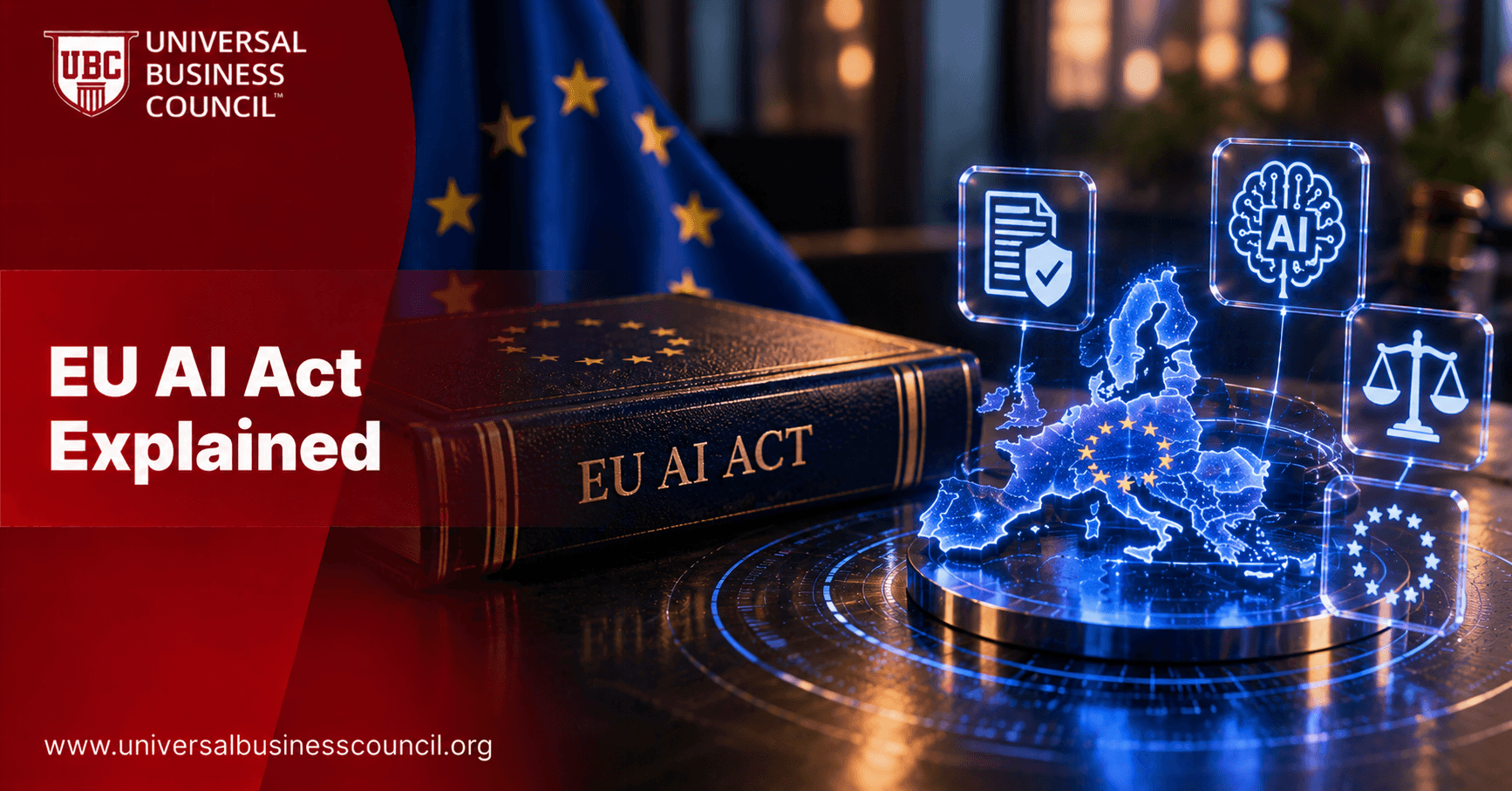
The EU AI Act is the first broad, binding law on artificial intelligence, and its reach goes beyond European borders. Any business that offers AI systems in the EU market, or whose AI outputs are used in the EU, may fall within its scope. Understanding how the Act sorts AI by risk is the first step toward knowing what it means for your organization.
This guide explains the EU AI Act in plain terms: its risk categories, the main requirements, who is affected and what businesses should do now. Professionals building skills in this area may also want to review the Certified Responsible AI Expert certification from Universal Business Council.

What Is the EU AI Act?
The EU AI Act (Regulation (EU) 2024/1689) is a risk-based law that sets rules for AI systems placed on the EU market or used in the EU. It entered into force in August 2024, with obligations phasing in over several years. The central idea is simple: the higher the potential harm of an AI system, the stricter the rules.
The Act applies to providers (those who develop or place AI on the market), deployers (those who use it professionally), importers and distributors. It can apply to non-EU companies when their AI systems or outputs reach the EU. Because timelines and implementation details have been subject to adjustment, businesses should confirm current dates with official EU sources.
The Four Risk Categories
Unacceptable Risk: Prohibited Practices
Some uses are banned outright because they threaten fundamental rights. Examples include harmful manipulation of behavior, social scoring by public authorities, untargeted scraping of facial images to build recognition databases and, with narrow exceptions, real-time remote biometric identification in public spaces by law enforcement. The Act also restricts emotion recognition in workplaces and schools. These prohibitions were the first to apply.
High Risk
High-risk systems are allowed but heavily regulated. They fall into two groups: AI used as a safety component in regulated products, such as medical devices, and AI used in sensitive areas listed in the Act. Those areas include:
Employment, worker management and recruitment
Education and vocational training
Access to essential services such as credit scoring and insurance
Law enforcement, migration and border control
Administration of justice and democratic processes
Critical infrastructure and biometrics
Limited Risk: Transparency Obligations
These systems must be clear about what they are. People must be told when they interact with a chatbot, and AI-generated or manipulated content such as deepfakes must be labeled.
Minimal Risk
Most AI, such as spam filters and recommendation features in games, faces no specific obligations, though voluntary codes of conduct are encouraged.
General-Purpose AI Models
The Act adds a separate layer for general-purpose AI models, the foundation models behind many generative AI tools. Providers must maintain technical documentation, share information with downstream developers, respect EU copyright rules and publish a summary of training content. Models judged to carry systemic risk face further duties, including evaluations, adversarial testing, incident reporting and cybersecurity protections.
Key Requirements for High-Risk AI
Providers of high-risk systems must meet a detailed set of requirements before and after placing a system on the market.
Risk management system running across the lifecycle
Data governance so training and testing data are relevant and as free of errors and bias as possible
Technical documentation and record-keeping through logs
Transparency and instructions for deployers
Human oversight built into the design
Accuracy, robustness and cybersecurity
Conformity assessment, a quality management system and registration in the EU database
Deployers also carry duties: using systems as instructed, assigning trained human overseers, monitoring operation, keeping logs and informing workers and affected individuals. In some cases they must carry out a fundamental rights impact assessment.
Penalties and Enforcement
Fines scale with the breach. Violations of the prohibited practices can reach 35 million euros or 7 percent of worldwide annual turnover, whichever is higher, with lower tiers for other breaches. National authorities enforce the Act, supported by the EU AI Office, which oversees general-purpose AI models.
Business Implications
For most companies, the Act means three practical shifts. First, AI inventories become essential, because you cannot classify systems you have not listed. Second, vendor management gets harder, since buyers need documentation and contractual assurances from AI suppliers. Third, AI literacy requirements push organizations to train staff who use or oversee AI.
Hiring is directly affected, because recruitment AI is high risk and the people who oversee such systems need the right skills. Employers sometimes verify the credentials of staff in sensitive compliance roles, and HireValid can support that process.
How to Prepare: A Practical Checklist
Start with an inventory of all AI systems and map each to the Act's categories. Identify your role for each system, whether provider, deployer or both. Close gaps in documentation, testing, data governance and human oversight for anything likely to be high risk. Update vendor contracts and set up incident-reporting routes.
Technical teams will need to understand logging, testing and monitoring in detail, and short tech certifications can help compliance staff speak the same language as engineers. Public-facing disclosure also matters, since chatbot and synthetic content labels affect marketing. A Digital Marketing Course can help teams apply transparency rules to campaigns responsibly.
Because AI regulation is moving quickly, keep tracking wider technology developments. Resources such as Deep Tech Certifications give useful background on emerging technologies.
Conclusion
The EU AI Act sorts AI into four risk levels and attaches duties that scale with potential harm. Know where your systems fall, document and test them, keep humans in the loop for high-risk uses and verify the current timeline with official sources. The FAQs below cover common questions.
Frequently Asked Questions
What is the EU AI Act?
A risk-based EU regulation that sets rules for the development and use of AI.
Who does the Act apply to?
Providers, deployers, importers and distributors, including non-EU firms whose AI reaches the EU.
What are the four risk categories?
Unacceptable, high, limited and minimal risk.
What AI is banned?
Practices such as harmful manipulation, social scoring and untargeted facial image scraping.
What counts as high-risk AI?
AI in safety components and sensitive areas such as hiring, education, credit and law enforcement.
Is a hiring algorithm high risk?
Yes, AI used for recruitment and worker management is listed as high risk.
What are transparency obligations?
Duties to tell people they are interacting with AI and to label synthetic content.
Are chatbots regulated?
They face transparency rules, and higher duties if used in high-risk contexts.
What is a general-purpose AI model?
A broadly capable model, such as a large language model, usable for many tasks.
What is systemic risk in AI models?
Risk from very capable models that can affect society at scale, triggering extra duties.
What is a provider versus a deployer?
A provider develops or markets the AI, while a deployer uses it in a professional setting.
What is a conformity assessment?
A check that a high-risk system meets the Act's requirements before market entry.
What are the penalties?
Up to 35 million euros or 7 percent of global turnover for the most serious breaches.
Who enforces the Act?
National authorities, with the EU AI Office overseeing general-purpose models.
Does it apply to US companies?
Yes, if their AI systems or outputs are used in the EU.
What is AI literacy under the Act?
The requirement to ensure staff using AI have sufficient understanding of it.
Is human oversight required?
Yes, high-risk systems must be designed to allow effective human oversight.
How should businesses start preparing?
Inventory AI systems, classify them and close documentation and testing gaps.
Are the deadlines fixed?
Obligations phase in over time and details can change, so confirm dates with official sources.
Do open-source models have exemptions?
Some, but not for prohibited practices, high-risk uses or systemic-risk models.
Related Articles
View All
Artificial Intelligence
ISO/IEC 42001 Explained: AI Management Systems and Certification Requirements
Understand what ISO/IEC 42001 is and how this international standard helps organizations establish, implement, and maintain an Artificial Intelligence Management System (AIMS). Explore its key requirements, benefits, certification process, and role in promoting responsible AI governance, risk management, transparency, and accountability.
Artificial Intelligence
NIST AI Risk Management Framework: A Practical Implementation Guide
Explore the NIST AI Risk Management Framework and learn how to implement it across the AI lifecycle. Understand its four core functions, Govern, Map, Measure, and Manage, along with practical steps for identifying AI risks, improving accountability, and building trustworthy AI systems.
Artificial Intelligence
AI Audit Explained: How to Audit AI Systems for Safety, Fairness and Compliance
Learn what an AI audit is and how to evaluate AI systems for safety, fairness, transparency, and regulatory compliance. Explore key audit steps, risk assessment methods, bias detection techniques, and monitoring practices that help organizations build trustworthy and responsible AI systems.
Trending Articles
The Role of Blockchain in Ethical AI Development
How blockchain technology is being used to promote transparency and accountability in artificial intelligence systems.
AWS Career Roadmap
A step-by-step guide to building a successful career in Amazon Web Services cloud computing.
Top 5 DeFi Platforms
Explore the leading decentralized finance platforms and what makes each one unique in the evolving DeFi landscape.