

What Is AI Ethics? Principles, Challenges and Business Applications
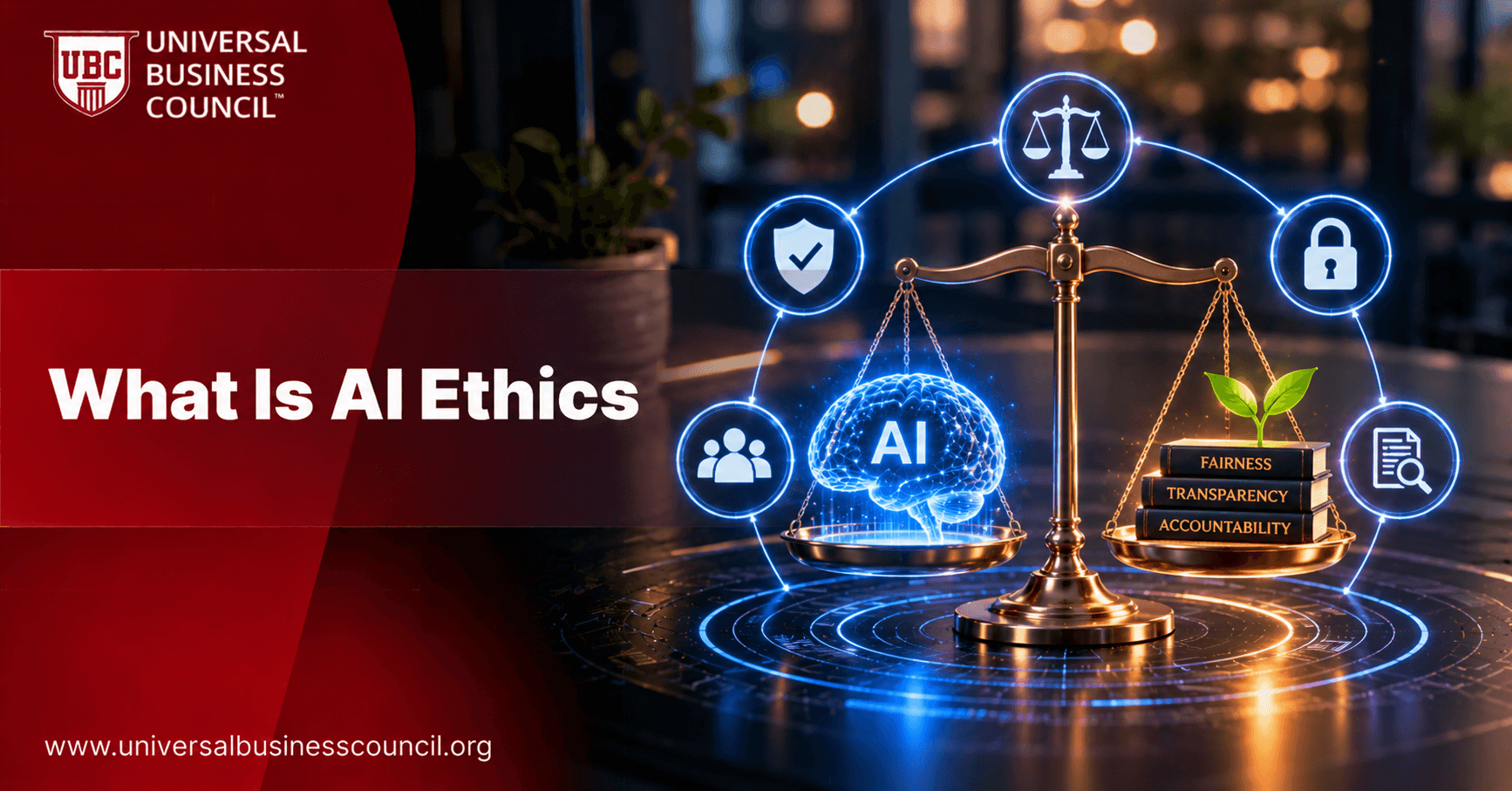
AI ethics is the practice of deciding, before a system ships, what it should and should not be allowed to do. It covers fairness, privacy, safety, transparency and accountability, and it turns broad values into everyday choices about data, design and deployment.
This guide explains what AI ethics is, the main principles behind it, the challenges companies run into and how businesses apply it in practice. If you want a structured path into the field, the Certified Responsible AI Expert certification from Universal Business Council is one option to explore. The sections below start with the basics and move toward real business use.

What is AI ethics?
AI ethics is a set of values, principles and practices that guide how artificial intelligence is designed, built and used. It asks questions such as: Is this system fair to the people it affects? Does it respect their privacy? Can its decisions be explained? Who is accountable if it causes harm?
AI ethics is related to, but different from, AI law and AI governance. Law sets the minimum that is required. Ethics asks what is right even where the law is silent. Governance is the set of structures, such as policies, committees and controls, that put ethical commitments into action.
Core principles of AI ethics
Many organizations, including the OECD, UNESCO and national governments, have published AI principles. The wording differs, but several themes appear again and again.
Fairness and non-discrimination, so systems do not treat people unjustly because of characteristics such as race, gender, age or disability
Transparency and explainability, so people can understand when AI is used and why it reached a decision
Accountability, so identifiable people or teams answer for the outcomes of AI systems
Privacy and data protection, so personal information is collected and used responsibly
Safety and robustness, so systems perform reliably and do not cause unintended harm
Human oversight, so people can monitor, challenge and override automated decisions
Societal and environmental well-being, so AI benefits people and avoids unnecessary harm
Key challenges in AI ethics
Bias in data and models
AI learns from historical data, and history includes human bias. If past hiring or lending decisions favored one group, a model trained on that data can reproduce the pattern. Well-known cases include a reported recruiting tool that was scrapped after it appeared to disadvantage women and studies showing that some facial analysis tools performed worse on darker-skinned women.
Opacity of complex models
Deep learning models can be hard to interpret, even for their creators. That makes it difficult to explain decisions to customers, regulators or courts, and harder to spot hidden problems.
Privacy and consent
AI often relies on large datasets, some containing personal information. Questions arise about consent, data minimization, secondary use and the risk of re-identification.
Accountability gaps
When a decision involves a data provider, a model developer, a vendor and a business user, responsibility can become blurred. Ethical practice requires clear ownership at every stage.
Competing values and trade-offs
Ethical goals can conflict. Greater accuracy might reduce explainability, and strong privacy protections might limit personalization. Fairness definitions themselves can conflict. Handling these trade-offs requires judgment, documentation and input from diverse perspectives.
Fast-moving technology and rules
Generative AI added new issues, including hallucinated content, copyright questions, deepfakes and misuse. Regulation is evolving too, with laws like the EU AI Act and guidance such as the NIST AI Risk Management Framework shaping expectations.
AI ethics in business applications
Ethics becomes valuable to a business when it shapes real decisions. Common application areas include:
Hiring and HR, where tools that screen or rank candidates need bias testing and human review
Lending and insurance, where decisions must be explainable and non-discriminatory
Healthcare, where models must be validated across diverse patient groups and used with clinical oversight
Marketing and customer service, where personalization should respect privacy and chatbots should be honest about being AI
Security and fraud detection, where false positives can harm legitimate customers
HR is a good example of where ethics and operations meet. Companies that use automated screening still need reliable ways to confirm candidate identity, credentials and work history, and services like HireValid support that verification step while humans stay involved in the decision.
How to put AI ethics into practice
Write down your principles in plain language and get leadership sign-off.
Create an inventory of AI systems and classify them by risk.
Run impact assessments for higher-risk uses before launch.
Test for bias, robustness and privacy risks, and document the results.
Define human oversight and escalation paths.
Monitor systems after launch and review them regularly.
Train employees and give them a safe way to raise concerns.
Technical literacy helps ethics teams work with engineers. Short tech certifications in programming and data skills make it easier to understand how models are built and where risks arise.
Communicating ethically about AI
How a company talks about AI is part of its ethics. Avoid exaggerated claims, disclose when people are interacting with AI and explain limits honestly. A Digital Marketing Course can help marketing teams present AI features accurately and avoid misleading language. For anyone who wants a broader view of emerging technology, Deep Tech Certifications cover AI alongside blockchain and other fields that raise related questions about data integrity and trust.
Conclusion
AI ethics is the work of making sure AI systems are fair, transparent, accountable, safe and respectful of privacy. The challenges are real, from bias and opacity to competing values and fast-changing rules, but they are manageable with clear principles, risk-based processes and people empowered to ask hard questions.
For businesses, ethics is not a barrier to innovation. It reduces risk, protects people and builds the trust that makes AI adoption last. Start by defining your principles, mapping your AI systems and focusing on the uses that matter most to people. The FAQs below answer common questions.
Frequently asked questions
What is AI ethics in simple terms?
Guidelines for building and using AI in ways that are fair, safe, transparent and accountable.
Why is AI ethics important?
AI can affect jobs, loans, health and rights, so mistakes can harm real people.
What are the main principles of AI ethics?
Fairness, transparency, accountability, privacy, safety and human oversight.
How is AI ethics different from AI governance?
Ethics sets values, and governance puts them into policies, roles and controls.
Is AI ethics a legal requirement?
Not always, but many ethical issues overlap with laws on discrimination, privacy and consumer protection.
What is algorithmic bias?
Systematic unfairness in AI outcomes, often caused by biased data or design choices.
What is explainable AI?
AI whose decisions can be understood and explained to humans.
Who is responsible for ethical AI?
Everyone involved, with named owners for each system and clear executive accountability.
What is an AI ethics committee?
A cross-functional group that reviews higher-risk AI uses and advises on ethical issues.
What is human oversight?
Letting people monitor, question and override AI decisions.
What are examples of unethical AI use?
Discriminatory screening tools, undisclosed surveillance, misleading deepfakes and manipulative design.
How does AI ethics apply to generative AI?
It covers accuracy, harmful content, privacy, copyright and misuse.
Can small businesses practice AI ethics?
Yes. Simple policies, vendor questions and human review go a long way.
What is an AI impact assessment?
A review of how an AI system could affect people before it is launched.
How do you measure ethical AI?
Through testing for bias and safety, documentation, audits and monitoring.
What frameworks guide AI ethics?
OECD AI Principles, UNESCO's recommendation, the NIST AI RMF and ISO/IEC 42001.
Does ethical AI slow innovation?
It adds steps, but it reduces rework, legal risk and loss of trust.
How can employees raise AI concerns?
Through clear reporting channels and protection from retaliation.
What skills help in AI ethics?
Data literacy, risk management, legal awareness and clear communication.
Where should a company begin?
With principles, an AI inventory and a risk review of the most impactful systems.
Related Articles
View All
Artificial Intelligence
EU AI Act Explained: Risk Categories, Requirements and Business Implications
Understand the EU AI Act, its risk-based categories, key compliance requirements, and business implications. Explore how the regulation classifies AI systems, what obligations apply to different risk levels, and how organizations can prepare for compliance while adopting responsible AI practices.
Artificial Intelligence
AI Governance vs AI Ethics: Differences, Use Cases and Implementation
Understand the differences between AI governance and AI ethics, including their principles, frameworks, use cases, and implementation approaches. Learn how organizations combine ethical guidelines with governance policies to manage AI risks, ensure accountability, promote transparency, and support responsible AI adoption.
Artificial Intelligence
Responsible AI vs Traditional AI: Key Differences and Business Impact
Understand the key differences between responsible AI and traditional AI, including their approaches to development, decision-making, transparency, and accountability. Explore how responsible AI practices impact business performance, reduce risks, build customer trust, and support ethical innovation.
Trending Articles
The Role of Blockchain in Ethical AI Development
How blockchain technology is being used to promote transparency and accountability in artificial intelligence systems.
AWS Career Roadmap
A step-by-step guide to building a successful career in Amazon Web Services cloud computing.
Top 5 DeFi Platforms
Explore the leading decentralized finance platforms and what makes each one unique in the evolving DeFi landscape.