

Responsible AI vs Traditional AI: Key Differences and Business Impact
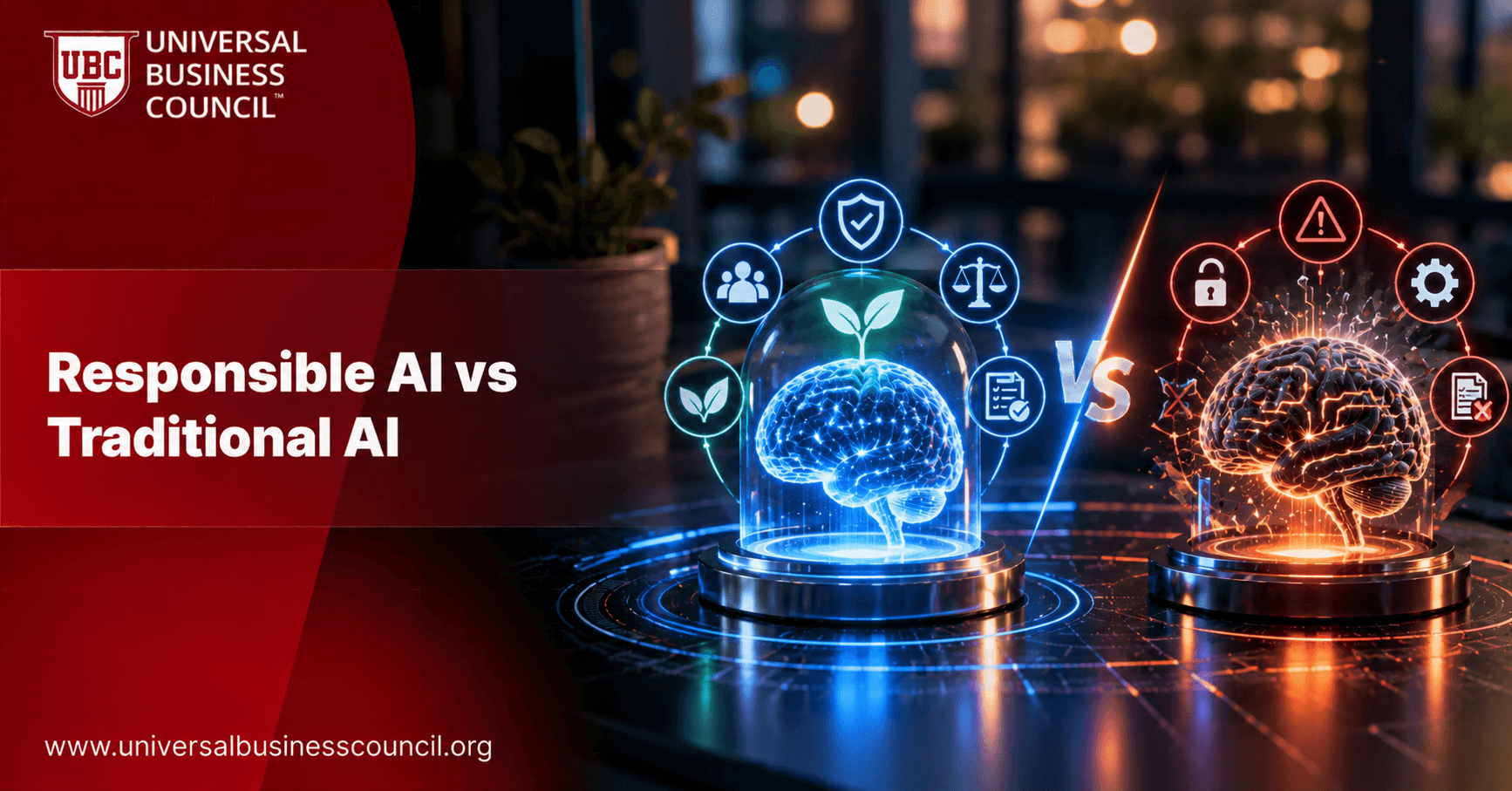
Traditional AI asks whether a model works. Responsible AI asks whether it works for everyone, safely and in the open. That shift in the question changes how teams collect data, build models, test them and answer for the results once they are in use.
This guide explains responsible AI vs traditional AI, where the two approaches differ and what the difference means for business risk, trust and growth. If you want a structured credential to anchor your learning, the Certified Responsible AI Expert certification from Universal Business Council is worth reviewing. The sections below cover definitions first, then the practical differences and the business case.

What is responsible AI, and what is traditional AI?
Traditional AI, as the term is used here, describes the common practice of building models to maximize a technical target such as accuracy, speed or revenue lift. Success is measured mainly by performance metrics, and questions about fairness, privacy, safety or accountability are handled late, informally or not at all.
Responsible AI is an approach to designing, building and deploying AI so that it is fair, transparent, safe, privacy-respecting and accountable. It doesn't replace technical performance. It adds requirements around people, process and oversight, so that a system that scores well in a lab also behaves acceptably in the real world. Organizations such as NIST and the OECD have published principles and frameworks that describe this approach.
Key differences between responsible AI and traditional AI
Goals and success metrics
Traditional AI optimizes one or two headline numbers. Responsible AI tracks a wider set: error rates across different groups, robustness under unusual inputs, privacy exposure, explainability and downstream harm. A model with strong overall accuracy can still fail a specific group, and responsible AI treats that failure as a defect, not a footnote.
Data practices
Traditional pipelines often use whatever data is available. Responsible AI asks where data came from, whether people consented, who is missing from it and whether it reflects the population the system will serve. It documents data sources and limits, and it avoids features that act as proxies for protected characteristics without a clear reason.
Development and testing
Traditional AI tests mainly for accuracy and performance on average cases
Responsible AI adds bias testing, stress testing, red teaming and edge-case review
Responsible AI documents decisions, for example with model cards and data sheets
Responsible AI sets thresholds for release, so a model that fails fairness or safety checks does not ship
Transparency and human oversight
Traditional AI often treats the model as a black box that delivers an answer. Responsible AI asks whether people affected by a decision can understand it, challenge it and reach a human. For high-stakes uses such as hiring, lending or healthcare, it builds in human review and clear escalation paths.
Accountability and governance
In many traditional projects, ownership ends when the model is deployed. Responsible AI assigns named owners, defines approval steps, monitors performance after launch and sets rules for retiring or retraining a model. Governance is part of the lifecycle, not an afterthought.
The business impact of the difference
Choosing responsible AI isn't only an ethical position. It has direct effects on risk, cost and competitiveness.
Lower legal and regulatory risk
Rules are tightening. The EU AI Act takes a risk-based approach, with stricter duties for high-risk systems, and in the United States existing laws on discrimination, consumer protection and credit already apply to automated decisions. Cities and states have added their own rules, such as New York City's bias audit requirement for automated employment decision tools. Companies that practice responsible AI are better placed to meet these requirements without scrambling.
Stronger trust and brand value
Customers, employees and partners increasingly ask how AI is used. Clear policies, honest claims and visible oversight build trust. Overstated or misleading AI claims can draw regulator attention, and a high-profile failure can damage a brand for years.
Better products and fewer costly failures
Systems that are tested across diverse users fail less often in the real world. Catching a biased or brittle model before launch costs far less than withdrawing it afterward, retraining it, handling complaints and rebuilding confidence.
Easier partnerships and procurement
Large buyers increasingly include AI governance questions in vendor reviews. Companies that can show documentation, testing results and accountable owners win those deals more easily.
When traditional approaches fall short
A hiring model trained on past decisions copies past bias
A credit model that uses proxies such as postal codes can produce unequal outcomes
A healthcare model trained on data from one population may perform worse for others
A chatbot with no guardrails can produce harmful or inaccurate content
A model that drifts over time without monitoring can quietly degrade
In each case, accuracy on a test set did not capture the real-world harm. Responsible AI practices exist to catch these problems earlier.
How to move from traditional to responsible AI
Inventory your AI systems and rank them by potential impact on people.
Adopt a framework, such as the NIST AI Risk Management Framework, to structure risk work.
Define fairness, safety and transparency requirements for each high-impact use.
Add testing, documentation and human review to your development process.
Assign owners, set approval gates and monitor systems after launch.
Train staff and review the program regularly.
People matter as much as process. Organizations that hire for AI, risk and compliance roles often verify credentials and work history before bringing someone onto sensitive projects, and services like HireValid can help confirm qualifications quickly. Technical teams also benefit from solid skills in data and programming, and short tech certifications can help build them.
Communicating responsible AI to the market
Doing the work is only half of it. Customers and partners need to understand your approach in plain language, without exaggeration. A Digital Marketing Course can help teams explain AI practices clearly and honestly across websites, reports and social channels. For readers who want a wider view of the technology landscape, Deep Tech Certifications cover areas such as AI and blockchain that increasingly overlap in data integrity and traceability.
Conclusion
Responsible AI vs traditional AI comes down to scope. Traditional AI focuses on whether a system performs. Responsible AI also asks whether it is fair, understandable, safe and governed, and it builds those checks into the full lifecycle. The business impact is practical: lower legal and reputational risk, stronger trust, better products and smoother partnerships.
Start with an inventory, pick a framework and focus first on the systems that affect people most. Build testing and oversight into the process rather than adding them at the end. The FAQs below answer common questions about the topic.
Frequently asked questions
What is responsible AI?
An approach to building and using AI that is fair, transparent, safe, privacy-respecting and accountable.
What is traditional AI?
AI built mainly to optimize technical performance, with ethics and governance handled late or informally.
How is responsible AI different from traditional AI?
It adds fairness, transparency, safety and accountability requirements across the whole lifecycle.
Does responsible AI reduce accuracy?
Not necessarily. Sometimes there are trade-offs, but many fixes improve real-world performance.
Why does responsible AI matter for business?
It reduces legal and reputational risk and builds trust with customers and partners.
Is responsible AI required by law?
Some requirements are legal, such as the EU AI Act and existing anti-discrimination laws, and others are voluntary.
What frameworks support responsible AI?
Examples include the NIST AI Risk Management Framework, OECD AI Principles and ISO/IEC 42001.
What are the core principles of responsible AI?
Fairness, transparency, accountability, privacy, safety and human oversight.
Who is responsible for AI in a company?
Named owners across leadership, product, data, legal and risk, with clear approval steps.
What is an AI risk assessment?
A structured review of how an AI system could cause harm and how to reduce it.
What is bias testing?
Checking whether a model performs differently across groups and fixing gaps.
What is a model card?
A short document describing a model's purpose, data, performance and limits.
Do small companies need responsible AI?
Yes, scaled to their risk. Even simple policies and checks help.
How do I start?
List your AI systems, rank them by impact and apply a framework to the highest-risk ones.
What is human-in-the-loop?
A design where a person reviews or can override AI decisions, especially in high-stakes cases.
Can responsible AI prevent all harm?
No, but it reduces risk and helps catch problems earlier.
How often should AI systems be reviewed?
Regularly, and whenever data, use cases or regulations change.
What skills are needed?
A mix of data science, risk, legal, ethics and communication skills.
Does responsible AI apply to generative AI?
Yes, including issues like accuracy, misuse, privacy and intellectual property.
How can I learn more?
Study recognized frameworks and consider a structured certification in responsible AI.
Related Articles
View All
Artificial Intelligence
Responsible AI vs Ethical AI vs Trustworthy AI: Key Differences
Understand the differences between responsible AI, ethical AI, and trustworthy AI, including their definitions, principles, and applications. Explore how these approaches address fairness, transparency, accountability, privacy, and safety to guide the development and use of reliable artificial intelligence systems.

Artificial Intelligence
EU AI Act Explained: Risk Categories, Requirements and Business Implications
Understand the EU AI Act, its risk-based categories, key compliance requirements, and business implications. Explore how the regulation classifies AI systems, what obligations apply to different risk levels, and how organizations can prepare for compliance while adopting responsible AI practices.
Artificial Intelligence
Responsible AI Policies: How to Create an Enterprise AI Policy
Understand what responsible AI policies are and why organizations need them to guide the ethical development and use of artificial intelligence. Explore key policy components, including data privacy, fairness, transparency, accountability, risk management, and human oversight to support responsible AI adoption.
Trending Articles
The Role of Blockchain in Ethical AI Development
How blockchain technology is being used to promote transparency and accountability in artificial intelligence systems.
AWS Career Roadmap
A step-by-step guide to building a successful career in Amazon Web Services cloud computing.
Top 5 DeFi Platforms
Explore the leading decentralized finance platforms and what makes each one unique in the evolving DeFi landscape.