

Responsible AI vs Ethical AI vs Trustworthy AI: Key Differences
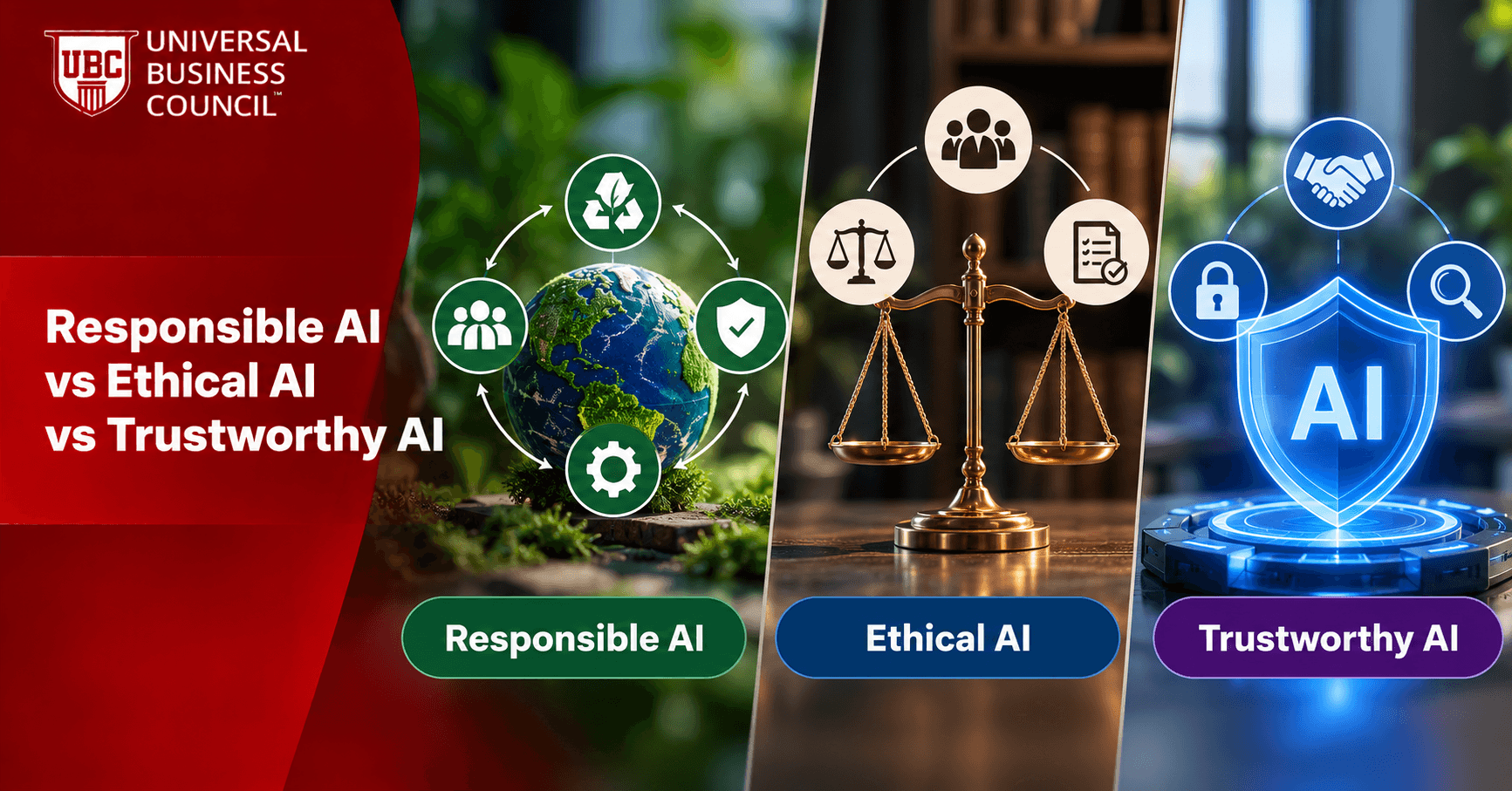
Responsible AI, ethical AI, trustworthy AI. The three phrases turn up in strategy decks, policy papers and job listings, often swapped around as if they were synonyms. They're close cousins, but they aren't twins, and mixing them up can lead to vague policies and muddled conversations. This guide explains responsible AI vs ethical AI vs trustworthy AI in plain terms, shows where they differ and overlap, and helps you decide which language fits your situation. If you'd like a structured path into this field, the Certified Responsible AI Expert program is a useful place to begin.
What are responsible AI, ethical AI and trustworthy AI?
Ethical AI
Ethical AI is about values. It asks what is right and wrong when AI affects people, and draws on ideas such as fairness, human dignity, autonomy and avoiding harm. Ethical AI is usually expressed as principles or a code of conduct.

Responsible AI
Responsible AI is about action and accountability. It turns values into practice through governance, roles, processes, testing and monitoring across the life of an AI system. It asks who is accountable and what we do to make sure the system behaves as intended.
Trustworthy AI
Trustworthy AI is about the result. It describes AI that people can reasonably rely on because it is reliable, safe, secure, fair, transparent and respectful of privacy. It asks whether the people affected have good reason to trust the system.
A simple way to tell them apart
Ethical AI is the "why" and the "what's right."
Responsible AI is the "how" and the "who's accountable."
Trustworthy AI is the "what you end up with."
Think of building a bridge. Ethics says the bridge must not endanger people. Responsibility is the engineering process, inspections and sign-offs that make that real. Trustworthiness is the bridge people feel safe crossing.
Key differences side by side
Main focus: ethical AI centers on values, responsible AI on processes and accountability, trustworthy AI on qualities of the system.
Core question: "Is this the right thing to do?" versus "Are we doing it properly, and who answers for it?" versus "Can people rely on this?"
Typical output: principles and codes versus governance structures, policies and audits versus tested, documented, explainable systems.
Who drives it: ethicists, leadership and policy teams for ethics; risk, legal, compliance and engineering for responsibility; product, quality and communications teams for trust.
How it's judged: by alignment with values, by evidence that practices are followed, and by user and stakeholder confidence.
In real conversations the boundaries blur, and that's fine. The important thing is that your organization knows what it means by each term when it uses it.
Where the three overlap
They share most of their ingredients: fairness, transparency, privacy, safety, accountability and human oversight. A fair hiring tool is an ethical goal, a responsible practice (audit the outcomes) and a trustworthy quality (candidates believe the process is fair). The difference lies in the angle you take on the same idea.
That overlap is a strength, not a flaw. It means work done on one front, such as a bias audit, supports all three goals at once.
How they work together: a hypothetical example
Imagine a company building an AI tool that helps prioritize customer support tickets.
The ethical layer
The team decides that urgent cases from vulnerable customers must never be pushed down the queue because of a quirk in the model, and that customers deserve honest information about how the tool works.
The responsible layer
The company names an owner, tests the tool on varied ticket types, documents its limits, sets up monitoring and creates a process for staff to override the system.
The trustworthy layer
The result is a tool that performs consistently, explains why a ticket was ranked a certain way and earns the confidence of support staff and customers.
Take away any one layer and the others suffer. Values without process stay on paper. Process without values becomes box-ticking. Neither produces trust unless the system actually works.
What each looks like inside an organization
Ethical AI: a short set of principles, an ethics review for sensitive projects and open discussion of difficult trade-offs.
Responsible AI: an AI inventory, risk ratings, named owners, approval gates, audits and incident response.
Trustworthy AI: robust testing, clear documentation, explanations for users and honest communication about limits.
Where the terms appear in frameworks
Official documents use the words in different ways, which is one reason confusion persists. Check the latest versions of each.
The NIST AI Risk Management Framework describes characteristics of trustworthy AI, such as validity and reliability, safety, security, accountability, transparency, explainability, privacy and fairness, and provides a process to manage risk.
The European Commission's expert group described trustworthy AI as lawful, ethical and robust, with requirements such as human oversight, technical robustness, privacy, transparency, non-discrimination and accountability.
The OECD AI Principles promote innovative and trustworthy AI that respects human rights and democratic values.
ISO/IEC 42001 sets out requirements for an AI management system, which is a responsible-AI-style process standard.
Reading these documents is easier when you can spot whether a passage is about values, practice or qualities. Technical fluency helps too. Short courses such as tech certifications can help non-engineers follow the terms used in model testing and data work.
Why the wording matters for communication
Words shape expectations. If a company calls its AI "ethical" but can't show processes or test results, people may feel misled. If it says "trustworthy" without evidence, the claim rings hollow. Marketing and communications teams need to match their language to what the organization can actually demonstrate.
It's the same discipline that good marketers apply to any claim. Anyone who has completed a digital marketing course will know that overpromising damages credibility. Use the term that fits the evidence, explain it in plain language and avoid turning any of the three into a slogan.
Common mix-ups to avoid
Treating ethics as compliance. Following a rule isn't always the same as doing the right thing, and rules often lag behind technology.
Writing principles with no owners. Values need people accountable for them.
Claiming trustworthiness without test results or documentation to back it up.
Letting each department define the terms differently, which makes policies hard to apply.
Assuming a vendor's "responsible AI" label covers how you use the tool.
A shared glossary of one line per term, agreed across legal, engineering, product and communications, prevents most of these problems.
Which term should you use?
Talking about values and moral questions: ethical AI.
Talking about governance, policies, accountability and compliance: responsible AI.
Talking about product quality, user confidence and outcomes: trustworthy AI.
Not sure? Define the term in one sentence the first time you use it.
Questions worth asking your team
Which of the three terms do we use, and what do we mean by it?
Where are our values written down, and who reviews difficult cases?
Who is accountable for each AI system, and how do we check it?
What evidence would convince a skeptical customer that our AI is reliable?
What would we do if one of our systems caused harm?
Skills and hiring
Whatever label a team prefers, the work calls for people who can weigh trade-offs, communicate clearly and notice risks. Employers hiring for these roles often look beyond a résumé. Platforms such as HireValid offer situational judgment and skills-based assessments that help hiring teams see how candidates reason through realistic scenarios.
Looking ahead
As AI moves into autonomous agents, connected devices and systems that interact with blockchain-based records, the three terms will keep evolving. New technology brings new questions about control, data and accountability. Introductory paths such as deep tech certifications can help professionals understand the technologies behind those questions.
Wrapping up: responsible AI vs ethical AI vs trustworthy AI
The responsible AI vs ethical AI vs trustworthy AI debate comes down to angle. Ethical AI is about values and what is right. Responsible AI is about governance, processes and accountability that put those values into practice. Trustworthy AI is about the qualities of the finished system and whether people have good reason to rely on it.
They share the same ingredients, including fairness, transparency, privacy, safety and human oversight, and they work best together. Values without process stay on paper, process without values becomes box-ticking, and neither earns trust unless the system performs. Frameworks from NIST, the European Commission's expert group, the OECD and ISO use the terms in different ways, so read each one on its own terms.
When you write or speak about AI, choose the word that matches your point, define it once and back it up with evidence. Clear language is a small step, but it makes policies sharper, teams more aligned and claims more credible. Understanding responsible AI vs ethical AI vs trustworthy AI is the first step toward building AI that deserves the confidence people place in it.
Frequently asked questions
What is the difference between responsible AI and ethical AI?
Ethical AI focuses on values and what's right. Responsible AI focuses on the processes and accountability that put those values into practice.
What is trustworthy AI?
AI that people can reasonably rely on because it is reliable, safe, secure, fair, transparent and respects privacy.
Is responsible AI the same as ethical AI?
No, though they overlap. Responsible AI is more about governance and practice.
Is trustworthy AI the same as responsible AI?
Not exactly. Trustworthy AI describes a system's qualities, while responsible AI describes how it's built and managed.
Which term is best for business use?
Responsible AI is common in governance and compliance, but define whichever term you use.
What are the principles of ethical AI?
Typically fairness, human dignity, autonomy, avoiding harm and transparency.
What makes AI trustworthy?
Reliability, safety, security, fairness, transparency, privacy and accountability.
How do the three concepts overlap?
They share ingredients like fairness, transparency, privacy, safety and human oversight.
Who is responsible for ethical AI?
Leadership, policy teams and everyone who builds or uses AI.
What is an AI ethics board?
A group that reviews sensitive AI projects against an organization's principles.
What does the NIST AI RMF say about trustworthy AI?
It lists characteristics such as validity, reliability, safety, security, accountability, transparency, explainability, privacy and fairness.
What is ethics washing?
Claiming ethical standards without real practices or evidence to support them.
Can AI be responsible but not trustworthy?
Yes, if good processes still produce a system that doesn't perform reliably or earn confidence.
Can AI be trustworthy without responsible practices?
It's hard to sustain. Without governance and monitoring, trust is difficult to maintain.
Does regulation address these terms?
Some laws and frameworks do, such as the EU AI Act and OECD principles, so check local rules.
How do you measure trustworthy AI?
Through testing for accuracy and fairness, documentation, audits and user feedback.
What is human oversight?
A person's ability to review, question and override important AI decisions.
Why do definitions of these terms differ?
Organizations, regulators and researchers each emphasize different goals.
How can companies communicate about these concepts honestly?
Define the terms, explain what you do and avoid claims you can't back up.
Where should a beginner start?
Learn the core principles, then study a framework such as the NIST AI RMF or the OECD AI Principles.
Related Articles
View All
Artificial Intelligence
Responsible AI vs Traditional AI: Key Differences and Business Impact
Understand the key differences between responsible AI and traditional AI, including their approaches to development, decision-making, transparency, and accountability. Explore how responsible AI practices impact business performance, reduce risks, build customer trust, and support ethical innovation.

Artificial Intelligence
Responsible AI Policies: How to Create an Enterprise AI Policy
Understand what responsible AI policies are and why organizations need them to guide the ethical development and use of artificial intelligence. Explore key policy components, including data privacy, fairness, transparency, accountability, risk management, and human oversight to support responsible AI adoption.
Artificial Intelligence
Responsible AI Compliance Checklist for Businesses
Explore a practical responsible AI compliance checklist for businesses to support ethical AI development and deployment. Learn how to assess AI risks, ensure data privacy, address algorithmic bias, maintain transparency, establish accountability, and align AI systems with relevant regulatory requirements.
Trending Articles
The Role of Blockchain in Ethical AI Development
How blockchain technology is being used to promote transparency and accountability in artificial intelligence systems.
AWS Career Roadmap
A step-by-step guide to building a successful career in Amazon Web Services cloud computing.
Top 5 DeFi Platforms
Explore the leading decentralized finance platforms and what makes each one unique in the evolving DeFi landscape.