

The 7 Core Principles of Responsible Artificial Intelligence
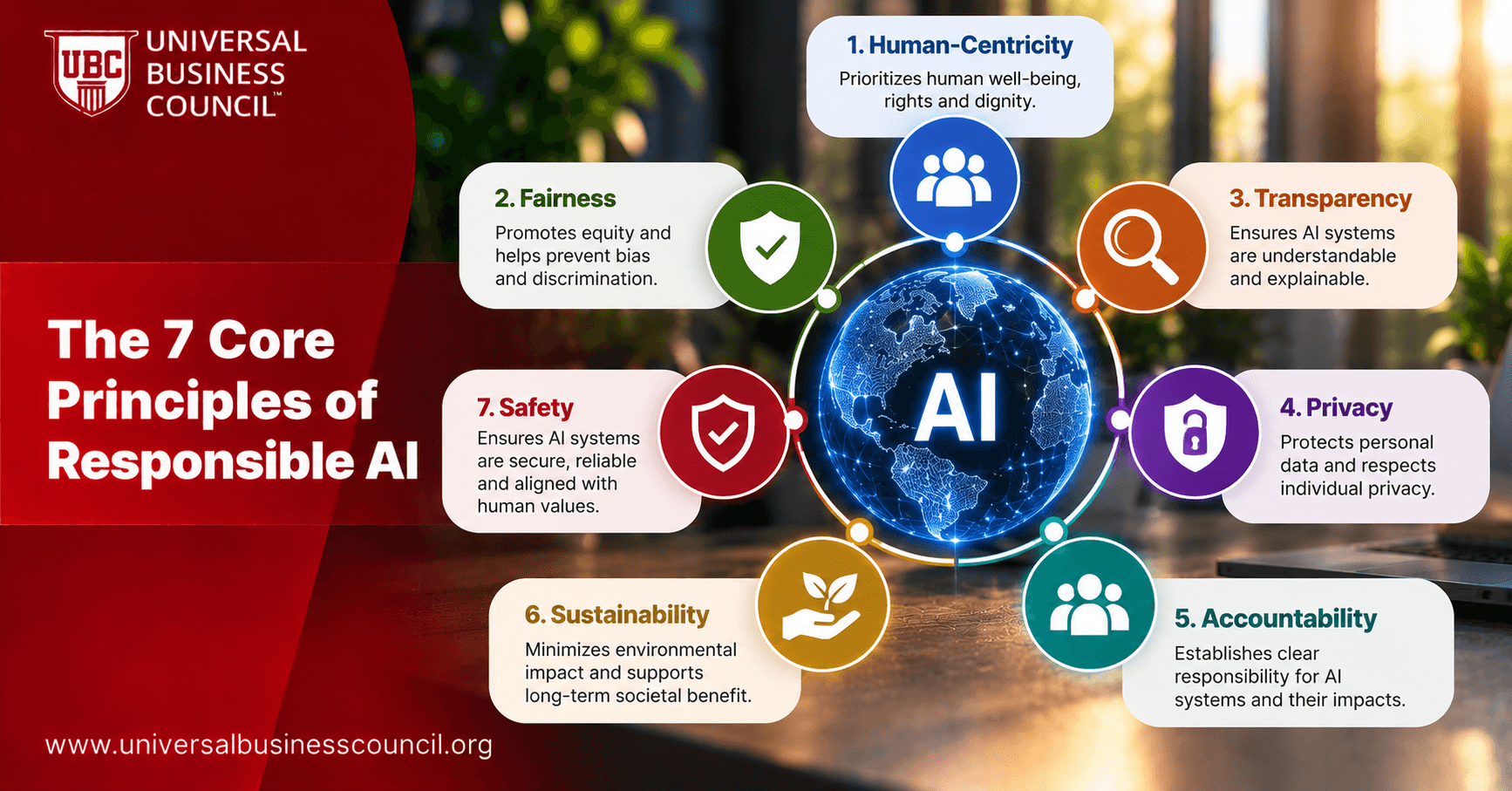
Seven isn't a magic number. Some frameworks list five principles, others six or eight, and a few use entirely different labels. But seven is a practical way to organize what most of them have in common, and it's easy to remember and apply. This guide walks through the seven core principles of responsible artificial intelligence, explains what each one means in everyday work and shows how to turn them from words on a page into habits. If you want a formal route into the field, the Certified Responsible AI Expert program is a good place to build your knowledge.
What are the core principles of responsible artificial intelligence?
The core principles of responsible artificial intelligence are the shared commitments that guide how AI systems are designed, built, deployed and monitored. They answer a simple question: what does it take for people to rely on an AI system and for the organization behind it to answer for it?

Different groups word them differently, and you'll see overlaps between lists from governments, standards bodies and companies. The seven below are a common, workable set: fairness, transparency, accountability, privacy and security, reliability and safety, human oversight and inclusiveness.
The seven principles, one by one
1. Fairness
AI should not create or reinforce unfair treatment of people or groups. In practice, that means checking training data for gaps, testing outcomes across different groups and correcting patterns that disadvantage anyone.
A useful question: who might this system work worse for, and how would we know?
2. Transparency
People should know when AI is involved in decisions that affect them, and the reasoning should be explainable in plain language. Transparency also covers documentation: what data was used, what the system is for and where it falls short.
A useful question: could we explain this decision to the person it affects?
3. Accountability
Every AI system needs a named owner and clear escalation paths. Responsibility doesn't disappear because a machine produced the output. Approval steps, audit trails and incident processes make accountability real.
A useful question: who answers if this goes wrong?
4. Privacy and security
Personal data should be collected only for good reasons, handled lawfully and protected from misuse. Systems also need protection from attacks, such as attempts to tamper with data or extract sensitive information.
A useful question: do we really need this data, and how is it protected?
5. Reliability and safety
AI should work as intended across realistic conditions, fail gracefully and be tested before release. Monitoring continues after launch, because performance can drift as the world changes.
A useful question: what happens when the system is wrong, and how quickly would we notice?
6. Human oversight
For decisions with serious consequences, a person should be able to review, question and override the system. Oversight only works if people have the time, training and authority to use it.
A useful question: can a human step in, and do they know when to?
7. Inclusiveness
AI should be designed with a wide range of people in mind, including those with disabilities, different languages and different cultural contexts. Including varied voices in design and testing catches problems that a narrow team would miss.
A useful question: who was in the room when this was designed, and who wasn't?
Why the principles work best together
Fairness without transparency is hard to verify.
Transparency without accountability leaves no one to act on what's revealed.
Privacy without reliability protects data in a system that may not work.
Oversight without inclusiveness may miss the people most affected.
Each principle supports the others, so treating them as a checklist to tick off one at a time misses the point. They describe a single standard of care.
When principles pull in different directions
Real projects involve trade-offs, and acknowledging them honestly is part of being responsible.
Transparency and privacy: explaining a decision in detail can expose personal data.
Accuracy and explainability: some very accurate models are harder to explain than simpler ones.
Fairness definitions: there are several ways to measure fairness, and they can conflict in a given case.
Speed and safety: pressure to launch can crowd out testing.
There's rarely a perfect answer. What matters is that trade-offs are discussed openly, decisions are recorded and a named person signs off.
Turning principles into practice
Pick your version. Adopt a short list, whether seven or fewer, and define each principle in one plain sentence.
Make them testable. For each principle, decide what evidence would show it's being met, such as bias test results or an owner list.
Build them into the workflow. Add checks to design reviews, procurement, launch approvals and monitoring.
Assign owners. Every principle needs a person or team responsible for it.
Train people. Staff who build, buy or use AI should know what the principles mean for their daily choices.
Review regularly. Technology, laws and expectations change.
Technical understanding helps people apply principles with confidence. Teams that know how data, models and code fit together can ask better questions, and short learning paths such as tech certifications help non-engineers get there.
The communication angle
Principles also shape what an organization can honestly say. If a company tells customers its AI is fair, transparent or safe, those words need evidence behind them. Marketing and communications teams who understand the principles can describe AI features accurately and avoid promises the product can't keep. Anyone who has completed a digital marketing course knows that trust is built by claims that hold up under scrutiny.
Putting people in the right roles
Principles depend on people who can apply judgment under pressure. For roles in data, product, risk and compliance, employers often want to see how candidates reason through realistic dilemmas, not just what they've listed on a résumé. Platforms such as HireValid offer situational judgment and skills-based assessments that help hiring teams do exactly that, and being open with candidates about how assessments are used is itself an example of transparency.
Looking ahead
As AI spreads into autonomous agents, connected devices and systems linked with blockchain records, the principles stay the same, but the questions get sharper. Who is accountable when an agent acts on its own? How do you protect privacy across connected systems? Introductory paths such as deep tech certifications help professionals understand the technologies behind those questions.
Wrapping up: the 7 core principles of responsible artificial intelligence
The 7 core principles of responsible artificial intelligence are fairness, transparency, accountability, privacy and security, reliability and safety, human oversight and inclusiveness. Fairness asks whether outcomes treat people equitably. Transparency asks whether decisions can be explained. Accountability asks who answers for the system. Privacy and security protect data and the system itself. Reliability and safety ask whether it works as intended. Human oversight keeps people in control. Inclusiveness makes sure many voices shape the design.
The principles work together, and they sometimes pull against each other. Honest trade-off discussions, written decisions and named sign-offs turn those tensions into good governance. To apply them, choose a clear version, make each one testable, build checks into the workflow, assign owners, train people and review often.
Principles on a slide don't protect anyone. Principles built into everyday work do. If you treat the 7 core principles of responsible artificial intelligence as a single standard of care, you give customers, employees and regulators good reason to trust what you build.
Frequently asked questions
What are the 7 core principles of responsible AI?
Fairness, transparency, accountability, privacy and security, reliability and safety, human oversight and inclusiveness.
Why are there seven principles?
Seven is a common way to group shared ideas, but other frameworks list more or fewer.
What is fairness in AI?
Making sure AI doesn't create or reinforce unfair treatment of people or groups.
What does transparency mean in AI?
Telling people when AI is used and explaining decisions and system limits in plain language.
What is AI accountability?
Having named owners and clear processes so someone answers for an AI system's outcomes.
How does privacy relate to responsible AI?
It means collecting only needed data, handling it lawfully and protecting it from misuse.
What is AI reliability and safety?
Making sure AI works as intended, is tested before release and is monitored afterward.
What is human oversight of AI?
A person's ability to review, question and override important AI decisions.
What is inclusiveness in AI?
Designing AI to work well for diverse people, including those often left out.
Do the principles ever conflict?
Yes. For example, explaining a decision in detail can expose private data.
How do you apply the principles in practice?
Define them, make them testable, build checks into workflows and assign owners.
Who should own responsible AI principles?
Leadership sets direction, and named owners are responsible for each system and principle.
Are these principles legally required?
Some are reflected in laws and regulations, which vary by region, so check local rules.
How do you measure fairness?
By testing outcomes across groups using agreed metrics and reviewing the results.
What is explainability?
The ability to describe how and why an AI system reached a result.
How often should principles be reviewed?
At least yearly, and whenever technology, regulation or business use changes.
Do small organizations need these principles?
Yes. Any organization using AI, including vendor tools, can apply them at its own scale.
What is the difference between principles and policies?
Principles state values. Policies set specific rules for how to follow them.
Which frameworks include these principles?
Examples include the NIST AI Risk Management Framework and the OECD AI Principles, among others.
Where should a beginner start?
List where AI is used, pick a short set of principles and test one system against them.
Related Articles
View All
Artificial Intelligence
What Is Responsible AI? Definition, Principles, Benefits and Examples
Explore what responsible AI means, including its definition, core principles, benefits, and real-world examples. Learn how fairness, transparency, accountability, privacy, and safety help guide the ethical development and use of artificial intelligence across industries.

Artificial Intelligence
Responsible AI Policies: How to Create an Enterprise AI Policy
Understand what responsible AI policies are and why organizations need them to guide the ethical development and use of artificial intelligence. Explore key policy components, including data privacy, fairness, transparency, accountability, risk management, and human oversight to support responsible AI adoption.
Artificial Intelligence
Responsible AI Compliance Checklist for Businesses
Explore a practical responsible AI compliance checklist for businesses to support ethical AI development and deployment. Learn how to assess AI risks, ensure data privacy, address algorithmic bias, maintain transparency, establish accountability, and align AI systems with relevant regulatory requirements.
Trending Articles
The Role of Blockchain in Ethical AI Development
How blockchain technology is being used to promote transparency and accountability in artificial intelligence systems.
AWS Career Roadmap
A step-by-step guide to building a successful career in Amazon Web Services cloud computing.
Top 5 DeFi Platforms
Explore the leading decentralized finance platforms and what makes each one unique in the evolving DeFi landscape.