

What Is Responsible AI? Definition, Principles, Benefits and Examples
Cars didn't become trustworthy because engines got more powerful. They became trustworthy when seat belts, brakes, crash tests and traffic rules caught up with the speed. Artificial intelligence is at a similar point. So, what is responsible AI? It's the set of principles, practices and checks that help organizations build and use AI systems that are fair, safe, transparent and accountable. This guide covers the definition, the main principles, the benefits and practical examples, so you can see what responsible AI looks like beyond the buzzword. If you want to build formal skills in this area, the Certified Responsible AI Expert program is a strong place to start.
What is responsible AI?
Responsible AI is an approach to designing, developing, deploying and managing AI systems so they do what they're meant to do, treat people fairly, protect their data and can be explained and corrected when something goes wrong. It covers the technology, the data behind it, the people who build and use it and the rules that guide them.

It isn't a single tool or a one-time review. It's a way of working that runs through the whole life of an AI system, from the first idea to the day it's retired.
You'll also hear related phrases such as ethical AI and trustworthy AI. They overlap heavily, and organizations often use them in slightly different ways. What matters most is that the commitments behind the label are real and can be checked.
Why it matters now
AI is no longer confined to research labs. It helps screen job applicants, set credit limits, flag medical scans, recommend products and answer customer questions. When a system like that makes a poor decision, real people can be affected, and the organization behind it is answerable.
At the same time, rules and expectations are growing. Governments, regulators, customers and employees increasingly ask how AI is being used and whether it can be trusted. Responsible AI gives organizations a structured way to answer.
Trust is also fragile. A single poorly handled incident can undo years of goodwill, which is why many organizations now treat AI oversight as part of overall risk management, alongside cybersecurity and data protection.
The core principles
Different organizations phrase them differently, but most lists include these.
Fairness
AI should not treat people unfairly because of characteristics like race, gender, age or disability. That means checking data and results for bias and fixing what you find.
Transparency and explainability
People should know when AI is being used, and the reasoning behind important decisions should be explainable in plain language.
Accountability
Someone is always responsible for an AI system's outcomes. Roles, approvals and escalation paths are clear.
Privacy and security
Personal data is collected, stored and used with care, and systems are protected from misuse and attacks.
Reliability and safety
AI should perform consistently, be tested before release and be monitored afterward, especially when mistakes could cause harm.
Human oversight
Where decisions have serious consequences, a person can review, question and override the system.
Inclusiveness
AI should work well for diverse groups of people, which means including varied perspectives in design and testing.
Benefits of responsible AI
Trust: customers, employees and partners are more willing to engage with systems they understand.
Lower risk: problems are caught earlier, before they turn into legal, financial or reputational damage.
Better decisions: testing for bias and errors tends to improve accuracy and quality.
Smoother compliance: documented processes make it easier to respond to regulators and auditors.
Stronger adoption: teams use tools they trust, and they push back less when concerns are addressed early.
There's a communication benefit too. Marketing and customer-facing teams can describe AI features honestly and confidently when they know how those features were built and tested. Anyone who has taken a digital marketing course knows that clear, truthful messaging builds lasting credibility, and the same holds when the product involves AI.
What it looks like in practice
These examples are illustrative scenarios, not accounts of specific companies.
Healthcare
A hospital tests an AI tool that flags possible issues in scans across different patient groups before using it, keeps clinicians in charge of final decisions and monitors results after launch.
Finance
A lender reviews its credit model for unfair patterns, documents which factors drive decisions and gives applicants understandable reasons when an application is declined.
Hiring
A company that uses AI to screen résumés audits outcomes by group, keeps a human recruiter involved and tells candidates how AI is used.
Retail and marketing
A retailer personalizes offers with clear consent, avoids using sensitive data in ways customers wouldn't expect and lets people opt out.
Customer service
A support chatbot tells users it's an AI, hands over to a person when it's out of its depth and logs conversations so mistakes can be reviewed.
Common misconceptions
"It slows innovation"
Good guardrails usually save time, because fixing a problem after launch costs far more than preventing it.
"It's only for big tech"
Any organization using AI, even through third-party tools, has responsibilities. Scale changes the process, not the principle.
"It's just a legal issue"
Compliance is part of it, but responsible AI also involves design, data, culture and day-to-day habits.
A quick self-check
Do we know every place AI is used in our organization?
Can we explain, in plain language, how an important AI decision was made?
Does a named person own each system's outcomes?
Have we tested for bias and errors, and do we keep testing?
Do people have a way to question or appeal an AI decision?
Do we know what data feeds each system, and whether we have the right to use it?
If several answers are "not sure," that's useful information. It shows where to begin.
Frameworks and standards to know
Several widely referenced resources can guide your approach. Details evolve, so check the latest versions before you rely on them.
The NIST AI Risk Management Framework, a voluntary US guide for identifying and managing AI risks
The OECD AI Principles, an international set of values-based guidelines
ISO/IEC 42001, a standard for AI management systems
The EU AI Act, a regulation that sets risk-based rules for AI systems and is being phased in
You don't need to master all of them at once. Start with one that fits your region and sector, and map your practices to it.
How to start
Take inventory. List where AI is used in your organization, including tools bought from vendors.
Rank by risk. Systems that affect hiring, credit, health or safety deserve the closest attention.
Set principles and owners. Agree on a short set of principles and name someone accountable for each system.
Test before and after launch. Check accuracy, bias, privacy and security, and keep monitoring.
Document and communicate. Record decisions and tell users how AI is used.
Train your people. Everyone who builds, buys or uses AI should understand the basics.
Technical literacy helps here. Teams that understand how data, models and code fit together can ask sharper questions and spot issues earlier, which is why learning paths such as tech certifications are useful for non-engineers as well as developers.
The people side
Responsible AI depends on people with sound judgment as much as on tools. When hiring for roles in data, product, risk or compliance, employers often look for candidates who can reason through ethical gray areas and spot problems in realistic scenarios. Platforms such as HireValid offer situational judgment and skills-based assessments that hiring teams can use to look beyond a résumé. Used thoughtfully, with clear explanations to candidates, tools like these can support fairer hiring.
Looking ahead
AI is moving into new areas, including autonomous agents, connected devices and systems that interact with blockchain-based records. Each brings fresh questions about control, data and accountability. Learning paths such as deep tech certifications can give professionals an introduction to these technologies and the risks that come with them.
Wrapping up: what is responsible AI?
So, what is responsible AI? It's the practice of designing, building, deploying and managing AI so that it's fair, transparent, accountable, secure, reliable and overseen by people. It runs through the whole life of a system, and it works best as a habit, not a one-time review.
The core principles are fairness, transparency and explainability, accountability, privacy and security, reliability and safety, human oversight and inclusiveness. The benefits are trust, lower risk, better decisions, smoother compliance and stronger adoption. Examples in healthcare, finance, hiring, retail and customer service all follow the same pattern: test, document, keep humans involved and monitor.
To get started, list where AI is used, rank systems by risk, assign owners, test before and after launch, document your choices and train your people. Lean on frameworks such as the NIST AI Risk Management Framework, the OECD AI Principles, ISO/IEC 42001 and the EU AI Act, and check for updates as they change. Responsible AI isn't about slowing down. It's about building systems that people can rely on, and that's an advantage for every organization.
Frequently asked questions
What is responsible AI?
It's an approach to building and using AI that is fair, transparent, accountable, secure, reliable and overseen by people.
Why is responsible AI important?
It reduces risk, builds trust and helps organizations meet growing expectations from regulators and customers.
What are the main principles of responsible AI?
Fairness, transparency, accountability, privacy and security, reliability and safety, human oversight and inclusiveness.
What is the difference between responsible AI and ethical AI?
The terms overlap. Responsible AI usually stresses practical processes and accountability, while ethical AI focuses on values.
Who is responsible for responsible AI in a company?
Leaders set direction, but named owners for each system and everyone who builds or uses AI share responsibility.
Does responsible AI apply to small businesses?
Yes. Any organization using AI, including vendor tools, has responsibilities, scaled to its risk.
What are examples of responsible AI?
Testing a medical tool across patient groups, auditing a hiring tool for bias and telling users when they're talking to a chatbot.
What are the benefits of responsible AI?
Trust, lower risk, better decisions, smoother compliance and stronger adoption.
Does responsible AI slow down innovation?
Usually not. Preventing problems early costs less than fixing them after launch.
What is AI bias?
Unfair patterns in AI outcomes, often caused by biased data or design choices.
What is explainable AI?
AI whose decisions can be understood and explained in plain language.
What is human oversight in AI?
A person's ability to review, question and override AI decisions that matter.
What frameworks guide responsible AI?
Examples include the NIST AI Risk Management Framework, the OECD AI Principles and ISO/IEC 42001.
Is responsible AI required by law?
Some rules apply in some regions, such as the EU AI Act, and requirements vary, so check local regulations.
How do you start with responsible AI?
List your AI systems, rank them by risk, assign owners and test before and after launch.
What is an AI risk assessment?
A review of how an AI system could cause harm and what controls reduce that risk.
Why does data quality matter in responsible AI?
Poor or unrepresentative data can lead to unfair or unreliable results.
Can AI ever be completely unbiased?
Not completely, but teams can measure bias, reduce it and monitor it over time.
What skills are needed for responsible AI?
Data and technical literacy, risk thinking, ethics, communication and domain knowledge.
How do you measure responsible AI?
Through tests for accuracy and fairness, audit results, incident tracking and user feedback.
Related Articles
View All
Artificial Intelligence
Responsible AI in Practice: Real-World Examples Across Industries
Explore real-world examples of responsible AI across industries, including healthcare, finance, education, retail, and manufacturing. Learn how organizations apply fairness, transparency, accountability, privacy, and human oversight to build safer, more reliable AI systems and improve business outcomes.
Artificial Intelligence
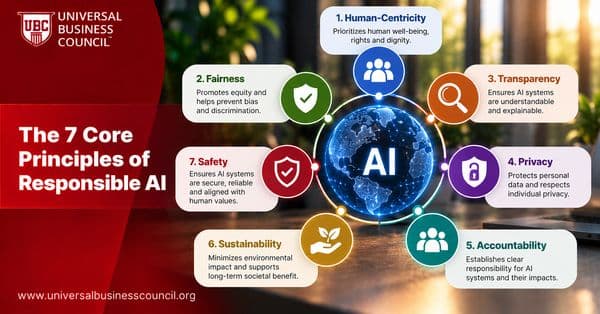
The 7 Core Principles of Responsible Artificial Intelligence
Explore the seven core principles of responsible artificial intelligence and understand how they guide the development and use of AI systems. Learn how fairness, transparency, accountability, privacy, safety, reliability, and human oversight help create AI technologies that benefit individuals and society.
Artificial Intelligence
Responsible AI Policies: How to Create an Enterprise AI Policy
Understand what responsible AI policies are and why organizations need them to guide the ethical development and use of artificial intelligence. Explore key policy components, including data privacy, fairness, transparency, accountability, risk management, and human oversight to support responsible AI adoption.
Trending Articles
The Role of Blockchain in Ethical AI Development
How blockchain technology is being used to promote transparency and accountability in artificial intelligence systems.
AWS Career Roadmap
A step-by-step guide to building a successful career in Amazon Web Services cloud computing.
Top 5 DeFi Platforms
Explore the leading decentralized finance platforms and what makes each one unique in the evolving DeFi landscape.