

AI Discrimination in Hiring, Lending and Healthcare: Risks and Solutions
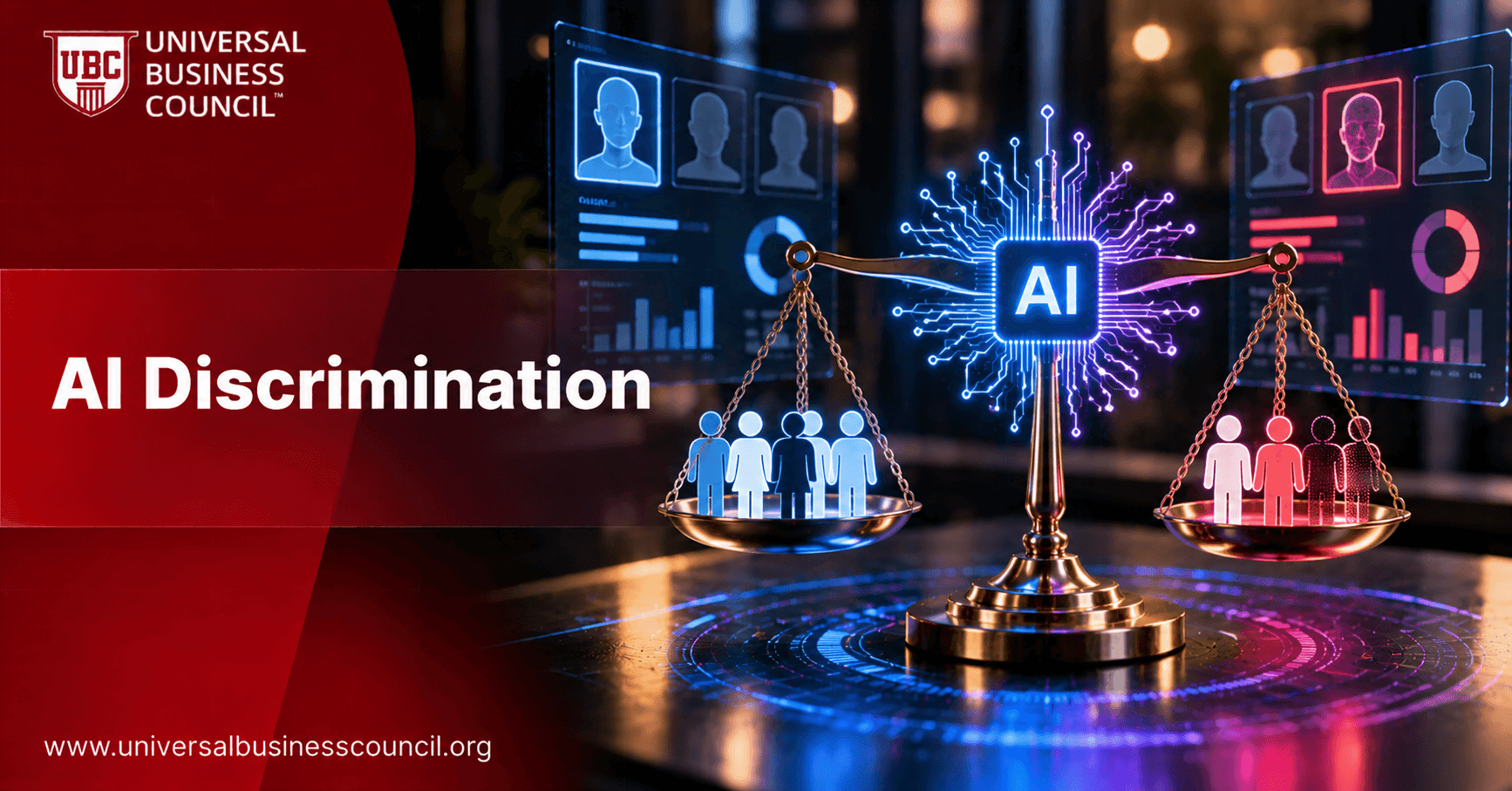
Three industries show the stakes of biased AI most clearly: hiring, lending and healthcare. In each, an automated decision can open or close a door, from a job interview to a mortgage to timely medical care, and in each, the same technical flaws can produce unfair outcomes at scale.
This guide explains how AI discrimination arises in these three areas, the legal and business risks and the solutions organizations can apply. If you're building expertise to manage these risks, the Certified Responsible AI Expert certification from Universal Business Council is one credential to review. The sections below start with the basics and then take each industry in turn.

What is AI discrimination?
AI discrimination happens when an automated system produces unjustified, unfavorable outcomes for people because of characteristics such as race, color, sex, age, disability, religion or national origin. It may be direct, if a protected attribute is used openly, or indirect, if a seemingly neutral factor leads to unequal effects. Indirect discrimination is more common in AI, because models find patterns and proxies in data even when sensitive fields are removed.
Existing laws can apply even when no law mentions AI. In the United States, these include equal employment, fair lending, fair housing, disability and consumer protection rules. Other regions have their own protections, and the EU AI Act classifies many systems used in employment, credit and essential services as high-risk.
Discrimination risks in hiring
Employers use AI to write job ads, screen resumes, rank candidates, analyze video interviews and run assessments. Each step can introduce bias.
Models trained on past hiring decisions can copy past preferences, as in a reported recruiting tool that was dropped after it appeared to penalize resumes associated with women
Resume parsers may handle names, gaps or formats unevenly
Video or voice analysis may perform differently for people with accents, disabilities or different appearances
Timed or game-based assessments can disadvantage some people with disabilities unless accommodations are offered
Regulators have taken notice. The U.S. Equal Employment Opportunity Commission has issued guidance on AI and disability and on adverse impact, and New York City requires bias audits and notices for certain automated employment decision tools.
Solutions for hiring
Validate that tools measure job-related skills and test for adverse impact across groups
Keep humans in decisions and give candidates a way to request accommodations or review
Ask vendors for documentation, audit results and contractual commitments
Combine automation with sound verification of facts. Services like HireValid help confirm identity, credentials and work history, which reduces reliance on opaque scoring of unverified information
Discrimination risks in lending
Lenders use AI for credit scoring, underwriting, pricing, fraud detection and collections. Credit decisions affect housing, education and business growth, so errors compound.
Historic lending patterns can be baked into training data
Proxy variables such as location, shopping patterns or device data can correlate with protected characteristics
Thin credit files can disadvantage people with limited credit history
Complex models can make it hard to give clear reasons for denial
In the U.S., the Equal Credit Opportunity Act and Regulation B require lenders to give specific reasons when they take adverse action, and the Consumer Financial Protection Bureau has said that using complex algorithms does not excuse a lender from that duty. Fair lending rules also look at disparate impact, where a neutral practice has an unjustified unequal effect.
Solutions for lending
Test models for disparate impact and search for less discriminatory alternatives
Review variables and proxies, and remove those that don't have a clear, justified link to creditworthiness
Use explainability methods to produce accurate, specific adverse action reasons
Monitor outcomes after launch and document model governance
Discrimination risks in healthcare
Healthcare AI supports diagnosis, triage, risk prediction, resource allocation and administrative tasks. Bias here can mean delayed care or misdiagnosis.
A widely cited 2019 study found that a healthcare risk algorithm used past spending as a proxy for need, which understated how sick some Black patients were
Training data from one population may not reflect others, which can reduce accuracy for underrepresented groups
Medical devices and measurements can vary by patient characteristics, as in concerns about pulse oximeter accuracy across skin tones
Clinicians may over-trust automated outputs or under-use tools that seem unreliable
U.S. health nondiscrimination rules under Section 1557 of the Affordable Care Act now address the use of patient care decision support tools, and health systems also face privacy rules such as HIPAA and clinical safety expectations.
Solutions for healthcare
Validate tools on diverse patient populations before and after deployment
Choose targets and proxies that reflect clinical need, not just cost
Keep clinicians in the loop and train them on a tool's limits
Monitor outcomes by group and report issues through clear channels
Cross-industry solutions
Inventory AI systems and rank them by impact on people.
Run impact assessments and bias tests before launch.
Choose fairness metrics suited to each decision and document the trade-offs.
Require vendor transparency and audit rights in contracts.
Provide notice, explanation and appeal options to affected people.
Monitor, re-audit and retrain regularly, with named owners.
Technical teams can use open-source fairness toolkits, and short tech certifications in programming and data science help staff apply them. Communication matters too. Be clear and accurate when you describe AI use to candidates, borrowers and patients, and consider how a Digital Marketing Course can help teams avoid misleading claims. For broader context on AI and related technologies, Deep Tech Certifications are another resource.
Conclusion
AI discrimination in hiring, lending and healthcare comes from biased data, poor proxies, weak testing and over-reliance on automated outputs. The harms are real, and so are the legal and reputational risks. The fixes are practical: test for disparate impact, validate on diverse groups, keep people in the loop, demand vendor transparency, explain decisions and monitor over time.
Start with the systems that affect people's jobs, money and health, and build a repeatable review process around them. The FAQs below answer common questions.
Frequently asked questions
What is AI discrimination?
Unjustified unfavorable outcomes from automated systems based on protected characteristics.
How does AI discriminate in hiring?
Through biased training data, uneven resume parsing, inaccessible assessments and skewed ranking.
Are hiring algorithms regulated?
Existing employment laws apply, and some places like New York City require bias audits.
What is adverse impact?
A neutral practice that disproportionately disadvantages a protected group.
Can AI tools violate disability laws?
Yes, if they screen out people with disabilities unfairly or lack accommodations.
How does AI discriminate in lending?
Through biased history, proxy variables and thin-file effects.
What is Regulation B?
The U.S. rule implementing the Equal Credit Opportunity Act, including adverse action reasons.
Do lenders need to explain AI decisions?
Yes. U.S. rules require specific reasons for adverse action even with complex models.
What is disparate impact?
An unequal effect from a neutral practice that is not justified by business need.
How does AI discriminate in healthcare?
Through unrepresentative data, flawed proxies like cost and uneven device accuracy.
What was the healthcare algorithm study?
A 2019 study found a risk tool used spending as a proxy for need, understating illness in Black patients.
Is clinical AI regulated?
Yes, through medical device oversight, privacy rules and health nondiscrimination requirements.
What is a bias audit?
An independent review of a system's outcomes across groups.
Who is liable for biased AI?
Organizations using AI generally remain responsible, even when a vendor built the tool.
How should companies assess vendors?
Request documentation, testing results, data sources and audit rights.
Does human review fix bias?
It helps, but reviewers can over-trust automated outputs without training.
What is a less discriminatory alternative?
A different model or practice that meets business goals with less unequal impact.
How often should systems be audited?
Before launch, regularly afterward and after major changes.
Can small companies manage these risks?
Yes, with vendor questions, simple testing and clear human oversight.
Where should I start?
List AI systems that affect hiring, credit or care and review the highest-impact ones first.
Related Articles
View All
Artificial Intelligence
AI Risk Management: Identifying, Assessing and Mitigating AI Risks
Understand what AI risk management is and explore the key strategies organizations use to identify, assess, mitigate, and monitor AI-related risks. Learn how effective risk management supports AI security, fairness, transparency, regulatory compliance, and responsible AI adoption.

Artificial Intelligence
Beyond AI-Generated Answers: How HireValid Supports Authentic Skills-Based Hiring
Discover how HireValid moves beyond AI-generated answers with job-relevant assessments, integrity signals, randomized testing, and skills-based evidence that helps employers identify authentic candidate ability.

Artificial Intelligence
ISO/IEC 42001 Explained: AI Management Systems and Certification Requirements
Understand what ISO/IEC 42001 is and how this international standard helps organizations establish, implement, and maintain an Artificial Intelligence Management System (AIMS). Explore its key requirements, benefits, certification process, and role in promoting responsible AI governance, risk management, transparency, and accountability.
Trending Articles
The Role of Blockchain in Ethical AI Development
How blockchain technology is being used to promote transparency and accountability in artificial intelligence systems.
AWS Career Roadmap
A step-by-step guide to building a successful career in Amazon Web Services cloud computing.
Top 5 DeFi Platforms
Explore the leading decentralized finance platforms and what makes each one unique in the evolving DeFi landscape.