

Beyond AI-Generated Answers: How HireValid Supports Authentic Skills-Based Hiring
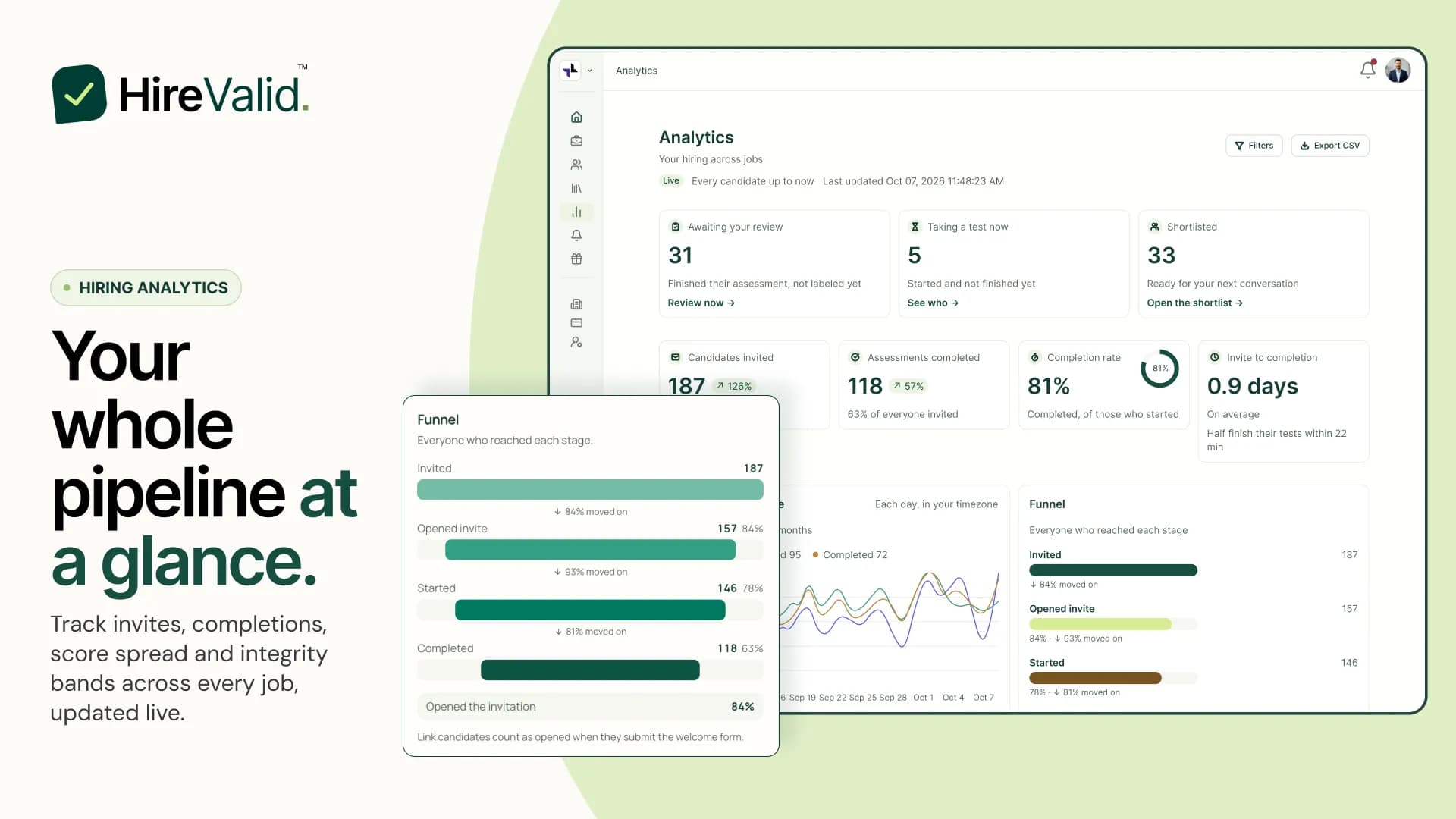
Artificial intelligence has changed how candidates prepare CVs, complete assessments and present themselves during recruitment. While AI tools can support legitimate learning and productivity, they can also make it harder for employers to determine whether a candidate can perform the actual job.
Skills-based hiring offers a practical way forward. Instead of relying only on qualifications, job titles or polished applications, employers evaluate candidates against the abilities required for a role. HireValid supports this approach with pre-employment skills and cognitive tests designed to make AI assistance harder to conceal and easier to review.

For small and midsized businesses, the goal is straightforward: assess real job skills, compare candidates using relevant evidence and make more informed hiring decisions without adding unnecessary complexity.
What Is Skills-Based Hiring in the AI Era?
Skills-based hiring is a recruitment approach that prioritises a candidate's demonstrated abilities over credentials alone. Employers evaluate whether applicants can complete tasks, solve problems, communicate effectively and apply knowledge relevant to the position.
In the AI era, this approach needs an additional consideration. A candidate may produce an impressive written answer with the help of an AI assistant, but that answer may not reflect their independent ability.
This does not mean AI use is always inappropriate. Many workplaces actively encourage employees to use AI tools. The important question is whether the assessment measures the capability the employer actually needs.
For example, a marketing coordinator may need to interpret campaign performance, identify audience opportunities and communicate recommendations. A polished response alone may not demonstrate all these abilities.
Employers need assessments that examine relevant skills and provide evidence that helps them understand how candidates performed.
Why Are AI-Generated Answers a Challenge for Recruitment?
AI tools can generate fluent text, suggest interview answers, explain technical concepts and assist with reasoning tasks. These capabilities can make traditional assessments less reliable when they depend heavily on generic written responses.
Three challenges stand out.
1. Polished answers may hide skill gaps
A well-written answer can create a strong first impression. However, employers may struggle to determine whether the candidate understands the concepts behind it or can apply them independently.
This is particularly important for roles involving customer communication, administration, marketing, data analysis and technical problem-solving.
2. Candidates may receive outside assistance
Some candidates may use AI tools during an assessment even when the employer expects independent work. Others may receive help from another person or reuse answers from external sources.
If employers cannot identify possible assistance, they may compare candidates using results that were produced under different conditions.
3. Traditional screening can miss practical ability
CVs and interviews remain useful, but they do not always show how someone will perform daily tasks. Qualifications can demonstrate learning, while interviews can reveal communication and experience. Neither necessarily proves that a candidate can complete the work independently.
Skills-based assessments help employers add another layer of evidence to the process.
The objective is not to eliminate AI from recruitment. It is to understand what a candidate can do, what assistance may have been used and how much confidence the employer can reasonably place in the result.
How Does HireValid Support Authentic Skills-Based Hiring?
HireValid is a self-service platform offering pre-employment skills and cognitive tests for small and midsized businesses. Its assessments are designed to help employers evaluate relevant abilities and review signals of possible AI assistance or other irregular activity.
The platform follows a straightforward workflow.
Step 1: Choose assessments for the role
Employers select suitable tests from the available library or use role-based bundles. Options are intended to support different hiring needs, including customer support, sales development, office administration, marketing coordination, junior data analysis and junior development.
The assessment should reflect the actual requirements of the job. A customer support role may require communication and reasoning, while a junior data role may need analytical thinking and practical skills.
Step 2: Invite candidates to complete the tests
Candidates receive an assessment invitation through a link or email and complete the test in their browser.
The candidate experience is designed to provide clear instructions and practice questions. Tests are intended to remain manageable, with approximately 20 to 40 minutes of total assessment time where the selected tests allow.
Step 3: Review assessment performance and integrity signals
HireValid combines assessment results with an integrity layer designed to make suspicious activity harder to conceal and easier to review.
Depending on the assessment and enabled settings, relevant signals may include unusual answer timing, tab switching, paste events, changes in full-screen status and other activity associated with the test. Webcam checks may be used when enabled by the employer and with appropriate candidate consent.
These signals are not conclusive proof of misconduct. They provide context that employers can review alongside the candidate's performance.
Step 4: Compare candidates using structured results
Employers can review candidate scores, benchmark percentiles where available, and an Integrity Score with supporting evidence.
This makes it easier to compare applicants against consistent assessment criteria rather than relying only on intuition or the quality of their written applications.
Step 5: Make the final hiring decision
HireValid supports the employer's decision-making process. It does not automatically decide who should be hired or rejected.
Employers should consider test performance, relevant experience, interviews, accommodations and the requirements of the position before making a final decision.
What Makes an AI-Resistant Assessment Different?
An AI-resistant assessment is designed to reduce the usefulness of unauthorised assistance and make unusual behaviour more visible. No browser-based assessment can guarantee that every form of AI assistance will be detected.
HireValid uses a combination of assessment design and activity signals to support a more informed review.
Assessment approach | How it helps |
Timed reasoning tasks | Encourages candidates to work within a defined period. |
Randomised questions | Reduces the likelihood that candidates receive identical question sequences. |
Visual and interactive tasks | Evaluates abilities beyond generic written responses. |
Short explanation prompts | Gives candidates an opportunity to explain their reasoning. |
Activity monitoring | Records relevant events, such as tab changes or paste activity, where supported. |
Integrity Score | Summarises integrity-related signals for human review. |
Benchmarked results | Helps employers compare performance against available reference data. |
These methods work best together. A short test, a strong score or a single activity flag should not determine a hiring decision on its own.
Employers should also decide whether AI use is prohibited, permitted or encouraged for each assessment. If the job requires candidates to use AI responsibly, the test should reflect that requirement instead of treating every use of AI as misconduct.
Why Is Skills-Based Hiring Useful for Small Businesses?
Large organisations may have dedicated recruitment teams and established assessment systems. Smaller businesses often have limited time and resources.
A business owner may receive dozens of applications for one position while continuing to manage customers, operations and existing employees. Reviewing every application in detail can slow down hiring.
A structured assessment process can help in several ways.
More consistent comparisons: Candidates complete assessments aligned with the role, giving employers a common basis for reviewing performance.
Better visibility into practical abilities: Employers can look beyond qualifications and written applications to evaluate job-related skills.
More informed screening: Ranked results can help identify candidates who deserve closer consideration, while integrity signals provide additional context.
Flexible recruitment costs: HireValid offers monthly plans rather than requiring an annual contract. Businesses can review the available plan terms and use options such as pausing between hiring rounds where supported.
A clearer process: Employers can use assessment results as one part of a documented hiring workflow rather than depending entirely on informal impressions.
These benefits do not remove the need for good interviews or reference checks. They help employers use their recruitment time more effectively.
How Can Employers Keep AI-Assisted Hiring Fair?
AI-resistant assessments should improve the quality of hiring decisions without creating unnecessary barriers for candidates.
A responsible process begins with clear expectations. Tell candidates what the assessment measures, whether AI tools are allowed and which monitoring features may be enabled.
Employers should also consider the following practices.
Assess skills that matter to the role
Avoid testing abilities that are unrelated to the job. A test should reflect realistic responsibilities rather than create artificial difficulty.
Explain the rules before testing
Candidates should know whether external tools, copied material or assistance from other people is prohibited. Ambiguous rules can produce unfair outcomes.
Treat integrity signals as evidence for review
An unexpected tab switch or unusual response time may have several explanations. Employers should review the context rather than treating a single flag as proof of cheating.
Provide reasonable accommodations
Candidates may need adjustments because of accessibility requirements or other circumstances. Employers should make appropriate accommodations and consider how these affect assessment conditions.
Handle personal data responsibly
Where webcam checks or other monitoring features are used, employers should obtain appropriate consent, explain the purpose and follow applicable privacy requirements.
Use more than one source of evidence
Assessment scores should be considered alongside relevant experience, interviews and other job-related information. Fair hiring requires judgement, not blind reliance on a numerical score.
HireValid's Integrity Score is intended to support human review, not replace it. The employer remains responsible for the final decision.
How Do Skills-Based Assessments Fit into a Modern Learning Path?
Skills-based hiring and professional learning can complement one another. Employers can use assessments to identify existing strengths and development needs. Candidates and employees can then pursue structured learning to build the capabilities required for their roles.
For professionals working in business, marketing or emerging technology, a practical learning path may include these stages:
Understand the role: Identify the knowledge, technical abilities and workplace behaviours required.
Assess current skills: Use relevant assessments to identify strengths and areas for improvement.
Build practical knowledge: Study relevant business, marketing, technology or AI concepts.
Apply learning: Complete projects, case studies or role-related tasks that demonstrate understanding.
Validate progress: Use assessments, practical work and feedback to evaluate improvement.
Continue professional development: Update skills as workplace requirements and technology change.
Professional certifications can provide a structured way to develop knowledge in a particular field. They complement practical assessment, but a certificate alone should not be treated as proof that a candidate can perform every job task.
Explore Professional Certifications from the Right Council
For readers who want to develop their skills alongside a more structured approach to talent assessment, several learning options are worth exploring. Professionals looking to strengthen their business, leadership and marketing skills can explore programmes from Universal Business Council. Those interested in artificial intelligence and emerging technologies can consider tech certifications from Global Tech Council, while professionals looking to build expertise in blockchain, Web3 and related fields can explore deep tech certifications from Blockchain Council.
Choosing a programme that aligns with your current experience, learning objectives and career goals can help make professional development more focused and relevant. Certifications can support learning, while practical experience and role-specific assessments help demonstrate how those skills translate into workplace capabilities.
How Can Employers Get Started with HireValid?
Employers can begin by identifying one role where they need better evidence of candidate ability. Choose assessments that match the job, define the rules for AI use and invite candidates to complete the tests.
After the results arrive, review scores, benchmarks where available and integrity-related evidence together. Use the findings to guide follow-up questions or practical interviews.
Before adopting a platform, review its current test library, monitoring settings, reporting features and plan terms. Availability can vary by assessment and configuration.
HireValid is designed for small and midsized businesses that want a practical way to evaluate candidates without committing to an annual contract. Monthly plans provide flexibility for organisations whose hiring needs change throughout the year.
Start with a more structured hiring process. Explore HireValid to see how skills assessments and integrity signals can help you make better-informed recruitment decisions.
Frequently Asked Questions
1. What is skills-based hiring?
Skills-based hiring evaluates candidates according to the abilities needed for a job, rather than relying only on qualifications, job titles or CVs. Employers use relevant assessments and practical evidence to understand whether applicants can perform key responsibilities.
2. Why are AI-generated answers a concern in recruitment?
AI-generated answers can make it harder to distinguish a candidate's own abilities from assistance provided by an AI tool. This matters when an assessment is intended to measure independent reasoning, writing or problem-solving.
3. What is HireValid?
HireValid is a pre-employment assessment platform for small and midsized businesses. It offers skills and cognitive tests, candidate comparison tools and integrity-related signals to support hiring decisions.
4. Can HireValid detect every type of AI cheating?
No assessment platform should claim to detect every possible form of AI assistance. HireValid combines assessment design with relevant activity signals to make certain forms of unauthorised assistance harder to conceal and easier to review.
5. What is the HireValid Integrity Score?
The Integrity Score is a score from 0 to 100 that summarises integrity-related signals and supporting evidence from an assessment. It is intended to help employers review activity in context, not to prove misconduct or automatically reject a candidate.
6. Does HireValid automatically reject candidates?
No. HireValid provides assessment results and signals for human review. Employers make the final hiring decision using the assessment, relevant experience, interviews and other appropriate evidence.
7. What types of skills can employers assess?
Depending on the available tests, employers can assess areas such as cognitive ability, language, behavioural tendencies and practical job skills. The most appropriate assessment depends on the role and the platform's current test availability.
8. Is HireValid suitable for small businesses?
HireValid is designed for small and midsized businesses that need a practical way to compare applicants. Its monthly-plan approach avoids requiring an annual contract, with plan features and terms subject to the current offering.
9. How can employers keep AI-resistant assessments fair?
Employers should use job-related tests, communicate rules clearly, provide reasonable accommodations and review integrity signals in context. They should also consider multiple sources of evidence and avoid making hiring decisions based on a single score or flag.
10. Can professional certifications replace practical skills assessments?
No. Certifications can demonstrate structured learning and subject knowledge, while practical assessments provide evidence of performance on specific tasks. Employers can use both, alongside interviews and relevant experience, to build a more complete picture of a candidate.
Related Articles
View All
Artificial Intelligence
The New Standard for AI-Era Recruitment: AI-Resistant Assessments with HireValid
Explore how HireValid is reshaping AI-era recruitment with AI-resistant assessments, job-relevant skills testing, integrity signals, and human-reviewed evidence of candidate ability.
Artificial Intelligence
Gemini 4 Argon: Features, Pricing, and Availability
Gemini 4 Argon is Google’s new flagship AI model for coding, science, finance, law and security. See its main features, API and subscription pricing, and where you can access it today.

Artificial Intelligence
What Is Meta Muse Wonder? Features and How It Works
Meta Muse Wonder is a new frontier AI model built for agents with Active Memory and Active Focus. Learn what it is, how it works, its features, pricing and how to access it.
Trending Articles
The Role of Blockchain in Ethical AI Development
How blockchain technology is being used to promote transparency and accountability in artificial intelligence systems.
AWS Career Roadmap
A step-by-step guide to building a successful career in Amazon Web Services cloud computing.
Top 5 DeFi Platforms
Explore the leading decentralized finance platforms and what makes each one unique in the evolving DeFi landscape.