

The New Standard for AI-Era Recruitment: AI-Resistant Assessments with HireValid
Artificial intelligence is changing recruitment, from how candidates prepare applications to how they complete online assessments. Employers can benefit from AI-powered productivity, but they also need reliable ways to evaluate whether candidates possess the skills required for a job.
AI-resistant assessments offer a practical response. They combine relevant skills tests with assessment design and integrity signals to help employers understand candidate performance and identify activity that may require further review.

HireValid supports this approach with pre-employment skills and cognitive tests designed for small and midsized businesses. Its platform provides structured assessment results, benchmark information where available, and an Integrity Score with supporting evidence. Employers can use these insights to compare applicants and make better-informed hiring decisions.
The goal is simple: hire people who can really do the job, not just people who can produce convincing answers.
Why Does Recruitment Need a New Standard in the AI Era?
Traditional recruitment methods remain valuable, but they can be less informative when candidates use AI assistance during screening.
A CV may be professionally written with an AI tool. An application question may receive a polished response generated in seconds. An online test may show a strong result without making it clear how the candidate arrived at the answer.
AI assistance is not automatically a problem. Employees in many roles are expected to use AI responsibly. The challenge is determining whether an assessment measures independent ability, AI-assisted productivity or a combination of both.
Employers should establish what each assessment is intended to measure and communicate the rules clearly.
For example, a marketing coordinator might need to interpret campaign data, identify audience opportunities and develop recommendations. If an assessment is intended to measure independent analytical reasoning, unauthorised AI assistance could distort the result. If the job requires effective use of AI tools, an assessment that permits and evaluates responsible AI use may be more appropriate.
A modern recruitment process therefore needs more than polished answers and a single test score. It needs job-relevant assessments, transparent expectations and evidence that supports human judgement.
What Are AI-Resistant Assessments?
AI-resistant assessments are designed to reduce the usefulness of unauthorised assistance and make certain suspicious activities easier to identify.
They may use timed reasoning questions, randomised question sets, visual tasks, interactive exercises and short prompts asking candidates to explain their reasoning. Depending on the platform, they may also record relevant activity signals during the test.
These methods can make some forms of assistance harder to use without detection. However, no browser-based assessment can guarantee that every AI tool or cheating method will be detected.
An effective assessment should have three characteristics:
Job relevance: It measures abilities connected to the position.
Consistent conditions: Candidates follow clear, comparable assessment rules.
Reviewable evidence: Employers receive results and relevant integrity signals that can be evaluated in context.
AI-resistant assessments are most useful when they complement interviews, work samples and other appropriate hiring methods.
How Does HireValid Work?
HireValid is a self-service pre-employment assessment platform for small and midsized businesses. It helps employers evaluate candidates through skills and cognitive tests while reviewing signals of possible AI assistance or other irregular activity.
The process follows five practical steps.
1. Select the Right Assessment
Employers choose tests from the available library or select suitable role-based bundles.
Relevant hiring scenarios include customer support, sales development, office administration, marketing coordination, junior data analysis, junior development and virtual assistant roles.
Selecting tests based on actual job responsibilities helps employers avoid evaluating candidates on skills they will not need in the position.
2. Invite Candidates to Complete the Test
Candidates receive an invitation by email or link and complete the assessment in their browser.
The candidate experience is designed to include clear instructions and practice questions. Assessment duration depends on the selected tests, with the platform's intended experience designed around short assessments where applicable.
Clear instructions help candidates understand the task, assessment conditions and expectations before they begin.
3. Review Skills and Assessment Activity
HireValid combines test performance with an integrity layer designed to make certain forms of unauthorised assistance harder to conceal and easier to review.
Depending on the assessment and enabled settings, relevant signals can include:
Tab switches and changes in full-screen status.
Paste events in written responses.
Unusual answer timing.
Webcam snapshots when the employer enables the feature and obtains appropriate consent.
Similar answers across candidates or repeated use of a device or network.
AI-text likelihood signals, treated as a weak indicator rather than proof.
These signals require careful interpretation. A tab switch or unusually fast response may have an innocent explanation. Employers should investigate relevant context before concluding.
4. Compare Candidates Using Structured Results
HireValid provides a ranked candidate view with assessment scores, benchmark percentiles where available and an Integrity Score with supporting evidence.
This helps employers compare applicants using consistent information instead of relying entirely on the appearance of a CV or the confidence displayed in an interview.
Rankings should guide review, not replace it. A candidate's overall suitability depends on the role, assessment results, experience, communication and other relevant evidence.
5. Make the Final Hiring Decision
HireValid supports employer decision-making rather than making hiring decisions automatically.
Employers remain responsible for deciding whether a candidate should progress. They should consider the complete picture and avoid treating any individual score or integrity flag as definitive proof of ability or misconduct.
Which Features Matter Most in AI-Era Recruitment?
An assessment platform should help employers understand both candidate performance and the conditions under which that performance was produced.
Feature | Recruitment benefit |
Skills and cognitive tests | Evaluates abilities relevant to the selected assessment. |
Randomised question pools | Makes identical question sequences less predictable. |
Timed reasoning and interactive tasks | Adds variety beyond generic written answers. |
Activity signals | Highlights events that may need further review. |
Integrity Score with evidence | Provides a structured starting point for human review. |
Benchmarked results | Supports comparison against available reference data. |
Role-based bundles | Helps employers choose assessments aligned with common job types. |
Monthly plans | Gives businesses flexibility without requiring an annual contract. |
No single feature establishes that a candidate is trustworthy or qualified. The value comes from combining relevant tests, structured reporting and careful human judgement.
How Can AI-Resistant Assessments Improve Hiring Decisions?
AI-resistant assessments can help businesses improve the consistency of their recruitment process when used appropriately.
Better visibility into real skills
A job-related test can reveal whether candidates understand a concept, solve a problem or complete a task. This provides additional evidence beyond CV claims and interview responses.
More consistent candidate comparisons
When applicants complete assessments under comparable conditions, employers can compare results against common criteria. This can help reduce reliance on subjective first impressions.
More informed review of possible AI assistance
Integrity signals provide context when a result appears unusual. Instead of immediately accepting or rejecting a candidate, an employer can review the evidence and ask appropriate follow-up questions.
More efficient screening
Structured results can help hiring teams prioritise candidates for further review. This can be especially valuable when a small business receives many applications but has limited time for screening.
Greater flexibility for smaller employers
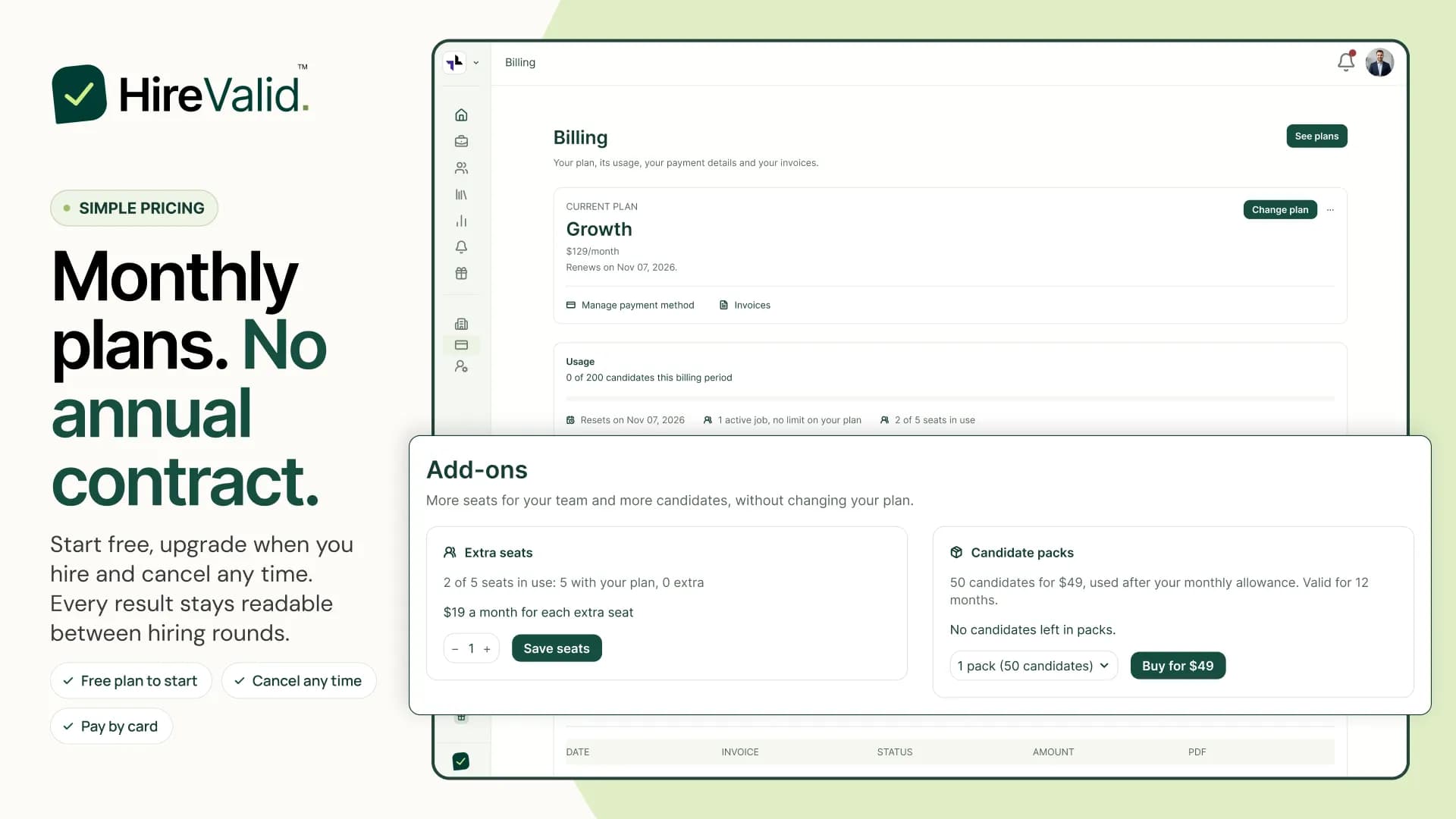
HireValid offers monthly plans rather than requiring an annual contract. Businesses can review the available terms and use plan options, such as pausing between hiring rounds, where supported.
These benefits depend on selecting appropriate tests and interpreting results responsibly. Assessments should improve decision quality, not create false certainty.
How Should Businesses Use AI-Resistant Tests Fairly?
The adoption of AI-resistant assessments should strengthen recruitment without unfairly penalising candidates.
Employers can follow these practices to build a more responsible process.
Define the purpose of each assessment. Decide whether the test measures independent skills, responsible AI use or both. The rules should match the intended outcome.
Communicate expectations clearly. Tell candidates whether external tools are allowed and explain any monitoring features before the assessment begins.
Use relevant tests. Select assessments that measure capabilities required for the role. Avoid using unrelated or unnecessarily difficult tests.
Review integrity signals in context. A single event should not automatically disqualify a candidate. Consider the evidence, the assessment conditions and any reasonable explanation.
Provide appropriate accommodations. Candidates may need adjustments related to accessibility or other circumstances. Employers should consider these needs when designing and evaluating assessments.
Protect candidate information. Explain data collection and monitoring practices, obtain appropriate consent where required and follow applicable privacy obligations.
Keep humans responsible for decisions. Assessment results should inform decisions alongside experience, interviews and practical evidence. HireValid does not automatically reject candidates.
Fairness is not separate from assessment quality. A process that produces misleading results or penalises candidates for irrelevant reasons can undermine hiring decisions rather than improve them.
Why Is This Approach Valuable for Small and Midsized Businesses?
Smaller organisations often lack dedicated recruitment teams and extensive assessment infrastructure. A business owner may need to review dozens of applicants while managing daily operations.
A self-service platform can make structured screening more accessible. Instead of building an assessment process from scratch, employers can select relevant tests, invite candidates and review the resulting reports.
HireValid is designed around this need. Its workflow brings together candidate assessment, ranked results and integrity-related evidence in one hiring process.
Monthly plans can also help businesses align assessment spending with recruitment activity. Employers should check the current plans and conditions before choosing a subscription.
The platform does not remove the need for good hiring practices. It provides an additional source of evidence that can make those practices more consistent and practical.
How Do Professional Certifications Support Skills Development?
Assessment and learning serve different purposes. Pre-employment tests help employers evaluate specific abilities, while professional certifications can provide structured learning in a chosen subject area.
For candidates and employees, a development path can include the following steps:
Identify the knowledge and skills required for a target role.
Evaluate current capabilities using relevant assessments.
Study the concepts and methods required to close identified gaps.
Practise through projects, case studies and realistic tasks.
Review progress using feedback and further assessment.
Continue learning as job requirements and technologies evolve.
Professional certifications can support this process when their subject matter matches the learner's objectives.
Explore Certification Programmes by Subject Area
Professionals looking to strengthen their business, leadership and marketing skills can explore professional development programmes from Universal Business Council. Those interested in artificial intelligence and emerging technologies can explore tech certifications from Global Tech Council, while learners looking to develop expertise in blockchain, Web3 and related technical subjects can consider deep tech certifications from Blockchain Council.
These programmes can support knowledge development and professional growth, but certifications should not be treated as a substitute for practical experience or evidence of job performance. Employers should evaluate candidates based on the actual skills and competencies required for the role.
What Should Employers Consider Before Choosing an Assessment Platform?
Before introducing an assessment platform, employers should consider the following questions:
Does the test measure skills that matter for the position?
Are assessment rules clear to candidates?
Can the employer review integrity signals and their supporting evidence?
Are benchmark data and reports available for the selected test?
Can the assessment accommodate appropriate candidate needs?
Are monitoring settings and consent requirements clearly explained?
Do the platform's current plans fit the organisation's hiring pattern?
These questions help businesses select a solution based on practical needs rather than broad claims about AI detection.
HireValid is designed to help employers assess candidates, review relevant integrity signals and compare results through a self-service workflow. Its role is to support better-informed decisions, while employers retain responsibility for the hiring outcome.
Conclusion: Building Trust in AI-Era Recruitment
AI has made it easier to create convincing applications and assessment answers. It has also made it more important for employers to understand what their recruitment process actually measures.
AI-resistant assessments offer one way to address this challenge. By combining job-related tests, structured results and reviewable integrity signals, employers can gain a clearer view of candidate performance.
HireValid helps small and midsized businesses bring these elements into a practical assessment workflow, with ranked results and an Integrity Score designed for human review.
The best recruitment process does not assume that every AI-assisted answer is dishonest. It establishes clear expectations, evaluates relevant abilities and uses evidence responsibly.
Explore HireValid to support a more structured hiring process and make more informed decisions about who can do the job.
Frequently Asked Questions
1. What are AI-resistant assessments?
AI-resistant assessments are designed to reduce the usefulness of unauthorised AI assistance and make certain suspicious activities easier to review. They may combine timed tasks, randomised questions, interactive exercises and activity signals.
2. Why are AI-resistant assessments important for recruitment?
They help employers evaluate job-related abilities when AI tools can generate polished answers or assist with online tests. They provide additional evidence that can support candidate comparisons and follow-up reviews.
3. How does HireValid support AI-era recruitment?
HireValid offers pre-employment skills and cognitive tests, candidate ranking, benchmark information where available and an Integrity Score with supporting evidence. Employers use these results to inform their hiring decisions.
4. Can AI-resistant assessments detect every type of cheating?
No. No browser-based assessment can guarantee detection of every AI tool or cheating method. Assessment design and integrity signals can help make some forms of unauthorised assistance harder to conceal, but results require careful interpretation.
5. What is the HireValid Integrity Score?
The Integrity Score ranges from 0 to 100 and summarises relevant integrity signals with supporting evidence. It helps employers decide whether further review is needed. It is not definitive proof of misconduct.
6. Does HireValid make hiring decisions automatically?
No. HireValid provides assessment results and integrity-related signals to support human review. Employers make the final decision using all relevant information.
7. What types of roles can use HireValid assessments?
Potential use cases include customer support, sales development, office administration, marketing coordination, junior data analysis, junior development and virtual assistant roles. The appropriate tests depend on the role and current platform availability.
8. Are AI-resistant assessments suitable for small businesses?
They can be useful for small and midsized businesses that need a structured way to compare applicants. HireValid offers a self-service workflow and monthly plans without requiring an annual contract.
9. How can employers ensure assessments remain fair?
Employers should select job-related tests, explain assessment rules, provide appropriate accommodations, protect candidate information and review integrity signals in context. Decisions should not rely on a single score or flag.
10. Do professional certifications prove that someone can perform a job?
Not by themselves. Certifications can demonstrate structured learning, but employers should also evaluate practical abilities, relevant experience and performance against the responsibilities of the position.
Related Articles
View All
Artificial Intelligence
Beyond AI-Generated Answers: How HireValid Supports Authentic Skills-Based Hiring
Discover how HireValid moves beyond AI-generated answers with job-relevant assessments, integrity signals, randomized testing, and skills-based evidence that helps employers identify authentic candidate ability.

Artificial Intelligence
NVIDIA’s New AI Models: Nemotron 3.5 Lightning, Cosmos 3 and the Future of Agentic AI
Explore NVIDIA Nemotron 3.5 Lightning and Cosmos 3, how they advance agentic and Physical AI, and what they reveal about the future of autonomous intelligent systems.
Artificial Intelligence
Gemini 4 Argon: Features, Pricing, and Availability
Gemini 4 Argon is Google’s new flagship AI model for coding, science, finance, law and security. See its main features, API and subscription pricing, and where you can access it today.
Trending Articles
The Role of Blockchain in Ethical AI Development
How blockchain technology is being used to promote transparency and accountability in artificial intelligence systems.
AWS Career Roadmap
A step-by-step guide to building a successful career in Amazon Web Services cloud computing.
Top 5 DeFi Platforms
Explore the leading decentralized finance platforms and what makes each one unique in the evolving DeFi landscape.