

Responsible AI Lifecycle: From Data Collection to AI Deployment

Most AI problems are born long before launch. A skewed dataset, a vague goal or a missing test can sit quietly for months and then surface in front of customers. That's why the responsible AI lifecycle matters: it spreads care across every stage, from the first idea to retirement, so issues are caught when they're cheap to fix. This guide walks through each stage, from data collection to deployment and beyond, with the checks, questions and records that belong at each step. If you're building skills in this field, the Certified Responsible AI Expert program is a strong place to start.
What is the responsible AI lifecycle?
The responsible AI lifecycle is the sequence of stages an AI system passes through, with responsible practices built into each one. The stages usually include planning, data collection, data preparation, model development, testing, approval, deployment, monitoring and retirement.

It's rarely a straight line. Teams loop back when testing reveals a data gap or monitoring shows drift. What matters is that every stage has defined checks and an owner, and that decisions are written down so others can follow them.
Stage 1: Plan and scope
Everything starts with purpose. Why are we building this, who will it affect and what could go wrong?
Define the problem and decide whether AI is the right tool at all.
Identify the people affected, including those who are rarely consulted.
Rate the risk level, since higher-stakes uses need stricter checks.
Name an accountable owner and a review group.
Output to keep: a short project brief with purpose, risk rating, owners and success measures.
Stage 2: Data collection
Data shapes everything downstream, so this stage deserves extra attention.
Check where the data comes from and whether you have the right to use it.
Collect only what you need, and respect consent and privacy rules.
Look for gaps: does the data represent the people and situations the system will meet?
Record the source, date range and known limits.
Output to keep: a data record, sometimes called a datasheet, describing origin, purpose, coverage and restrictions.
Stage 3: Data preparation and labeling
Cleaning and labeling data involves many small judgments that can introduce bias.
Document how missing values, outliers and duplicates are handled.
Give labelers clear guidelines, and check for disagreement between them.
Watch for proxy variables, which are fields that stand in for sensitive characteristics, such as certain location data.
Protect personal information through minimization, masking or other privacy-protecting methods.
Output to keep: cleaning decisions, labeling instructions and privacy measures.
Stage 4: Model design and training
Design choices matter as much as data.
Choose a model type that fits the risk. For high-stakes decisions, simpler and more explainable models may be preferable.
Decide which fairness measures matter and what trade-offs are acceptable.
Keep training records so results can be reproduced.
Involve diverse perspectives in design discussions.
Technical understanding makes these conversations far richer. Learning paths such as tech certifications help non-engineers follow what's happening in this stage and ask meaningful questions.
Stage 5: Evaluation and testing
Testing goes beyond a single accuracy number.
Accuracy and reliability
Does the system work across realistic conditions, including unusual cases?
Fairness
Do results differ across groups in ways that can't be justified?
Robustness and security
Can the system be tricked, manipulated or pushed into failure? Teams often use red teaming, which means deliberately trying to break or misuse the system.
Explainability
Can the reasoning be described to the people affected?
Output to keep: test results, known limits and a list of issues with how each was handled.
Stage 6: Review and approval
Before launch, a defined group checks the evidence and decides whether the system is ready.
Compare results with the success measures and risk rating from stage one.
Confirm legal, privacy and security reviews are complete.
Agree on conditions, such as limited rollout or extra human review.
Record who approved what and why.
High-risk systems should face tougher review than low-risk ones, and the reviewers need the independence to say no.
Stage 7: Deployment
Launch is where the system meets real people, so communication matters.
Tell users when AI is involved and explain what it does in plain language.
Offer a way to question, appeal or reach a human.
Train staff who will work with the system.
Prepare a rollback plan in case something goes wrong.
The way you describe a system shapes what people expect from it. Marketing and communications teams, especially anyone who has completed a digital marketing course, understand that honest, specific claims build trust, while overpromising invites backlash. Describe what the system can do, what it can't and who to contact.
Stage 8: Monitoring and improvement
A system that was fair and accurate at launch may not stay that way.
Track accuracy, fairness measures, complaints and incidents over time.
Watch for drift, which happens when real-world data moves away from the training data.
Set thresholds that trigger a review or pause.
Collect feedback from users and frontline staff.
Re-test after any significant change to data, model or use.
Output to keep: monitoring reports, incident logs and update records.
Stage 9: Retirement
Every system eventually ends. Plan for it by deciding how data will be archived or deleted, informing users of changes and recording lessons learned. Retiring an AI system responsibly closes the loop and feeds improvements into the next project.
Running through every stage
Documentation: if it isn't recorded, it's hard to defend or repeat.
Roles: every stage has someone responsible and someone who reviews.
Human oversight: decisions with serious consequences keep a person involved.
Vendor management: when stages are handled by a supplier, ask for the same evidence.
Culture: people feel safe raising concerns at any stage.
Hiring for these roles calls for judgment, not only credentials. Situational judgment and skills-based assessments, such as those offered by HireValid, can help teams see how candidates handle realistic dilemmas when staffing data, product and risk roles.
New technology, same stages
Newer systems, such as autonomous agents and AI connected to blockchain-based records, stretch the lifecycle in new ways, especially around permissions, data lineage and accountability. The stages still apply, and teams that understand the underlying technologies handle them better. Introductory paths such as deep tech certifications can help build that understanding.
Wrapping up: the responsible AI lifecycle
The responsible AI lifecycle puts care into every stage, from planning to retirement. Planning sets purpose, risk and owners. Data collection checks rights, coverage and limits. Data preparation documents cleaning, labeling and privacy choices. Model design balances accuracy, explainability and fairness. Testing covers accuracy, fairness, robustness and explanation. Review and approval decide readiness with independent eyes. Deployment informs users and offers recourse. Monitoring catches drift and incidents. Retirement closes the loop.
Across all stages, documentation, clear roles, human oversight, vendor checks and a culture of speaking up keep the process honest. The stages loop and overlap, but each one needs defined checks and an owner.
If you're starting out, pick one live project, map it against the nine stages and mark where evidence is missing. Fill the gaps in order of risk. The responsible AI lifecycle isn't a hurdle at the end of development. It's the way good AI gets built, and it pays back every time a problem is caught early instead of in public.
Frequently asked questions
What is the responsible AI lifecycle?
The stages of an AI system's life, from planning to retirement, with responsible checks at each one.
What are the stages of the AI lifecycle?
Planning, data collection, data preparation, model development, testing, approval, deployment, monitoring and retirement.
Why start responsible AI at the data stage?
Problems in data carry through to the model, so early checks prevent bigger issues later.
What is a datasheet for data?
A record of a dataset's source, purpose, coverage, limits and restrictions.
What are proxy variables?
Fields that indirectly stand in for sensitive characteristics, such as certain location data.
What should be tested before deployment?
Accuracy, fairness, robustness, security and the ability to explain results.
What is red teaming?
Deliberately trying to break or misuse a system to uncover weaknesses.
Who approves an AI system for launch?
A defined review group, which may include risk, legal, security and business owners.
What is a rollback plan?
A plan for pausing or reversing a system if something goes wrong.
What is model drift?
A drop in performance as real-world data moves away from the training data.
How often should AI systems be monitored?
Continuously for key measures, with formal reviews on a regular schedule.
What should be documented?
Purpose, data sources, design choices, tests, approvals, incidents and changes.
How does human oversight fit in?
People review or can override key decisions, with the time and authority to do so.
How do you handle vendor AI in the lifecycle?
Ask suppliers for evidence on data, testing, monitoring and controls.
Does the lifecycle apply to small projects?
Yes, scaled to the level of risk and with simpler records.
What happens when an AI system is retired?
Data is archived or deleted, users are informed and lessons are recorded.
How do you tell users about AI?
Use plain language to say that AI is involved, what it does and how to reach a person.
What is the biggest lifecycle mistake?
Treating responsibility as a final check instead of a practice at every stage.
Which frameworks cover the lifecycle?
The NIST AI Risk Management Framework and ISO/IEC 42001 both address lifecycle management.
Where should a team begin?
Map one live project against the stages and find where evidence is missing.
Related Articles
View All
Artificial Intelligence
Responsible AI Policies: How to Create an Enterprise AI Policy
Understand what responsible AI policies are and why organizations need them to guide the ethical development and use of artificial intelligence. Explore key policy components, including data privacy, fairness, transparency, accountability, risk management, and human oversight to support responsible AI adoption.
Artificial Intelligence
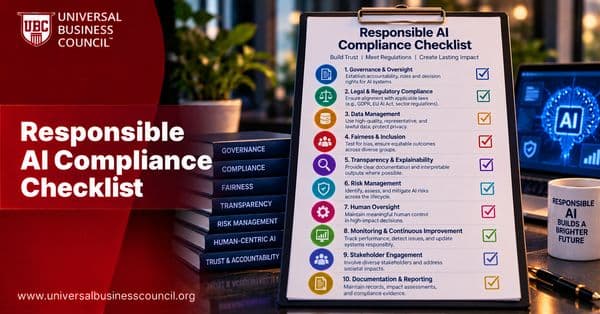
Responsible AI Compliance Checklist for Businesses
Explore a practical responsible AI compliance checklist for businesses to support ethical AI development and deployment. Learn how to assess AI risks, ensure data privacy, address algorithmic bias, maintain transparency, establish accountability, and align AI systems with relevant regulatory requirements.
Artificial Intelligence
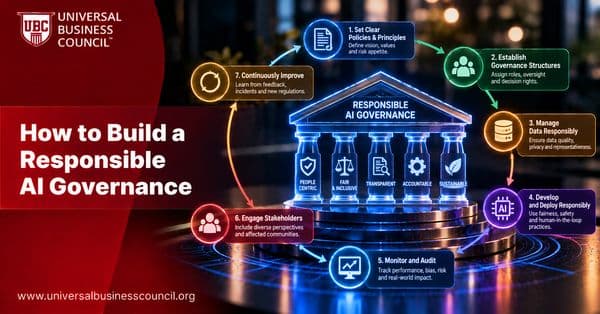
How to Build a Responsible AI Governance Framework
Learn how to build a responsible AI governance framework that supports ethical AI development and deployment. Explore key steps, including defining governance policies, assigning responsibilities, assessing risks, ensuring regulatory compliance, and establishing continuous monitoring and accountability.
Trending Articles
The Role of Blockchain in Ethical AI Development
How blockchain technology is being used to promote transparency and accountability in artificial intelligence systems.
AWS Career Roadmap
A step-by-step guide to building a successful career in Amazon Web Services cloud computing.
Top 5 DeFi Platforms
Explore the leading decentralized finance platforms and what makes each one unique in the evolving DeFi landscape.