

How Does Responsible AI Work? A Beginner's Guide
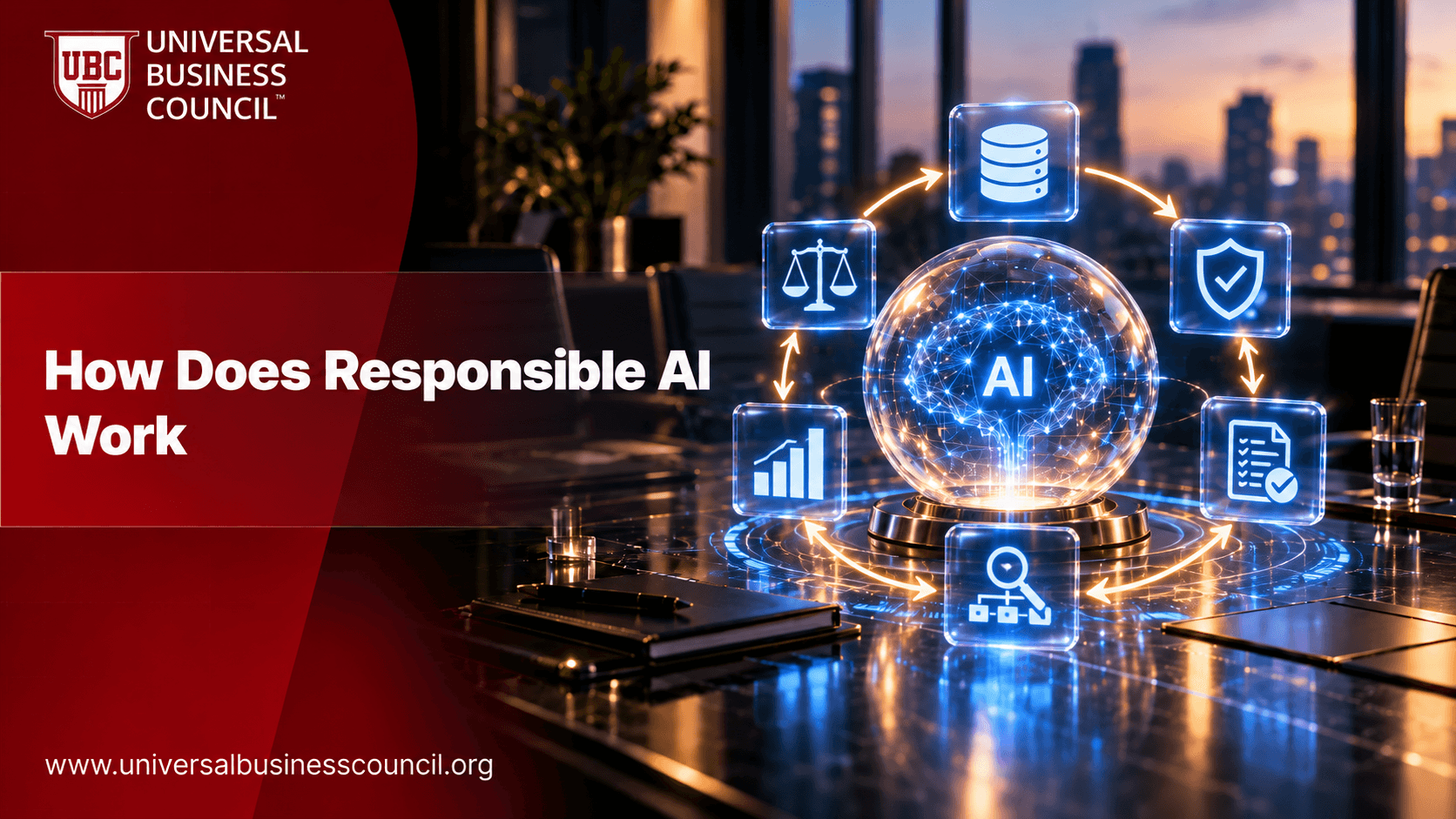
Think of a restaurant kitchen. There's a menu that says what the restaurant stands for, recipes that people follow, food safety checks at every stage, labels for allergens, a head chef who signs off, and inspectors who can walk in at any time. Nobody calls that bureaucracy. It's how a kitchen earns the right to serve strangers. So, how does responsible AI work? In much the same way. This beginner's guide explains the moving parts in plain language, walks through a project from start to finish and shows where newcomers can begin. If you'd like a structured learning path, the Certified Responsible AI Expert program is a good place to start.
What is responsible AI, in simple terms?
Responsible AI is the practice of building and using artificial intelligence so that it's fair, safe, transparent and accountable. It isn't one tool or one rule. It's a set of habits, checks and responsibilities that apply across the life of an AI system, from the first idea to the day it's switched off.

The aim is simple: AI that does what it should, treats people fairly, protects their information and can be explained and corrected when things go wrong.
The four building blocks
Principles
These are the values that guide decisions, such as fairness, transparency, privacy, safety, accountability and human oversight. They set direction, but on their own they're just words.
Governance
Governance turns principles into structure: policies, named owners, approval steps, risk ratings and escalation routes. It answers who decides, who checks and who is accountable.
Technical practices
These are the hands-on methods: testing data and models for bias, checking accuracy, protecting privacy and security, explaining outputs and monitoring performance after launch.
People and culture
Tools and rules only work if people understand them and feel free to raise concerns. Training, clear roles and a culture where questions are welcome keep the whole system honest.
How it works through an AI project
Here's a simplified path. Real projects loop back and forth, but the logic holds.
1. Define the purpose and the risks
Start by asking what the system is for, who it affects and what could go wrong. A tool that recommends music carries different risks from one that screens job applicants. The higher the stakes, the more care it needs.
2. Look closely at the data
AI learns from data, so problems in the data become problems in the system. Teams check where data came from, whether they have the right to use it, whether it represents the people the system will serve and whether it includes sensitive details that need protection.
3. Build and test
Developers train the model and test it, not only for accuracy but also for fairness across groups, resilience to unusual inputs and security weaknesses. Results are documented.
4. Review and approve
Before launch, a defined group, such as a risk team or review board, checks the evidence and decides whether the system is ready. High-risk systems get closer scrutiny.
5. Deploy with safeguards
Launch includes clear information for users, human oversight where needed, ways to challenge decisions and a plan for pausing the system if something goes wrong.
6. Monitor and improve
Performance can drift as the world changes. Teams track results, collect feedback, investigate incidents and update or retire the system when needed.
A simple hypothetical example
Imagine a small lender that wants an AI tool to help review loan applications. Here's how responsible practices might shape the project.
Purpose and risk: lending affects people's finances, so the system is rated high risk.
Data: the team checks that past decisions don't carry unfair patterns and removes details that could act as proxies for protected characteristics.
Testing: results are compared across groups, and the model is tuned if gaps appear.
Explanation: the tool produces plain-language reasons that applicants can understand.
Oversight: a loan officer reviews borderline cases and can override the system.
Monitoring: the lender tracks outcomes every month and reviews the model if patterns shift.
This is an invented scenario, but the same pattern applies in hiring, healthcare, insurance and customer service.
Terms and techniques worth knowing
Bias testing: comparing outcomes across groups to spot unfair patterns.
Explainability: methods that help people understand why a model produced a result.
Documentation: records such as model cards and data sheets that describe a system's purpose, data and limits.
Red teaming: deliberately trying to break or misuse a system to find weaknesses before others do.
Privacy-protecting techniques: approaches that reduce the exposure of personal data.
Monitoring: ongoing checks for accuracy, drift and unexpected behavior.
Human in the loop: a person reviews or can override key decisions.
You don't need to master every method. Knowing what they're for helps you ask the right questions of the people who do.
Who does what
Leadership sets direction, funds the work and owns the overall risk.
Product and business owners define purpose and accept accountability for outcomes.
Data and engineering teams build, test and monitor the systems.
Legal, risk and compliance teams interpret rules and review high-risk uses.
Communications and marketing teams describe AI use honestly to customers.
Everyday users follow the policies and report problems.
Marketers have a particular role in this chain, because they shape what people expect. Anyone who has taken a digital marketing course knows the importance of making claims you can prove. With AI, that means being clear about what a system can and can't do.
Common beginner mistakes
Treating it as a one-time checklist instead of a continuing practice
Focusing on the model and ignoring the data
Forgetting that vendor tools carry risk too
Writing principles with no owners
Skipping monitoring after launch
Assuming that "the algorithm decided" settles responsibility
How to start learning
Learn the core principles and how they connect.
Read an overview of a framework such as the NIST AI Risk Management Framework or the OECD AI Principles.
Pick a simple AI tool at work and ask: what data does it use, who owns it and how is it checked?
Build basic technical literacy, so you can follow conversations about data and models.
Join or start a small review group to practice asking good questions.
Technical literacy matters more than people expect. Short paths such as tech certifications help beginners understand how data, code and models fit together, even if they never write production software.
Careers and hiring
Responsible AI work is growing across roles, from data and product to risk, legal and policy. Employers often look for people who can reason through gray areas, not only recite definitions. Hiring teams sometimes use situational judgment tests to see how candidates think, and platforms such as HireValid offer assessments of that kind. As a candidate, practicing realistic scenarios can sharpen your own thinking.
What's next
AI keeps expanding into agents, connected devices and systems that work with blockchain-based records. The basics you learn now will carry over, because the questions stay familiar: what is it for, what could go wrong and who is responsible? Introductory learning such as deep tech certifications can help you understand the technologies behind the next wave.
Wrapping up: how does responsible AI work?
So, how does responsible AI work? It works through four building blocks that support each other: principles that set direction, governance that assigns decisions and accountability, technical practices that test and monitor systems, and people and culture that make it all stick.
In a project, it follows a clear path. Define the purpose and risks, examine the data, build and test, review and approve, deploy with safeguards, and monitor and improve. Techniques such as bias testing, explainability, documentation, red teaming and human review are the tools along the way. Roles are shared across leadership, product, engineering, risk, communications and everyday users.
For beginners, the best next step is small and practical. Learn the principles, read about one framework, pick a real tool and ask who owns it, what data it uses and how it's checked. Avoid common traps such as one-time checklists, ignoring data and skipping monitoring. Like a good kitchen, responsible AI isn't about slowing the service down. It's about earning the trust of the people you serve, one careful step at a time.
Frequently asked questions
How does responsible AI work?
Through principles, governance, technical practices and a supportive culture applied across an AI system's life.
What are the steps of a responsible AI project?
Define purpose and risks, check data, build and test, review, deploy with safeguards, then monitor.
What is AI governance?
The policies, roles and processes that guide how AI is built and used.
Why does data matter so much?
AI learns from data, so gaps or bias in the data can lead to unfair or unreliable results.
What is bias testing?
Comparing AI outcomes across groups to find and fix unfair patterns.
What is explainable AI?
AI whose decisions can be understood and described in plain language.
What is red teaming?
Deliberately trying to break or misuse a system to find weaknesses early.
What is a model card?
A document describing a model's purpose, data, performance and limits.
What does human in the loop mean?
A person reviews or can override key AI decisions.
Who is responsible for responsible AI?
Leaders set direction, and named owners and teams share accountability for each system.
Does it apply to AI I buy from vendors?
Yes. You remain answerable for how vendor tools are used in your organization.
Can small teams do responsible AI?
Yes, with simple, proportionate steps like inventories, owners and basic testing.
How do you monitor an AI system?
Track accuracy, drift, complaints and incidents, and review them regularly.
What is AI drift?
A decline in performance as real-world conditions change from the training data.
What frameworks can beginners read?
The NIST AI Risk Management Framework and the OECD AI Principles are good starting points.
Do I need to code to work in responsible AI?
Not always. Many roles focus on policy, risk and communication, though technical literacy helps.
How is it different from regular AI development?
It adds structured checks for fairness, safety, privacy and accountability throughout.
Is responsible AI required by law?
Some rules apply in some regions, and they vary, so check local regulations.
What is the biggest beginner mistake?
Treating it as a one-time checklist instead of an ongoing practice.
Where should I start?
Learn the core principles, then pick one AI tool and ask who owns it and how it's checked.
Related Articles
View All
Artificial Intelligence
NIST AI Risk Management Framework: A Practical Implementation Guide
Explore the NIST AI Risk Management Framework and learn how to implement it across the AI lifecycle. Understand its four core functions, Govern, Map, Measure, and Manage, along with practical steps for identifying AI risks, improving accountability, and building trustworthy AI systems.

Artificial Intelligence
AI Governance for Enterprise Leaders: A Step-by-Step Implementation Guide
Learn how enterprise leaders can implement effective AI governance through a step-by-step approach. Explore key strategies for establishing governance policies, defining responsibilities, managing AI risks, ensuring regulatory compliance, and promoting transparency and accountability across enterprise AI initiatives.
Artificial Intelligence
Responsible AI Policies: How to Create an Enterprise AI Policy
Understand what responsible AI policies are and why organizations need them to guide the ethical development and use of artificial intelligence. Explore key policy components, including data privacy, fairness, transparency, accountability, risk management, and human oversight to support responsible AI adoption.
Trending Articles
The Role of Blockchain in Ethical AI Development
How blockchain technology is being used to promote transparency and accountability in artificial intelligence systems.
AWS Career Roadmap
A step-by-step guide to building a successful career in Amazon Web Services cloud computing.
Top 5 DeFi Platforms
Explore the leading decentralized finance platforms and what makes each one unique in the evolving DeFi landscape.