

Why Is Responsible AI Important for Businesses in 2027?
By 2027, "we use AI" won't set a company apart. "We can show how we use it" will. That shift explains why is responsible AI important for businesses in 2027, and why the question has moved from the ethics committee to the boardroom. AI now sits inside hiring tools, customer chatbots, pricing engines, marketing platforms and the software your teams already pay for. Each of those touchpoints carries legal, financial and reputational weight. This guide explains what's driving the change, what's at stake and how to get ready without freezing your roadmap. And if you want a structured way to build expertise, the Certified Responsible AI Expert program is a useful starting point.
What does responsible AI mean for a business?
For a business, responsible AI means using artificial intelligence in ways that are fair, transparent, secure, reliable and accountable, with clear human oversight and documented decisions. It covers the AI you build yourself and the AI you buy or switch on inside other products.

Put simply, it's the discipline that lets a company answer three questions with evidence: what AI are we using, what could go wrong and who is responsible for preventing it?
Six reasons it matters more by 2027
Regulation is catching up
Rules for AI are taking shape in many regions. The EU AI Act, for example, uses a risk-based approach and is being phased in, with several obligations scheduled over the next few years, while other governments are issuing guidance or laws of their own. Timelines and details have been under discussion, so check current dates and requirements for the markets where you operate. Companies that already have an inventory, risk ratings and documentation will find compliance far less painful than those starting from scratch.
Customers and partners are asking questions
Procurement teams increasingly add AI questions to vendor reviews: how is data used, how are outputs checked, who can intervene? A clear, honest answer can speed up a deal. A blank stare can stall one.
The cost of failure is higher
A biased hiring tool, a chatbot that gives harmful advice or a data leak through an AI service can bring legal claims, regulatory attention and lost customers. Prevention is cheaper than cleanup.
Talent cares
Skilled employees increasingly want to work for organizations that use technology thoughtfully. Clear AI guidelines also help staff know what's allowed, which reduces risky improvisation.
Investors and boards are watching
Leaders are expected to understand and oversee AI risk the way they oversee cybersecurity and financial controls. Documented governance gives them something concrete to review.
Better products
Testing for bias, errors and edge cases tends to improve quality. Responsible practices aren't only defensive. They help teams ship systems that work well for more people.
What's different about 2027
AI is embedded everywhere. Even companies that never built a model are using AI through office tools, CRMs and ad platforms.
Agents act, not just advise. Systems that take actions on behalf of users raise new questions about permissions and accountability.
Shadow AI is common. Employees try tools on their own, sometimes pasting sensitive data into them.
Vendor dependence is high. Many risks come from third-party models you don't control.
Expectations are rising. Customers and regulators are getting better at asking the right questions.
The common thread: you can't govern what you can't see. Visibility comes first.
The cost of waiting
Scrambling to document systems after a regulator or customer asks
Pulling a product or feature back after launch
Rebuilding trust after a public mistake
Losing deals because you can't answer vendor questionnaires
Duplicate tools and unmanaged risk spread across departments
How it plays out across functions
Marketing
AI writes copy, targets audiences and personalizes offers. Responsible use means honest claims, respect for consent and care with sensitive data. Anyone with a background from a digital marketing course knows that trust, once lost, is expensive to win back, and AI-generated content is no exception.
Human resources
AI can screen résumés and score candidates. Hiring decisions are high-stakes, so bias testing, human review and transparency with applicants matter. Assessment platforms such as HireValid, which focus on skills-based and situational testing, are one example of tools that hiring teams can use to look at candidates through realistic scenarios, and any such tool should be reviewed for fairness like any other.
Finance and operations
Forecasting, fraud detection and credit decisions need explainability, monitoring and clear audit trails.
Customer service
Chatbots should be upfront about being AI, hand over smoothly to people and avoid confident wrong answers.
Product and engineering
Teams need testing standards, documentation and a path to pause or roll back a system that misbehaves.
A practical 90-day start
Days 1 to 30: see what you have
Build an inventory of AI systems and tools, including vendor products and unofficial use. Note what data each one touches and who owns it.
Days 31 to 60: rank and set rules
Rate each system by risk. Draft a short AI policy covering acceptable use, data handling, human review and escalation. Name an executive sponsor and an owner for each important system.
Days 61 to 90: test and train
Run bias, accuracy and security checks on the highest-risk systems. Train staff on the policy. Set up monitoring and an incident process.
After that, review quarterly. The aim isn't perfection in 90 days. It's a working foundation you can improve.
People with technical fluency make this much easier. Courses such as tech certifications can help managers and non-engineers understand data and model basics well enough to challenge assumptions.
How to show the value
Fewer AI-related incidents and faster resolution when they happen
Shorter time to answer customer and vendor AI questionnaires
Percentage of AI systems inventoried, risk-rated and owned
Results of bias and quality tests over time
Staff completion of AI training
Customer and employee confidence, measured by surveys or feedback
Tracking even a few of these turns governance from a cost center into a visible business asset.
Looking beyond the next year
AI will keep merging with other technologies, including connected devices and blockchain-based records, and the governance questions will grow with it. Organizations that build good habits now will adapt more easily. Introductory learning such as deep tech certifications gives teams a head start in understanding the technologies shaping the next wave.
Wrapping up: why is responsible AI important for businesses in 2027?
So, why is responsible AI important for businesses in 2027? Because AI is now embedded across daily operations, rules are taking shape, customers and partners are asking harder questions and the cost of getting it wrong keeps rising. Responsible AI gives a business a way to show what it uses, how it's checked and who is accountable.
The reasons stack up: regulatory readiness, stronger customer trust, lower risk, talent appeal, board and investor confidence, and better products. What's new in 2027 is the spread of AI into every tool, the rise of agents that take actions, the problem of shadow AI and heavy reliance on vendors. Waiting means scrambling later, with more at stake.
The way forward is practical. Take inventory, rank by risk, set a clear policy, assign owners, test the high-risk systems, train your people and track a handful of measures. Review regularly and keep an eye on changing rules in your markets. Companies that treat responsible AI as part of how they work, not a project to finish, will be the ones that earn trust and move faster when it counts.
Frequently asked questions
Why is responsible AI important for businesses?
It reduces legal, financial and reputational risk and builds trust with customers, partners and regulators.
What is responsible AI in business?
Using AI in ways that are fair, transparent, secure, reliable and accountable, with human oversight.
Why does 2027 matter?
Several AI rules are scheduled to phase in around then, and AI is spreading into almost every business tool.
Does the EU AI Act affect businesses outside Europe?
It can, if you offer AI systems or outputs in the EU market, so check how it applies to you.
What is shadow AI?
Employees using AI tools without approval or oversight, sometimes with sensitive data.
What are the main risks of ignoring responsible AI?
Legal claims, regulatory action, biased outcomes, data leaks and lost customer trust.
How do you start with responsible AI?
Inventory your AI systems, rank them by risk, set a policy and assign owners.
Who owns responsible AI in a company?
An executive sponsor sets direction, and named owners manage each system.
Do small businesses need responsible AI?
Yes. Any business using AI, including vendor tools, can apply simple, proportionate practices.
How does responsible AI affect marketing?
It encourages honest claims, consent-based personalization and careful use of data.
How does responsible AI affect hiring?
It calls for bias testing, human review and transparency with candidates.
What should an AI policy include?
Acceptable use, data handling, human review, vendor rules and escalation steps.
How do you assess AI vendors?
Ask how data is used, how outputs are tested, what controls exist and who is accountable.
What is an AI inventory?
A list of all AI systems and tools in use, with their purpose, data and owners.
How do you measure responsible AI?
Track incidents, test results, inventory coverage, training completion and stakeholder confidence.
Does responsible AI slow innovation?
Usually not. It reduces rework and helps teams launch with confidence.
What is human oversight?
A person's ability to review, question and override important AI decisions.
How often should AI systems be reviewed?
Regularly, such as quarterly for high-risk systems, and after major changes.
What skills do teams need?
Data literacy, risk thinking, communication and domain expertise.
Where can I learn more?
Frameworks such as the NIST AI Risk Management Framework and the OECD AI Principles are good starting points.
Related Articles
View All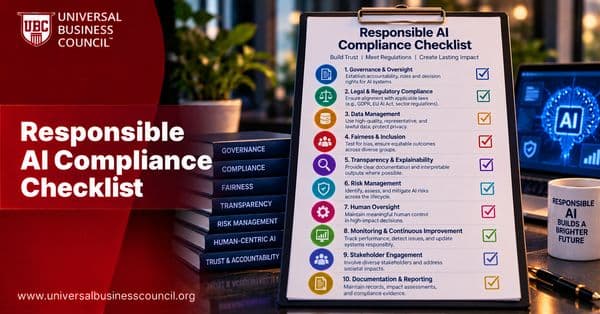
Artificial Intelligence
Responsible AI Compliance Checklist for Businesses
Explore a practical responsible AI compliance checklist for businesses to support ethical AI development and deployment. Learn how to assess AI risks, ensure data privacy, address algorithmic bias, maintain transparency, establish accountability, and align AI systems with relevant regulatory requirements.
Artificial Intelligence
Responsible AI Policies: How to Create an Enterprise AI Policy
Understand what responsible AI policies are and why organizations need them to guide the ethical development and use of artificial intelligence. Explore key policy components, including data privacy, fairness, transparency, accountability, risk management, and human oversight to support responsible AI adoption.
Artificial Intelligence
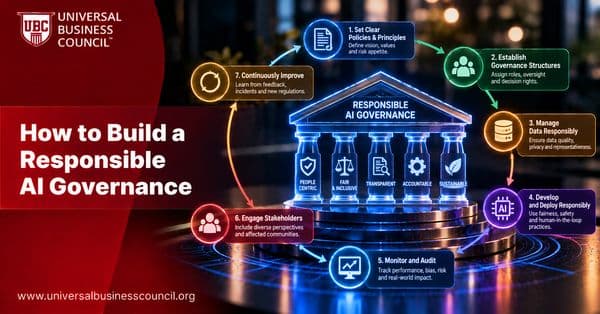
How to Build a Responsible AI Governance Framework
Learn how to build a responsible AI governance framework that supports ethical AI development and deployment. Explore key steps, including defining governance policies, assigning responsibilities, assessing risks, ensuring regulatory compliance, and establishing continuous monitoring and accountability.
Trending Articles
The Role of Blockchain in Ethical AI Development
How blockchain technology is being used to promote transparency and accountability in artificial intelligence systems.
AWS Career Roadmap
A step-by-step guide to building a successful career in Amazon Web Services cloud computing.
Top 5 DeFi Platforms
Explore the leading decentralized finance platforms and what makes each one unique in the evolving DeFi landscape.