

Responsible AI Training for Businesses: How to Upskill Teams in AI Ethics and Governance
Buying AI tools is the easy part. Making sure the people who use, build, buy and oversee them know what responsible use looks like is harder, and it is where many programs stall. Responsible AI training closes that gap by giving every team the knowledge it needs for its own part of the AI lifecycle.
This guide shows businesses how to plan and deliver responsible AI training: who needs what, what to teach, how to deliver it and how to measure results. For individual or team learning, the Certified Responsible AI Expert certification from Universal Business Council can serve as one structured pathway.

What Is Responsible AI Training?
Responsible AI training is education that prepares employees to develop, deploy, buy, use and oversee AI systems ethically, safely and in line with the law. It covers principles such as fairness, transparency, privacy, security and accountability, as well as practical skills like risk assessment, bias testing, documentation and incident reporting.
It is not a single course. Effective programs are layered, so that a marketer using a chatbot, a data scientist training a model and a board member approving AI strategy each receive content that fits their role.
Why Businesses Need It
Policies alone do not change behavior. Employees who do not understand why confidential data should stay out of public AI tools, or why model outputs need review, will make avoidable mistakes. Regulation adds pressure as well: the EU AI Act, for instance, expects organizations to ensure an adequate level of AI literacy among staff who work with AI systems.
Training also supports business goals. Teams that understand risk move faster because they know the approved path. Customers and partners gain confidence, and the organization builds the internal capability to meet frameworks such as the NIST AI RMF and ISO/IEC 42001.
Step 1: Assess Needs and Segment Audiences
Begin with a skills and risk assessment. Inventory where AI is used, identify who touches it and find knowledge gaps through short surveys, interviews or quizzes. Then group employees by role, since each group needs different depth.
All employees: basic AI literacy, acceptable use rules and how to report concerns
Builders (data scientists, engineers): bias testing, documentation, security, privacy engineering and monitoring
Buyers and business owners: use case approval, vendor due diligence and ownership duties
Legal, compliance and risk teams: regulations, frameworks, audits and impact assessments
HR and people managers: fair use of AI in hiring and workforce decisions
Executives and the board: risk appetite, oversight duties and strategic trade-offs
Step 2: Define the Curriculum
A solid curriculum balances principles with practice. The core topics usually include:
Foundations
What AI and generative AI are, where they fail and why responsible AI matters. Teach plain-language concepts such as hallucination, bias, drift and prompt injection, using realistic examples from your industry.
Governance and Law
Your internal AI policy, roles and approval process, plus an overview of relevant laws and frameworks such as the EU AI Act, NIST AI RMF, ISO/IEC 42001 and the OECD AI Principles.
Practical Skills
Risk assessment, fairness testing, privacy and data handling, human oversight, vendor review and incident response. Technical staff often benefit from adding coding and data skills, and short tech certifications are a flexible way to do that.
Step 3: Choose Delivery Methods
People learn differently, so combine formats. Self-paced online modules suit broad awareness and scale well. Live workshops work for scenario practice and discussion. Role-based labs let builders and reviewers practice on real artifacts. Short refreshers, such as monthly briefings or internal newsletters, keep the topic alive.
External certifications give structured depth for key roles. Compare options on curriculum coverage, framework alignment, practical content, flexibility and verification. Weigh them against internal sessions, which are better for company-specific rules.
Step 4: Build Competence Into Hiring and Roles
Training works best alongside the right hiring and role design. Define the AI governance competencies each role requires, and include them in job descriptions and performance goals. When bringing in specialists, verify credentials and experience, since governance roles carry real responsibility. HireValid can help organizations confirm qualifications as part of that process.
Step 5: Make It Stick
Training that ends with a quiz fades quickly. Link it to daily work by embedding checklists in project templates, procurement forms and approval workflows. Appoint AI champions in each department to answer questions and gather feedback. Use real incidents, anonymized where needed, as discussion material, and update content when policies or laws change.
Communication teams also need guidance on describing AI use accurately and on disclosure expectations. A Digital Marketing Course can help marketers apply these rules while keeping campaigns effective.
Step 6: Measure Results
Track both participation and impact. Useful indicators include:
Training completion rates by role
Assessment scores before and after training
Number of AI systems registered and risk-assessed
Policy violations and near misses reported
Time taken to complete approvals and reviews
Employee confidence in surveys
Rising incident reports early on can be a good sign, since it means people recognize and speak up about problems. Review results with leadership and refine the program each year.
Common Mistakes to Avoid
One generic course for everyone
Focusing only on tools and ignoring ethics and law
Treating training as a one-time event
Leaving executives and the board out
Failing to connect training to real workflows
It also helps to broaden perspective. AI increasingly intersects with other emerging technologies, and Deep Tech Certifications provide useful background for teams who want to follow those connections.
Conclusion
Responsible AI training turns policy into practice. Assess needs, tailor content by role, blend delivery formats, tie learning to workflows and measure results. Treat it as an ongoing capability, not a one-off course. The FAQs below answer common questions from businesses.
Frequently Asked Questions
What is responsible AI training?
Education that prepares employees to use and oversee AI ethically, safely and lawfully.
Why do businesses need it?
To reduce risk, support compliance and help staff follow AI policies.
Who should be trained?
Everyone who uses, builds, buys or oversees AI, from employees to the board.
What is AI literacy?
A basic understanding of what AI can and cannot do and its risks.
Does the EU AI Act require training?
It expects organizations to ensure adequate AI literacy among staff working with AI.
What topics should be covered?
Principles, policies, law, bias, privacy, security, oversight and incident reporting.
How is training tailored by role?
Each group gets content matched to its duties, from basic awareness to technical depth.
What should executives learn?
Risk appetite, oversight duties and how to weigh AI benefits against risks.
What should developers learn?
Bias testing, documentation, privacy engineering, security and monitoring.
What delivery formats work best?
A mix of online modules, live workshops, labs and short refreshers.
Should we use external certifications?
They suit key roles needing structured depth, alongside internal company-specific training.
How long should training take?
Awareness can take an hour or two, while specialist programs take longer.
How often should training be repeated?
At least yearly, with updates when policies or laws change.
What are AI champions?
Department-level advocates who answer questions and share feedback.
How do you measure effectiveness?
Through assessments, completion rates, incident reporting and workflow metrics.
Can small businesses do this?
Yes, with a lighter program using short modules and clear rules.
Should HR be involved?
Yes, especially for fair AI use in hiring and workforce decisions.
How do we keep content current?
Review it with each policy or regulatory change and add new examples.
What are common training mistakes?
Generic content, one-off sessions, ignoring leaders and no link to daily work.
Where should we start?
With an assessment of AI use and skills gaps across roles.
Related Articles
View All
Artificial Intelligence
Responsible AI Data Governance: Quality, Consent and Provenance
Explore how responsible AI data governance supports reliable and ethical AI systems through data quality, informed consent, and data provenance. Learn how organizations can manage training data, protect individual privacy, track data origins, reduce bias, and maintain accountability throughout the AI lifecycle.
Artificial Intelligence
Responsible AI in RAG Systems: Data Privacy, Accuracy and Governance
Learn how to apply responsible AI principles to retrieval-augmented generation (RAG) systems. Explore key considerations for protecting data privacy, improving response accuracy, reducing bias, and establishing effective governance to build secure, transparent, and trustworthy RAG applications.
Artificial Intelligence
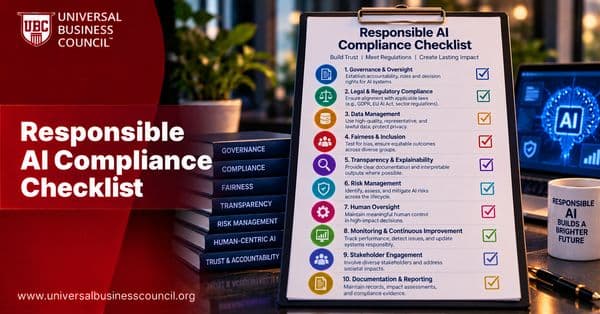
Responsible AI Compliance Checklist for Businesses
Explore a practical responsible AI compliance checklist for businesses to support ethical AI development and deployment. Learn how to assess AI risks, ensure data privacy, address algorithmic bias, maintain transparency, establish accountability, and align AI systems with relevant regulatory requirements.
Trending Articles
The Role of Blockchain in Ethical AI Development
How blockchain technology is being used to promote transparency and accountability in artificial intelligence systems.
AWS Career Roadmap
A step-by-step guide to building a successful career in Amazon Web Services cloud computing.
Top 5 DeFi Platforms
Explore the leading decentralized finance platforms and what makes each one unique in the evolving DeFi landscape.