

Responsible AI Requirements in the Software Development Lifecycle
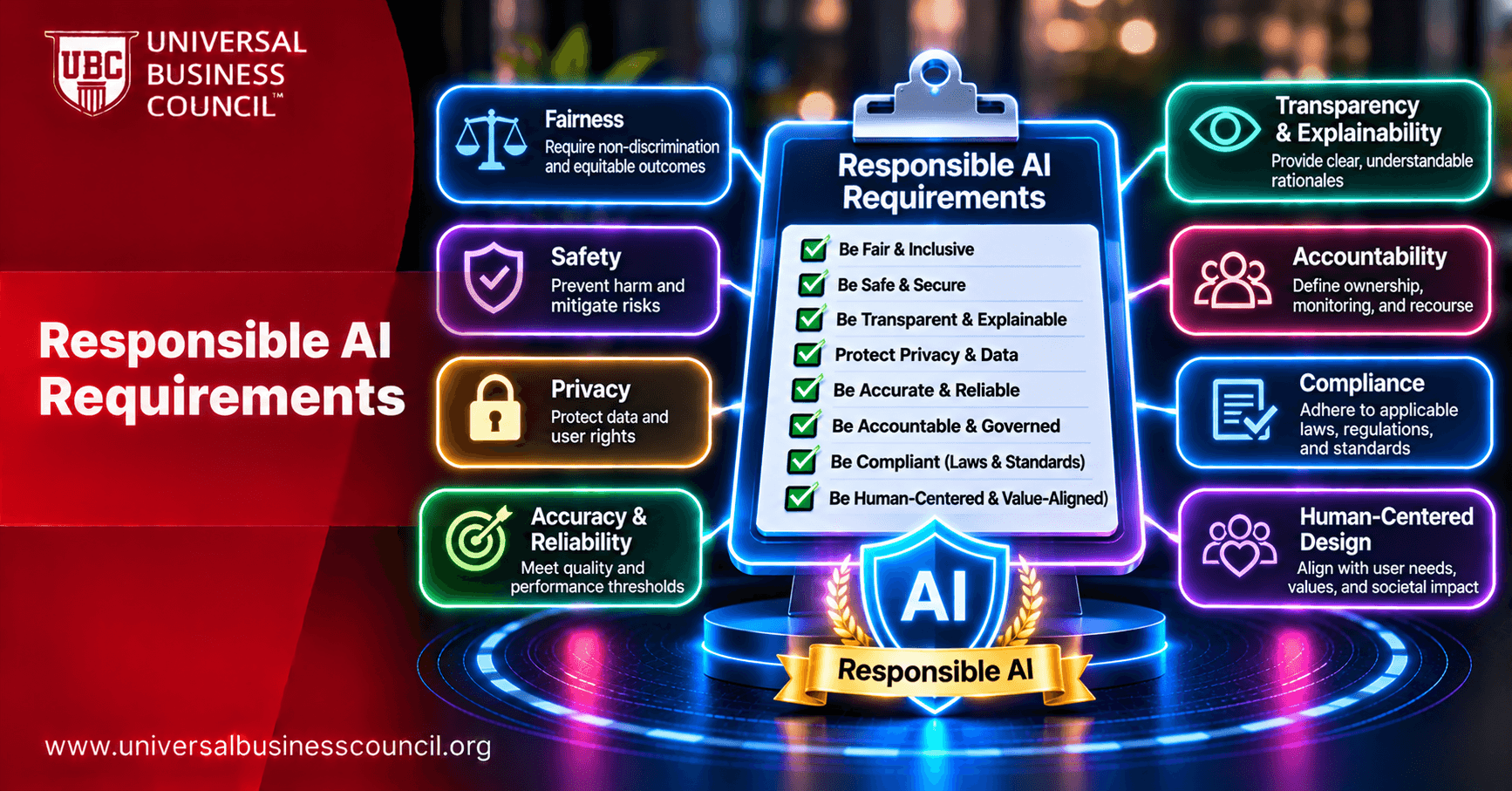
Most responsible AI failures can be traced to a decision that was made, or skipped, early in a project: an unclear purpose, an unexamined dataset, a missing test or an approval nobody owned. Building responsibility into the software development lifecycle (SDLC) means asking the right questions at every stage, while changes are still cheap.
This guide walks through responsible AI requirements across each SDLC phase, from planning to retirement, and shows how to turn them into artifacts, gates and checks that teams can actually follow. For readers who want structured training in the field, the Certified Responsible AI Expert certification from Universal Business Council offers a useful reference.

What Are Responsible AI Requirements in the SDLC?
Responsible AI requirements are the specific obligations a project must meet so that an AI system is fair, safe, secure, transparent, privacy-respecting and accountable. In the SDLC, they appear as concrete work: impact assessments in planning, data checks in design, bias and security testing before release, monitoring in operation and documented decommissioning at the end.
AI changes the lifecycle in several ways. Behavior depends on data as well as code, performance can drift after release, and harm often arises from how a system is used rather than from a coding bug. The AI lifecycle therefore adds data and model stages, and standards reflect this. ISO/IEC 42001 requires lifecycle controls, the NIST AI Risk Management Framework spans mapping, measuring and managing risk across the lifecycle and the EU AI Act sets requirements for high-risk systems from design through post-market monitoring.
Phase 1: Planning and Requirements
Responsible AI work begins before any code is written. Define the purpose, users, affected groups and success measures, and decide whether AI is the right tool at all. Complete a risk classification and, for higher-risk uses, an impact assessment covering fairness, privacy, safety, security and legal issues.
Requirements to Capture
Intended use and explicitly out-of-scope use
Risk tier and applicable laws, standards and internal policies
Accuracy, robustness and fairness targets, with thresholds
Privacy, consent and data retention requirements
Human oversight and escalation needs
Transparency and explanation requirements for users
Named system owner and approvers
Write these as testable requirements in the backlog, with acceptance criteria, instead of general statements. A requirement such as "the model should be fair" cannot be verified, whereas "false-negative rates differ by no more than a set margin across defined groups" can.
Phase 2: Design and Data
Architecture and Security by Design
Threat-model the system, including training data, prompts, model access and third-party components. Design for least privilege, secure data flows and logging, and plan fallbacks and human override. Choose model approaches with explainability and risk in mind, and record key decisions and trade-offs.
Data Governance
Check data sources, legal basis and consent, quality and representativeness. Create datasheets for datasets, track lineage and apply minimization. For third-party data or pretrained models, perform vendor due diligence and review licenses and known limitations.
Phase 3: Development and Training
Treat models, prompts, datasets and configurations as versioned artifacts under change control. Peer-review code and model changes, and scan dependencies for vulnerabilities. Keep experiment records so results can be reproduced. During training, apply techniques suited to the risks, such as bias mitigation, privacy-preserving methods or adversarial training, and document what was done.
Developers who build these safeguards need strong technical foundations, and short tech certifications can help teams strengthen coding and data skills alongside responsible AI knowledge.
Phase 4: Verification and Validation
Testing should trace back to the requirements and risks identified earlier. Cover accuracy, robustness and edge cases, subgroup fairness, security and adversarial testing, privacy leakage, harmful output and explanation quality. Use independent test data and, for high-risk systems, independent reviewers.
Run automated tests in the build pipeline for every model or data change
Conduct red-team exercises before release
Validate with domain experts and, where relevant, representative users
Record results in a model card and risk register
Hold a release review with named approvers and explicit acceptance of residual risk
Phase 5: Deployment and Release
Use staged rollouts, feature flags and rollback plans. Confirm that user notices, disclosures and instructions are in place and that support teams are trained. Check that monitoring, logging and incident response are working before traffic is turned on. Compile the documentation package: purpose, data description, test results, known limits, oversight arrangements and contacts.
Phase 6: Operation and Monitoring
Responsibility does not end at launch. Monitor performance, drift, fairness metrics, security events, user complaints and misuse. Define thresholds that trigger investigation, retraining or shutdown, and review them on a schedule. Handle incidents under a defined process and feed lessons back into requirements and tests. Keep a change log so that any model update goes through the same checks as the original release.
Phase 7: Retirement
Plan decommissioning, including notifying users, handling data deletion or retention, archiving documentation for audit and removing access and keys. Make sure dependent systems are updated, and record why the system was retired.
Making It Work: Gates, Roles and Tooling
Lifecycle requirements succeed when they are built into the tools teams already use. Add checklists to ticket templates, automated checks to continuous integration pipelines and approval gates tied to risk tier. Keep low-risk work lightweight and apply heavier reviews only where harm potential is high, so governance does not become a bottleneck.
Clarify roles: a system owner accountable for the whole lifecycle, developers and data scientists responsible for building and testing, security and privacy reviewers, and a governance committee for high-risk approvals. Specialist roles carry responsibility, so many organizations verify credentials and experience in hiring, and HireValid can help with that screening.
Release notes and customer communication should also be accurate and consistent with test evidence. A Digital Marketing Course can help teams talk about AI features responsibly. As AI products interact with other technologies, resources such as Deep Tech Certifications can provide helpful background.
Common Mistakes
Adding responsible AI only at the end, as a review
Writing vague requirements that cannot be tested
Ignoring data and prompt changes in change control
Skipping post-release monitoring
Applying the same heavy process to every project
Conclusion
Embedding responsible AI in the SDLC means defining testable requirements early, governing data and design, verifying thoroughly, releasing in stages, monitoring continuously and retiring systems carefully. Tie each step to roles, gates and tooling so responsibility becomes routine. The FAQs below answer common questions.
Frequently Asked Questions
What are responsible AI requirements in the SDLC?
Obligations at each lifecycle stage ensuring AI is fair, safe, secure, transparent and accountable.
Why integrate them into the SDLC?
Fixing issues early is cheaper and prevents harm after release.
How does AI change the SDLC?
It adds data and model stages and requires monitoring for drift and behavior change.
What should planning include?
Purpose, risk tier, impact assessment, thresholds and ownership.
What is a testable requirement?
A requirement with measurable acceptance criteria.
What is threat modeling for AI?
Mapping assets, attackers and abuse cases, including data and prompts.
Why version datasets and models?
For reproducibility, rollback and audit.
What testing is needed before release?
Accuracy, robustness, fairness, security, privacy and harmful output tests.
What is a release review?
A formal approval checkpoint with documented residual risk.
What is a staged rollout?
Gradual release with monitoring and rollback options.
What should be monitored after launch?
Performance, drift, fairness, security events and complaints.
Who owns the AI system lifecycle?
A named system owner supported by technical, risk and governance teams.
How do model cards fit in?
They document purpose, data, tests and limits for each model version.
Do small projects need all these steps?
No, scale controls to the risk tier of the system.
How are third-party models handled?
Through due diligence, testing and contract terms.
What happens at retirement?
Users are notified, data handled, records archived and access removed.
How does ISO/IEC 42001 relate?
It requires lifecycle controls within an AI management system.
What does the EU AI Act require across the lifecycle?
Risk management, documentation, testing and post-market monitoring for high-risk systems.
How do you avoid bottlenecks?
Automate checks and use risk-based, proportionate reviews.
What is a common mistake?
Treating responsible AI as a final review instead of a lifecycle practice.
Related Articles
View All
Artificial Intelligence
MLOps and Responsible AI: Governance Across the Model Lifecycle
Explore how MLOps supports responsible AI by integrating governance, monitoring, and accountability throughout the machine learning model lifecycle. Learn how organizations can manage data quality, model development, validation, deployment, performance monitoring, and ongoing risk assessment to maintain reliable and trustworthy AI systems.

Artificial Intelligence
OECD AI Principles: Guidelines for Responsible AI Development
Understand the OECD AI Principles and how they guide the development and use of trustworthy artificial intelligence. Explore the five core values-based principles and recommendations covering inclusive growth, human rights, transparency, robustness, safety, and accountability, along with their role in shaping responsible AI policies worldwide.

Artificial Intelligence
Responsible AI Lifecycle: From Data Collection to AI Deployment
Explore the responsible AI lifecycle, from data collection and preparation to model development, testing, deployment, and monitoring. Learn how organizations apply fairness, transparency, accountability, privacy, and human oversight at every stage to build reliable and ethical AI systems.
Trending Articles
The Role of Blockchain in Ethical AI Development
How blockchain technology is being used to promote transparency and accountability in artificial intelligence systems.
AWS Career Roadmap
A step-by-step guide to building a successful career in Amazon Web Services cloud computing.
Top 5 DeFi Platforms
Explore the leading decentralized finance platforms and what makes each one unique in the evolving DeFi landscape.