

OECD AI Principles: Guidelines for Responsible AI Development
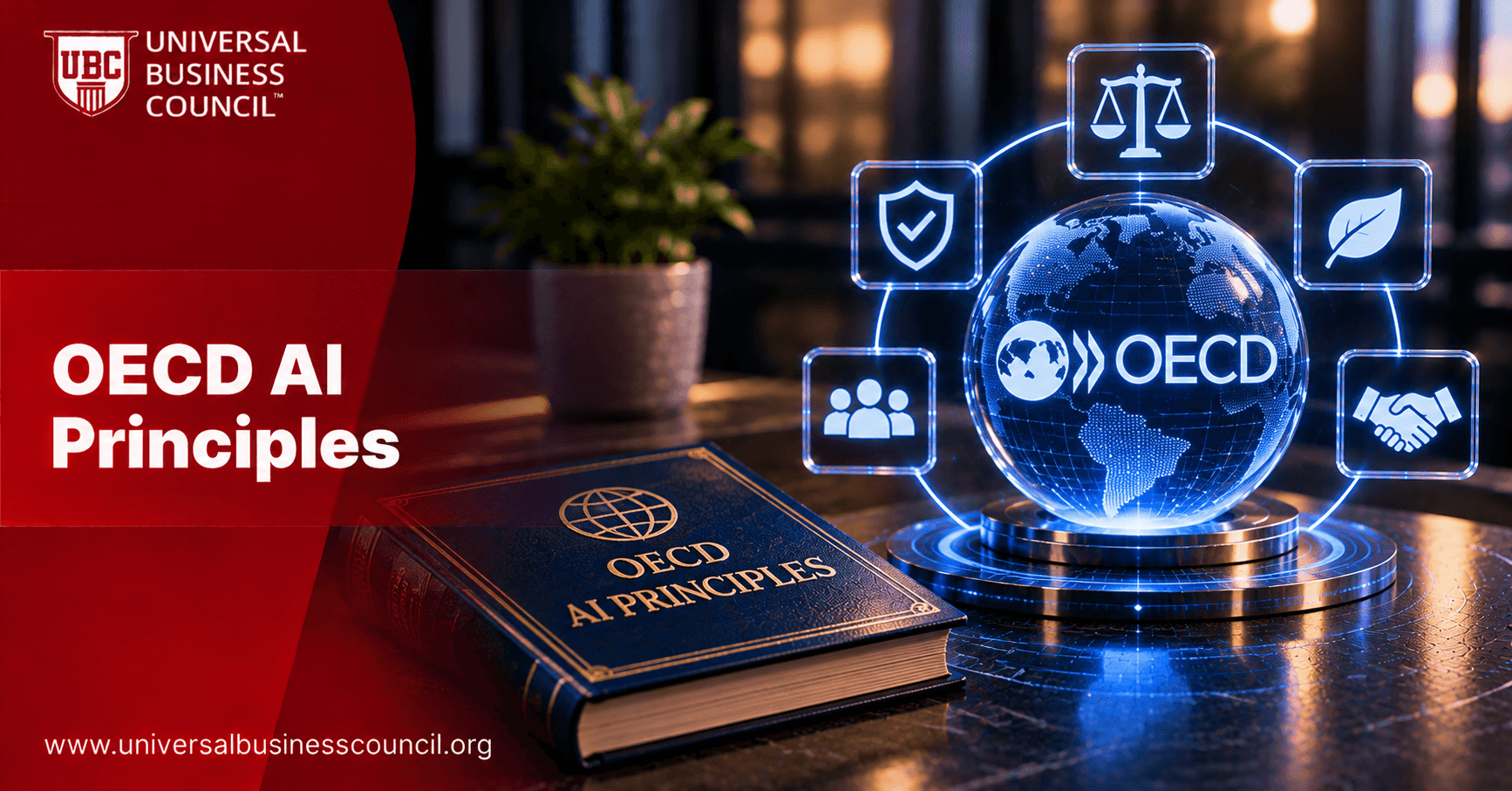
Before most national AI laws existed, governments needed a shared vocabulary for what trustworthy AI should look like. The OECD AI Principles supplied it. Adopted in 2019 and still referenced by policymakers, standards bodies and companies, they remain one of the most widely cited foundations for responsible AI development.
This guide explains the principles, the recommendations behind them and how organizations can apply them in practice. Those looking for structured training in the field can also explore the Certified Responsible AI Expert certification from Universal Business Council.

What Are the OECD AI Principles?
The OECD AI Principles are the first intergovernmental standard on artificial intelligence. They were adopted by the Organization for Economic Co-operation and Development in May 2019 and updated in 2023 and 2024 to reflect advances such as generative AI. Many non-member countries have adhered to them, and the G20 drew on them for its own AI principles.
The principles are non-binding. They guide governments and organizations rather than impose penalties. Their influence comes from being a common reference that later laws, frameworks and standards, including the EU AI Act and the NIST AI Risk Management Framework, echo. The OECD's definition of an AI system has also been adopted, in adapted form, in several regulations.
The Five Values-Based Principles
The first set of principles speaks to everyone involved in AI, from developers to deployers.
1. Inclusive Growth, Sustainable Development and Well-Being
AI should benefit people and the planet by supporting inclusive growth, reducing inequalities and protecting natural environments. Organizations can apply this by weighing social and environmental impacts, not only financial returns, when choosing AI use cases.
2. Human Rights and Democratic Values, Including Fairness and Privacy
AI actors should respect the rule of law, human rights and democratic values across the lifecycle. This includes non-discrimination, fairness, privacy and data protection and attention to risks such as misinformation. In practice, it translates into bias testing, privacy reviews and safeguards for human autonomy.
3. Transparency and Explainability
People should know when they interact with AI and be able to understand, at a suitable level, how outputs are reached. Where decisions affect people, they should be able to challenge them. Documentation, clear notices and understandable explanations put this into practice.
4. Robustness, Security and Safety
AI systems should work reliably, resist attacks and avoid causing unreasonable safety risks under normal use and foreseeable misuse. The updated principles stress mechanisms to override, repair or safely decommission systems that cause harm or behave unexpectedly.
5. Accountability
Those who develop, deploy or operate AI should be accountable for its proper functioning and for respecting the other principles. This calls for traceability, risk management across the lifecycle and cooperation between actors in the AI supply chain.
Recommendations for Policymakers
A second set of five recommendations addresses governments. They call for investing in AI research and development, fostering an inclusive digital ecosystem with access to data, compute and knowledge, shaping an enabling policy environment, building human capacity and preparing for labor market change and cooperating internationally for trustworthy AI. Businesses benefit from understanding these because they signal where regulation and public funding are heading.
Why the Principles Matter for Businesses
For companies, the principles serve as a sound starting point for an internal AI policy. They are short, widely recognized and compatible with other frameworks, so aligning with them reduces duplicated effort when new regulation arrives. They also give boards and executives a straightforward way to discuss AI risk in terms of values and outcomes.
Alignment can also support trust with customers and partners. Organizations that can show they follow recognized principles are better placed in procurement, partnership and regulatory conversations.
Turning Principles into Practice
Principles only matter when they change what teams do. A practical approach maps each principle to specific controls.
Inclusive growth: social and environmental impact review during use case approval
Human rights and fairness: bias testing, privacy assessments and complaint channels
Transparency: user notices, model documentation and explanation methods
Robustness and safety: stress testing, security reviews and shutdown or rollback plans
Accountability: named system owners, audit trails and incident response
Accountability depends on competent people. When filling AI risk, audit or compliance roles, many organizations verify qualifications and work history, and HireValid can assist with those checks.
Technical teams will carry out much of the testing and monitoring, and compliance staff work better with them when they share some technical language. Short tech certifications can help bridge that gap. The transparency principle also affects external messaging, so a Digital Marketing Course can help communications teams describe AI features truthfully.
How the OECD Principles Connect to Other Frameworks
The principles sit at the values layer, while other frameworks add detail. The NIST AI RMF offers risk practices, ISO/IEC 42001 provides a management system and the EU AI Act sets binding rules. A company that builds its program on the OECD values can map to all of them. The OECD also maintains the AI Policy Observatory, which tracks national AI policies and tools, and the OECD AI incidents resources help organizations learn from real-world failures.
Because AI keeps converging with other technologies, it is useful to follow wider developments. Deep Tech Certifications offer helpful background on areas that touch AI.
Conclusion
The OECD AI Principles give organizations a concise, trusted statement of what responsible AI means: inclusive and sustainable benefit, respect for rights and fairness, transparency, robustness and safety and accountability. Use them as the base for your policy, map each to concrete controls and review them as technology evolves. The FAQs below answer common questions.
Frequently Asked Questions
What are the OECD AI Principles?
The first intergovernmental standard for trustworthy AI, adopted in 2019.
Are they legally binding?
No, they are voluntary guidance.
How many principles are there?
Five values-based principles and five recommendations for policymakers.
What are the five principles?
Inclusive growth and well-being, human rights and fairness, transparency, robustness and safety and accountability.
Were the principles updated?
Yes, updates in 2023 and 2024 reflected advances such as generative AI.
Who uses them?
Governments, regulators, standards bodies and companies.
How do they influence regulation?
Many laws and frameworks echo their concepts and definitions.
What does transparency mean here?
People should know when AI is used and be able to understand and challenge outcomes.
What does accountability require?
Responsible actors, traceability and risk management across the lifecycle.
What is robustness in AI?
Reliable performance and resistance to errors, attacks and misuse.
Do the principles cover fairness?
Yes, under the principle on human rights and democratic values.
What are the policymaker recommendations?
Investing in research, building digital ecosystems, enabling policy, developing human capacity and international cooperation.
How can companies apply them?
By mapping each principle to specific policies, tests and controls.
Do they apply to generative AI?
Yes, and the updates address issues such as misinformation and safety.
How do they relate to the EU AI Act?
The Act is binding law that reflects many of the same values.
How do they relate to NIST AI RMF?
NIST provides detailed risk practices that support the principles.
What is the OECD AI Policy Observatory?
An OECD platform that tracks AI policies, metrics and resources.
Which countries follow them?
OECD members and a number of non-member countries have adhered.
Are they relevant to small businesses?
Yes, they offer a simple base for any AI policy.
Related Articles
View All
Artificial Intelligence
Responsible Generative AI: Risks, Principles and Best Practices
Learn what responsible generative AI means and how organizations can develop and use generative AI systems ethically. Explore key principles, including fairness, transparency, privacy, accountability, safety, and human oversight, along with practical strategies for reducing risks and building trustworthy AI applications.

Artificial Intelligence
Responsible AI Regulations in India: Laws, Guidelines and Compliance Considerations
Explore the regulatory landscape for responsible AI in India, including government policies, legal frameworks, and key guidelines governing artificial intelligence. Learn how Indian organizations can address AI ethics, data privacy, algorithmic bias, transparency, and accountability while aligning with responsible AI practices.
Artificial Intelligence
The 7 Core Principles of Responsible Artificial Intelligence
Explore the seven core principles of responsible artificial intelligence and understand how they guide the development and use of AI systems. Learn how fairness, transparency, accountability, privacy, safety, reliability, and human oversight help create AI technologies that benefit individuals and society.
Trending Articles
The Role of Blockchain in Ethical AI Development
How blockchain technology is being used to promote transparency and accountability in artificial intelligence systems.
AWS Career Roadmap
A step-by-step guide to building a successful career in Amazon Web Services cloud computing.
Top 5 DeFi Platforms
Explore the leading decentralized finance platforms and what makes each one unique in the evolving DeFi landscape.