

Responsible Generative AI: Risks, Principles and Best Practices
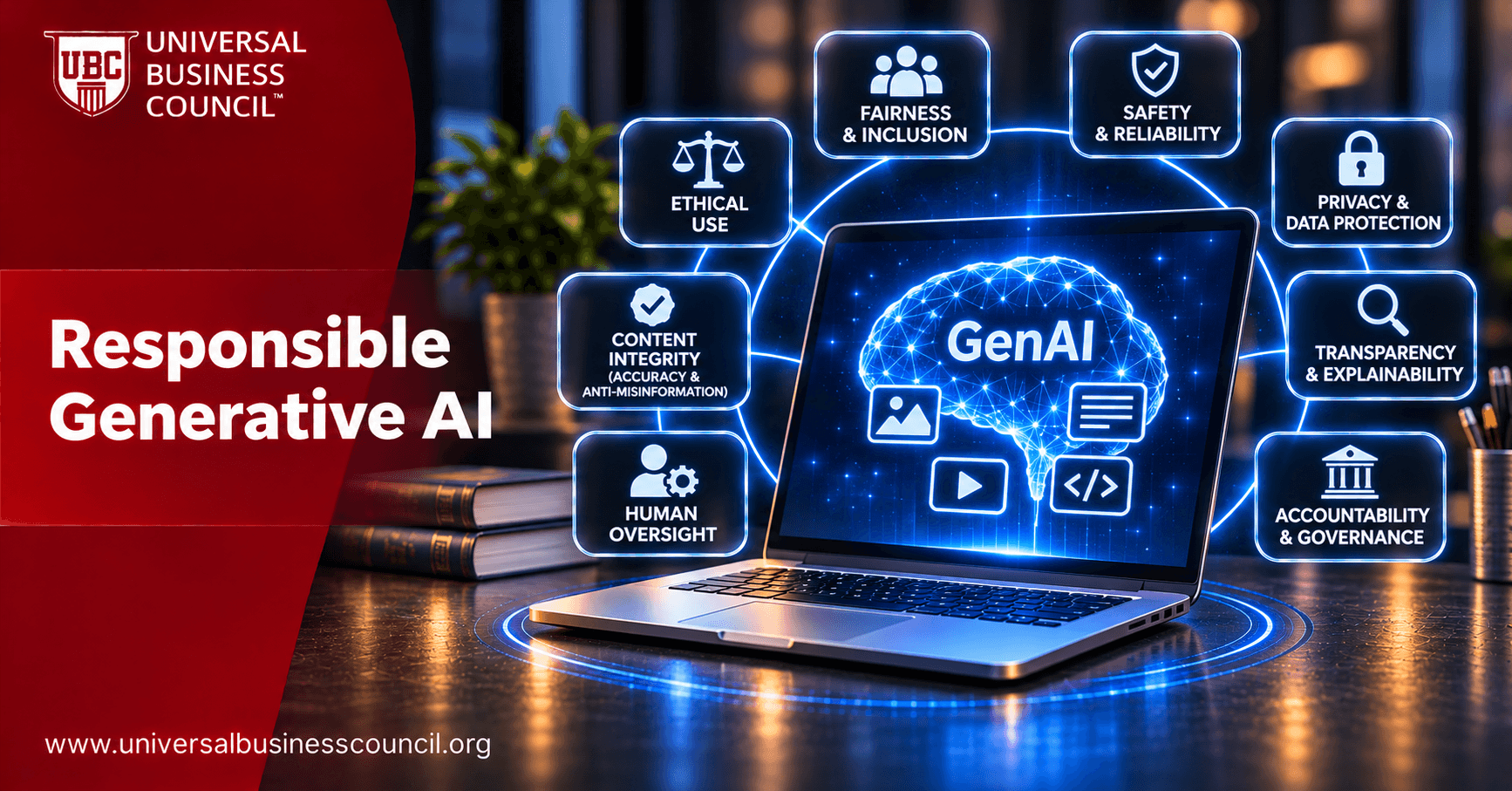
Generative AI went from curiosity to everyday tool in a matter of months, and the rules for using it well have been catching up ever since. Responsible generative AI is the practice of getting the benefits of these systems while keeping a firm grip on what can go wrong. This guide covers the main risks, the principles that should guide your choices and the best practices that turn those principles into daily habits. If you want structured training alongside it, the Certified Responsible AI Expert program is a good fit.
What is responsible generative AI?
Responsible generative AI means designing, buying and using systems that create text, images, audio, video or code in ways that are safe, fair, transparent and accountable. It covers the model itself, the data behind it, the applications built on top and the people who use them.

It differs from older AI governance in one way that matters: the outputs are open-ended. A scoring model returns a number. A generative model can write anything, so the range of possible failures is much wider and harder to test in advance.
The main risks of generative AI
Inaccurate or invented output, often delivered with complete confidence
Bias and stereotyping that reflect patterns in the training data
Privacy leaks, either from data users enter or from data the model has absorbed
Intellectual property questions around training data and generated content
Harmful, unsafe or inappropriate content
Security attacks such as prompt injection and data extraction
Misuse for fraud, impersonation and disinformation
Over-reliance, where people stop checking the output
Not every risk applies to every use. A tool that drafts internal meeting notes carries a different risk profile from a public chatbot that answers customer questions.
Principles to build on
Fairness
Test outputs across different groups and contexts, and fix patterns that treat people unequally. Fairness checks need to be repeated after every significant change to the model or prompts.
Transparency
People should know when they are dealing with generative AI and when content has been machine-made. Document what the system does, what data it uses and where it is likely to fail.
Privacy and data protection
Limit what personal and confidential data goes into prompts, training sets and logs. Choose tools whose data handling terms you have actually read.
Safety and security
Test for harmful outputs and for attacks before launch, and keep testing after it. Treat the model as part of your attack surface.
Accountability and human oversight
A named person should answer for each deployment, and people should review outputs that matter before they reach customers or drive decisions.
Best practices across the lifecycle
Before you build or buy
Define the use case and the risks it carries
Run an impact assessment for anything that touches people's rights or opportunities
Compare vendors on data handling, security, testing evidence and support
Decide what the system must never be used for
While you build
Keep the scope narrow at first. Ground outputs in trusted sources where accuracy matters, add content filters, and set limits on what the system can access or do. Test with realistic and adversarial inputs, not only friendly ones.
After launch
Monitor outputs, user complaints and unusual usage. Set thresholds that trigger a review, give people a simple way to report problems, and keep a clear process for pausing or rolling back the system.
Frameworks worth knowing
You do not have to invent a program from scratch. The NIST AI Risk Management Framework and its Generative AI Profile offer a structured way to find and manage risks specific to these systems. ISO/IEC 42001 sets out requirements for an AI management system that can be certified. The OWASP Top 10 for Large Language Model Applications lists common security weaknesses that development teams should check for.
Marketing and content teams
Content and campaign teams were among the first to adopt generative tools, and they face questions about disclosure, accuracy of claims and the use of customer data in prompts. Marketers who want to build skills in this area can look at the Certified Digital Marketing Expert program.
Skills, records and trusted people
Safe deployment depends on engineers who understand how these systems behave. Teams can strengthen that foundation through the programming and technology certifications from Global Tech Council. Good records support every other control, and those exploring tamper-evident logging can see how it works through the deep tech certifications from Blockchain Council. When you hire for AI governance roles or bring in outside testers, HireValid can help verify backgrounds and credentials.
Conclusion: making responsible generative AI routine
Responsible generative AI is about getting value from open-ended systems without losing control of them. The risks are well known: invented answers, bias, privacy leaks, intellectual property questions, harmful content, security attacks, misuse and over-reliance. Six principles help organize the response: fairness, transparency, privacy, safety and security, accountability and human oversight.
Those principles turn into practice at three stages. Before building or buying, define the use case, assess impact and compare vendors. While building, narrow the scope, ground outputs and test adversarially. After launch, monitor, collect reports and keep a way to pause the system. Frameworks from NIST and ISO, and security lists from OWASP, save you from starting at zero. Pick one live generative AI use case this month, review it against these steps and close the biggest gaps first. The Certified Responsible AI Expert program mentioned at the start is a sensible way to deepen the skills behind responsible generative AI.
FAQs
1. What is responsible generative AI?
It is the practice of building and using generative AI in ways that are safe, fair, transparent and accountable.
2. Why is generative AI harder to govern than other AI?
Its outputs are open-ended, so the range of possible failures is wider and harder to test.
3. What are the biggest risks?
Invented answers, bias, privacy leaks, harmful content, security attacks, misuse and over-reliance.
4. Should staff be allowed to use public generative AI tools?
Only under clear rules on approved tools and on what data may be entered.
5. How do we protect confidential data?
Limit what goes into prompts, use tools with reviewed data terms and keep sensitive material out of unapproved systems.
6. Do we need to tell people when content is AI-generated?
Often yes, and several laws and platforms expect it. Disclosure also builds trust.
7. How can we reduce invented answers?
Ground outputs in trusted sources, narrow the task and have people check important results.
8. What is prompt injection?
An attack where crafted input tricks the model into ignoring its instructions or revealing data.
9. Is human review always required?
For high-stakes outputs, yes. Low-risk uses may need lighter checks.
10. What is the NIST Generative AI Profile?
A companion to the NIST AI RMF that lists risks specific to generative AI and suggested actions.
11. Does ISO/IEC 42001 cover generative AI?
It applies to AI management systems in general, including generative AI.
12. How should we test generative AI systems?
Use realistic and adversarial inputs, check fairness and safety, and repeat tests after changes.
13. Who should own a generative AI deployment?
A named system owner with authority to approve changes and pause the system.
14. What should an acceptable use policy say?
Approved tools, banned uses, data rules, review duties and how to report problems.
15. How do we handle copyright concerns?
Review vendor terms, avoid passing off generated content as original work and take legal advice for sensitive uses.
16. Can small companies follow these practices?
Yes. A short policy, approved tools and basic review habits go a long way.
17. How often should we review our generative AI use?
At least twice a year, and whenever tools, laws or use cases change.
18. What records should we keep?
Use case approvals, risk assessments, test results, incident logs and vendor documents.
19. How do we train employees?
Use short, practical sessions with real examples, repeated when tools or rules change.
20. Where can I learn more?
Programs such as the Certified Responsible AI Expert, plus the NIST and OWASP resources, are a good start.
Related Articles
View All
Artificial Intelligence
Data Privacy in Artificial Intelligence: Risks, Controls and Best Practices
Explore the key data privacy risks associated with artificial intelligence and how organizations can address them. Learn about sensitive data exposure, unauthorized access, consent, data protection controls, and best practices for safeguarding personal information throughout the AI lifecycle.

Artificial Intelligence
Responsible Prompt Engineering: Privacy, Bias and Security Best Practices
Learn how to practice responsible prompt engineering while protecting privacy, reducing bias, and maintaining AI security. Explore best practices for writing safe and effective prompts, handling sensitive information, preventing harmful outputs, and using generative AI responsibly across personal and business applications.

Artificial Intelligence
Federated Learning and Responsible AI: Benefits, Risks and Limitations
Explore how federated learning supports responsible AI by allowing machine learning models to train across decentralized data sources without directly sharing raw data. Learn about its benefits for privacy and collaboration, along with risks, technical limitations, security concerns, and practical applications.
Trending Articles
The Role of Blockchain in Ethical AI Development
How blockchain technology is being used to promote transparency and accountability in artificial intelligence systems.
AWS Career Roadmap
A step-by-step guide to building a successful career in Amazon Web Services cloud computing.
Top 5 DeFi Platforms
Explore the leading decentralized finance platforms and what makes each one unique in the evolving DeFi landscape.